Aug 11, 2026
10 questions about Roman square pizza
Square pizza is not a round pizza that changed molds. It is a different way of understanding the dough, the oven, the cutting, and even the moment of sharing. That is why, when questions arise about Roman square pizza, the answer almost always starts with the base: a well-worked, airy, slow-fermentation dough with that croccante crust that crackles before it conquers.
In Rome, pizza in teglia is part of the daily landscape. You see it in display cases, it is cut to size, and eaten on the go, at a table with friends, or as a serious midday craving. In Costa Rica, it still feels like a discovery. And thank goodness: there is much more behind that golden rectangle than just a pretty shape for a photo.
Questions about Roman square pizza that actually matter
1. Why is it square?
Because it is baked in a teglia, the rectangular pan that gives it its characteristic shape. It is neither a decorative detail nor a modern whim. The format allows the dough to expand evenly and the base to achieve a uniform bake, providing a wide surface to showcase ingredients.
Additionally, the rectangular cut makes ordering multiple flavors much more fun. A group can try different combinations without committing to a single whole pizza. It is a pizza designed to share, compare, and order again.
2. What does Roman pizza in teglia mean?
“In teglia” literally means “in a pan.” It is the Roman style baked in a rectangular mold, different from Neapolitan pizza, which is usually round, softer in the center, and with a high crust.
Roman in teglia seeks contrast: a firm and croccante base, a light and airy interior, and toppings that feel distinct. It does not compete with the Neapolitan because it plays a different game. If you like a delicate, moist, knife-and-fork pizza, you might prefer the Neapolitan. If you want texture, bite, and a base that holds ingredients with character, Roman in teglia is an excellent choice.
3. Does 72-hour dough really make a difference?
Yes, and it shows. A 72-hour fermentation requires time, control, and patience. During this process, the dough develops flavor, improves its structure, and achieves that lightness that cannot be rushed by forcing the clock.
This does not mean that every long-fermentation pizza is automatically excellent. Flour, hydration, temperature, handling, and baking also matter. But when the technique is well-executed, the result is a crumb with visible bubbles, a less heavy feeling, and a deeper flavor. The dough stops being a simple support: it becomes the protagonist.
4. Is it crispy or is it hard?
A good Roman pizza should be croccante, not a dry cracker. The difference lies in the balance. The base and the crusts offer crackle and sound, while the interior retains air and softness. That combination is part of its charm.
If the pizza is too rigid, there might be overbaking or poorly hydrated dough. If it is soggy and wet underneath, it lacked oven time or the topping released more water than expected. The ideal point is clear: you can hold it with your hand, it maintains its structure, and yet it feels light to the bite.
5. Why does it have so many bubbles?
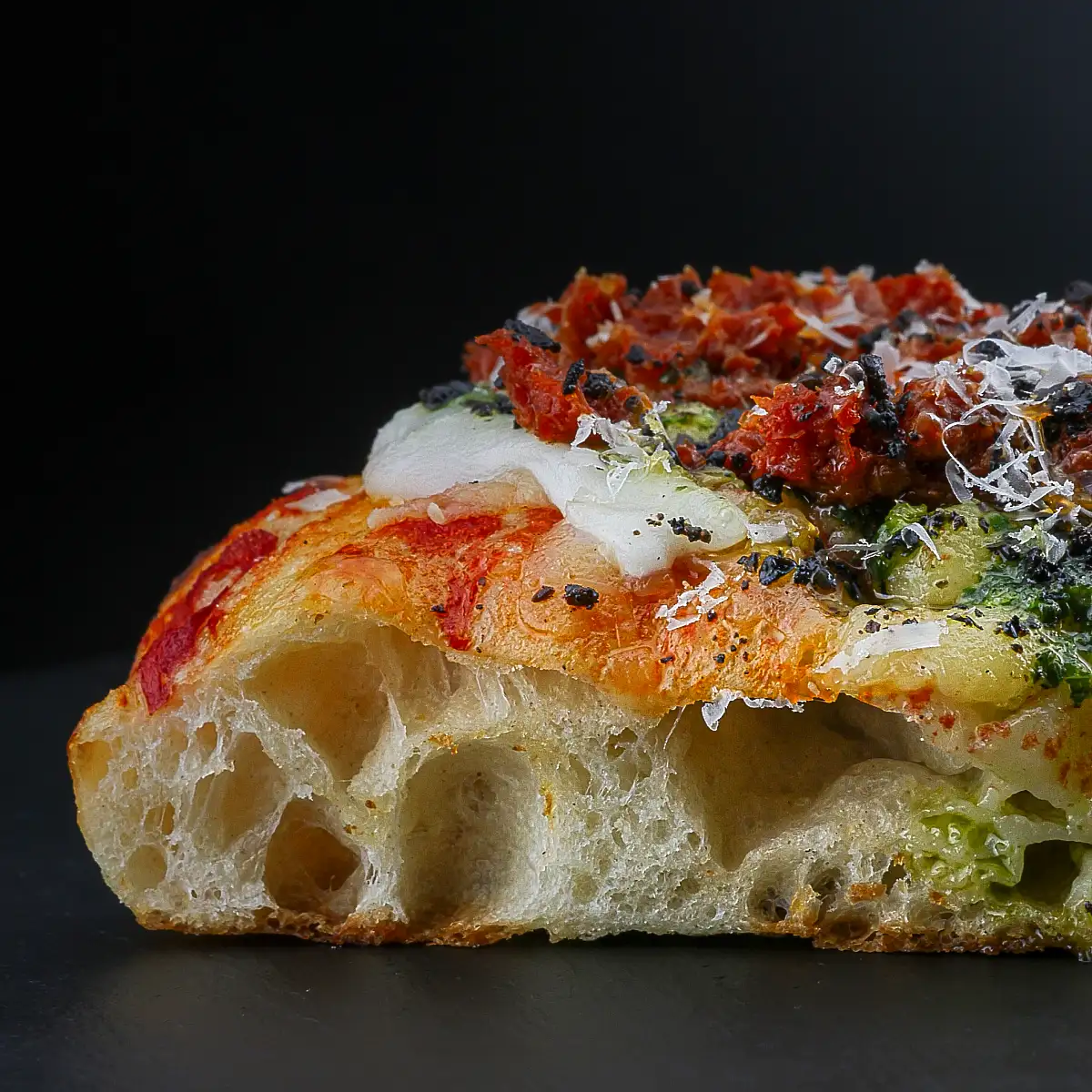
Those bubbles are the air pockets (alveoli) of the dough. They are a visual sign of fermentation, hydration, and careful handling. They do not appear by chance: they form when the gas produced during fermentation is trapped in a well-developed gluten network.
The bubbles do not have to look identical or giant for the pizza to be good. Every dough has its own personality. The important thing is that they provide an open, pleasant, textured crumb, without turning the slice into an empty cave. Well-made Roman pizza has beautiful irregularity, not carelessness.
6. Is it sold by the slice or whole?
Both options make sense. In its Roman tradition, pizza in teglia is usually displayed whole and cut according to each person's preference. It is ideal for trying a slice of potato and rosemary, another of mortadella with pistachio, or a classic tomato and mozzarella.
For a table, ordering a tray or several slices of different flavors allows you to put together a much more entertaining experience. The amount depends on hunger, whether there will be appetizers, and how many flavors you want to explore. As a practical rule, it is better to ask for variety rather than filling the table with a single topping. The charm is in the journey.
7. What toppings work best on it?
The ingredients should complement the dough, not hide it. A tomato with good acidity, well-drained mozzarella, roasted vegetables, Italian cold cuts, mushrooms, potatoes, intense cheeses, and fresh herbs work very well when used wisely.
There is also a matter of timing. Some ingredients are baked from the start, others are added at the end to preserve freshness, texture, or aroma. Mortadella, for example, looks better when it goes on a freshly baked base; basil wins when it does not spend too much time under the heat. A premium pizza is not the one with the most things on it: it is the one that knows exactly when to place each one.
8. Are Roman square pizza and focaccia the same thing?
They look similar because of their format and the importance of the dough, but they are not the same. Roman pizza in teglia usually has sauce, cheese, or toppings just like a pizza. Focaccia has its own identity, with an Italian bakery dough that can be enjoyed on its own, with olive oil and salt, or sliced open to become a spectacular sandwich.
And then there is the schiacciata, another gem of Italian baking tradition: thinner, crispier, and perfect for fillings. If you are craving something hearty but different from traditional pizza, a stuffed focaccia or a schiacciata can be the winning move.
9. How do you eat it to truly enjoy it?
Fresh out of the oven is when the texture shines brightest. The heat activates the aromas, the cheese is at its perfect point, and the base retains that croccante that defines the experience. If you are going to share, order contrasting flavors: a classic one, a more intense one, and one with an unexpected twist.
There is no need to fold it like a New York slice or attack it with utensils if the dough has good structure. Grab it, bite, and listen. If you take it home, the ideal way is to reheat it in an oven or skillet, not in the microwave. The microwave softens the base and robs it of its magic.
10. Where to try authentic Roman pizza in Heredia?
Look for concrete signs, not just an Italian label on the menu. Ask about the fermentation, look at the texture of the dough, and observe if the product is baked in a pan with a truly golden base. Authenticity is proven, not just advertised.
In San Pablo de Heredia, Bianka® Pizza Romana brings this tradition to the forefront with 72-hour fermentation doughs, pizza in teglia, stuffed focaccia, and a concept made to step away from the generic pizzeria. It is a stop for those who want to eat Italian with technique, personality, and lots of croccante.
The next slice might change your standard
Roman square pizza does not ask for permission to be different. It arrives with an airy base, an intense bite, and the confidence of a tradition that has known how to evolve without losing its essence. Next time the plan is pizza, go for a slice that has something to say. Che buono.