Jun 26, 2026
7 types of artisanal Italian focaccia
Not every focaccia that looks beautiful actually is. The difference is felt as soon as you bite into it: a light base but with structure, a croccante crust, well-formed air pockets, olive oil that perfumes without drowning, and a fermentation that gives flavor, not just volume. When talking about types of artisanal Italian focaccia, one is talking about baking tradition, regions with their own identity, and a product that is much broader than the generic version that usually appears in display cases and menus.
In Italy, focaccia is not just any flatbread. It is an entire family. It changes depending on the city, the flour, the hydration, the thickness, the brine, the use of oil, and, of course, the purpose: there are focaccias designed to be eaten on their own, others to be stuffed, others to accompany cured meats, cheeses, or mortadella, and others that border on pizza territory while still being bread. That is precisely where the interest lies: understanding its nuances.
Types of artisanal Italian focaccia that are actually worth knowing
Talking about artisanal focaccia implies talking about process. It is not enough to bake dough with rosemary on top. Real craftsmanship lies in slow fermentation, in correct dough handling, and in respecting the style of origin. Therefore, these types are distinguished not only by toppings, but by technique and texture.
Focaccia Genovese
It is probably the most well-known and also one of the most misunderstood. Focaccia genovese, or fugassa, comes from Liguria and has a very clear personality: it is relatively low, soft on the inside, slightly crispy on the outside, and marked by small dimples where an emulsion of water, salt, and oil is concentrated.
That detail changes everything. It doesn't end up dry or heavy. It turns out flavorful, aromatic, and with a shiny surface that invites you to eat it fresh out of the oven. The classic version has coarse salt and, sometimes, rosemary, although the most traditional can be quite minimalist. If the dough does not have good development and fermentation, it is noticed immediately. The genovese is very unforgiving.
Focaccia Barese
From Puglia arrives a focaccia with more visual character and a more indulgent profile. The barese usually incorporates tomato, olives, and, in many recipes, potato inside the dough. This gives it a moister and tender crumb, while the base takes on a deep golden tone thanks to good olive oil and high heat.
It is a focaccia that feels more rustic and sunny. It has that southern Italian spirit where bread and tomato coexist effortlessly. If you like more direct flavors and a less dry texture than the genovese, this might be your favorite. Mind you, a well-made barese needs balance: too much moisture makes it soggy; too little, and it loses its charm.
Tuscan Schiacciata
Here we enter territory that captivates anyone who enjoys doughs with identity. The schiacciata, closely linked to Florence and Tuscany, shares a family with focaccia but has its own language. It is usually thinner, more stretched out, and with a texture that can range from airy to decidedly croccante, depending on the style and the oven.
Its name comes from “schiacciare”, which means to press down or flatten. That already says plenty about its shape. It can be served plain, with salt and oil, or split open to be stuffed with mortadella, prosciutto, porchetta, stracchino, or roasted vegetables. When well-made, every bite combines exterior fragility with a very elegant internal elasticity. It doesn't try to look like just any sandwich. It plays in another league.
Focaccia di Recco
This one does not resemble the classic idea of focaccia that many people have in mind. Focaccia di Recco, also originating from Liguria, is prepared with two paper-thin layers of unleavened or minimally fermented dough, filled with soft, melting cheese, traditionally stracchino.
The result is spectacular: crispy, delicate, and creamy at the same time. More than a bread, it is a textural experience. It is not spongy or airy; it is taut, thin, and deeply flavorful. That's why, when someone puts any thick dough stuffed with cheese into the same category, they miss out on a world of Italian precision. Recco has technique, history, and its own profile.
Roman Focaccia
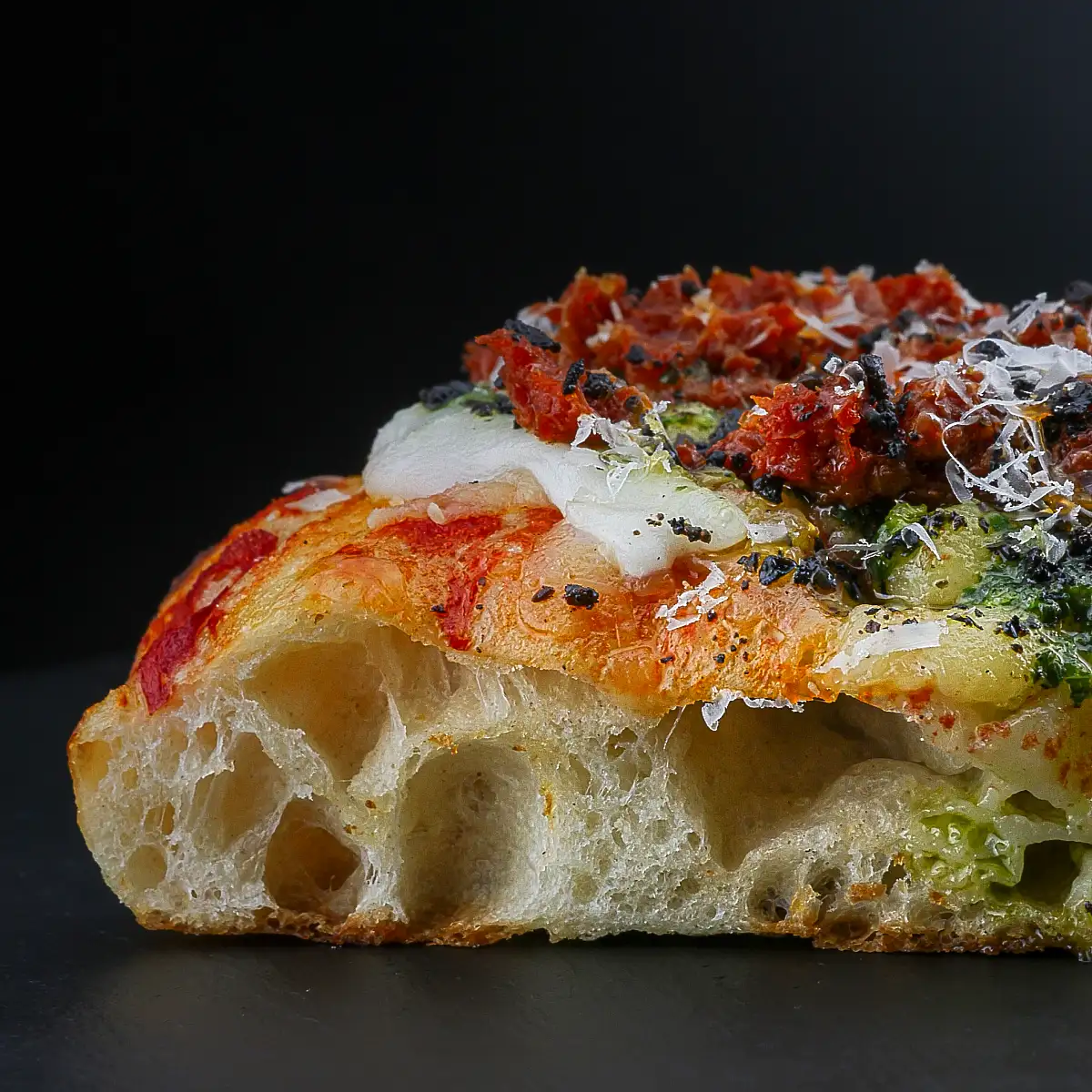
The Roman tradition has a natural relationship with high-hydration doughs, long fermentations, and light bases with great crunch. Among the types of artisanal Italian focaccia, Roman focaccia stands out for being airier, more structured, and highly designed to be enjoyed on its own as well as becoming a perfect format for premium fillings.
In this style, the bottom crust matters a lot. It should crack slightly as soon as you break it. The crumb, on the other hand, must remain light, open, and not chewy at all. It is an ideal focaccia for those looking for a real contrast of textures. Well-executed, it does not feel heavy even when generous. It feels alive. Che buono.
Stuffed Focaccia
Here it is worth making a clarification. “Stuffed” is not a single regional style, but rather a serving method that can be built on different Italian bases. And precisely for that reason, it deserves its place. An artisanal stuffed focaccia does not consist of putting random ingredients between two pieces of bread. The beauty lies in choosing a dough that holds the filling without losing its crunch or becoming dominant.
When the base has long fermentation and correct structure, it elevates everything it touches. Mortadella and pistachio, prosciutto and stracciatella, grilled vegetables with burrata, porchetta with soft cream: the fillings work best when the bread doesn't compete, but rather accompanies with character. It is one of the most attractive expressions for an audience that wants to eat something memorable, complete, and with a brutal aesthetic.
Sweet or Seasonal Focaccia
Yes, it also exists, and it is not a modern invention for social networks. In different areas of Italy there are more festive or seasonal versions, some with grapes, sugar, figs, or even inspired by local celebrations. They are not the most widespread version outside of Italy, but they show something key: focaccia is versatile without losing its nobility.
A good sweet focaccia maintains the artisanal logic of the dough. It should not feel like an improvised dessert nor like disguised salty bread. It must retain structure, aroma, and balance. When this is achieved, it is highly surprising.
How to recognize real artisanal focaccia
Beyond style, there are clear signs. The first is texture. An artisanal focaccia is not a greasy pillow nor a dry sheet. It has tension, air, color, and a developed crumb that speaks of time and craft. The second is flavor. Slow fermentation leaves more complex notes and a generally easier digestion.
The surface also matters. The dimples are not decoration. They serve to trap oil, brine, or seasonings and are part of the final result. The olive oil should be noticeable but not saturating. And the baking has to build contrast: golden edges, firm bottom, moist interior in the best way.
If it is also used for stuffing, there is another trial by fire: that it doesn't fall apart. A well-made focaccia holds premium ingredients without collapsing halfway through the first bite. It seems basic, but that is where the artisanal is separated from the simply eye-catching.
What type of artisanal Italian focaccia to choose according to what you crave
If you want something classic, straightforward, and elegant, the genovese works very well. If you prefer a more rustic and flavorful experience, the barese has plenty of charm. If thin, crispy doughs that are perfect for fillings are your thing, the schiacciata and Roman focaccia are serious bets.
If you are looking for something more indulgent, the di Recco has the upper hand because of that creamy center that wins you over very quickly. And if you want a complete, visual, premium, and conversational meal, the stuffed focaccia is probably the queen of the moment.
The best choice depends on what you value most: crunch, lightness, moisture, intensity, or the ability to accompany fillings. There is no single universal champion. There are different styles for different moments, and that is part of the magic.
At Bianka® Pizza Romana that difference really matters, because a specialized Italian dough is not about looking good in a display case, but about honoring technique, texture, and origin in every single piece.
Why this topic matters more than it seems
Understanding focaccia changes how you order it. You no longer choose “bread with toppings.” You choose a specific tradition, a technique, and a textural experience. That raises the level of the culinary conversation and makes the craving more demanding too.
For those who enjoy discovering authentic offerings in Costa Rica, knowing these styles opens another door within Italian cuisine. One that is much less obvious, more specialized, and quite a bit more exciting than the usual generic options. And when you try a well-made artisanal focaccia, one of those that crunches on the outside and breathes on the inside, it is hard to go back.