Jul 16, 2026
Artisanal Roman pizza review: is it worth it?
An artisanal Roman pizza review shouldn't just be about whether the pizza is "delicious." The real question is different: can you feel the technique in every bite? When the dough spends 72 hours fermenting, when the base crunches without becoming hard, and when the ingredients have room to express themselves, the answer changes completely. This isn't your usual round pizza. This is Roma in teglia: square, light, croccante (crispy), and made to be eaten with curiosity.
For those looking for a different outing in Heredia or the GAM, artisanal Roman pizza has an immediate appeal: it looks spectacular, is easily shared, and has a personality that needs no disguise. But it also demands high standards. A good teglia must support generous ingredients without losing texture, and it must reach the table with that irresistible contrast between a crispy crust and an airy crumb.
Artisanal Roman pizza review: what makes it special
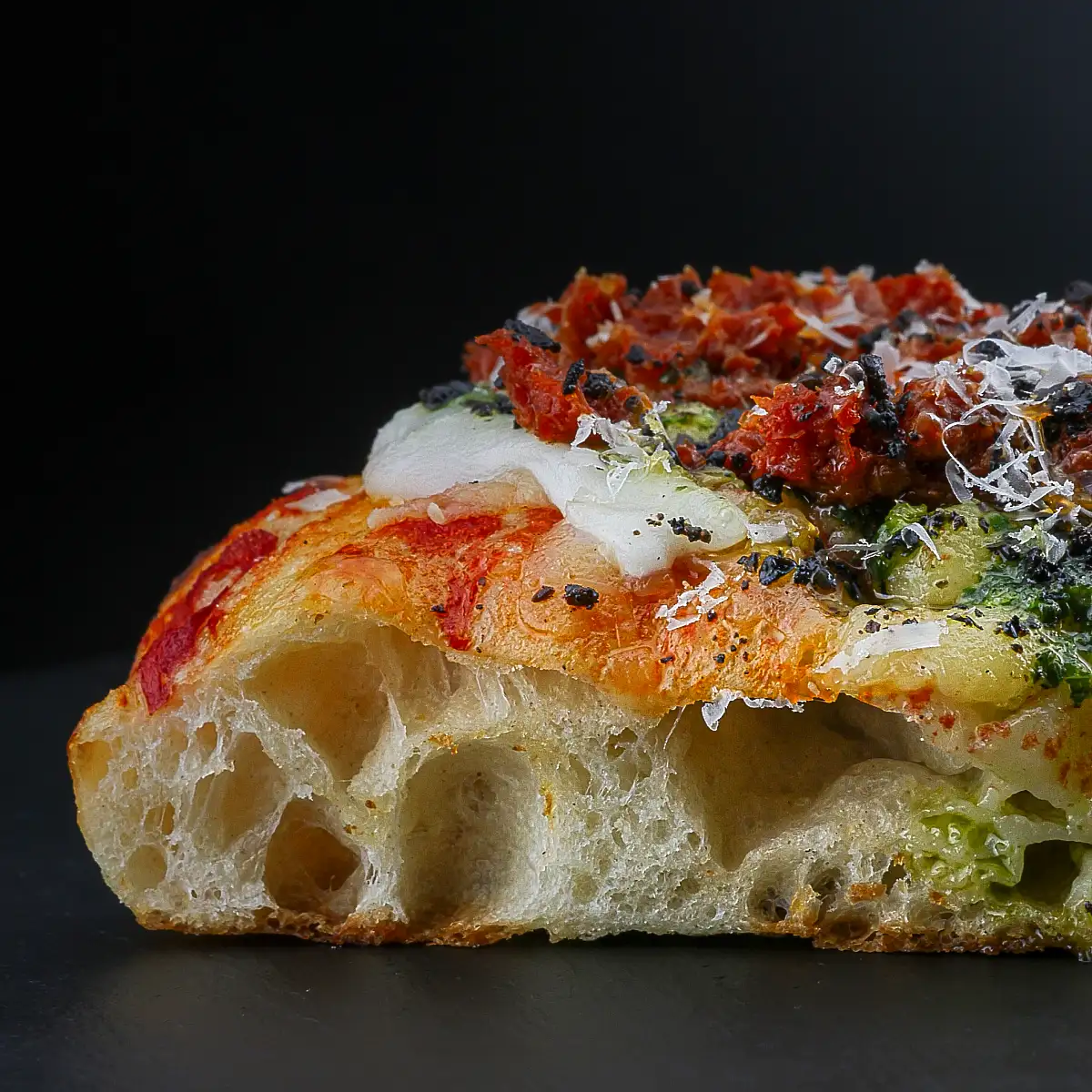
Roman style pizza in teglia is born from a baking tradition. Its identity doesn't depend on an inflated crust or a heavy dough loaded with cheese. It depends on time, hydration, fermentation, and the oven. The result is a rectangular or square piece, with a firm and crispy base, and a crumb full of air pockets that feels light even when the flavors are intense.
The 72 hours of fermentation are not just a decorative detail. They give depth to the flavor of the dough, foster a more elegant texture, and allow the pizza to feel less dense. That difference is noticeable from the first cut: the base offers resistance, then breaks with a clean crack, while the interior retains its softness. Che buono.
The way to eat it changes too. Roman pizza invites you to try more than one combination, share in the center, and alternate flavors. It is ideal for a date, a table of friends, or a lunch that deserves more than just satisfying hunger. Its format allows each slice to have its own character and ensures the experience is as conversational as it is photogenic.
The texture rules: croccante on the outside, airy on the inside
An artisanal pizza can have excellent ingredients and still fail if the dough is not well executed. In Roman pizza, that point is even more evident. If it turns out too dry, it loses its charm. If the base is soft, it stops being in teglia. If the fermentation wasn't precise, the flavor becomes flat or the crumb feels heavy.
A good version is recognized by its balance. The base must be crispy, but not a cracker. The interior must be fluffy, but not chewy. The toppings must complement the dough, not cover it up. It is an architecture of flavor and texture where every layer has a function.
That's why it's worth ordering it fresh out of the oven and eating it without rushing. The crispiness is at its best when the heat is still lifting the aromas of the tomato, cheese, roasted vegetables, or Italian cured meats. Waiting too long can soften the base due to the moisture of the ingredients. It is a small detail, but anyone looking for a premium experience will notice.
It is not a pizza to compare with just any pizza
Comparing it directly to a Neapolitan pizza can be unfair to both. Neapolitan celebrates a soft center, high edge, and elasticity. Roman in teglia celebrates the crunch, structure, and light crumb. One does not automatically replace the other: they satisfy different cravings.
If you want a flexible, single-serve pizza with a pronounced edge, perhaps Neapolitan is your choice that day. If you want a crispy crust, portions to share, and combinations that feel closer to artisanal Italian baking, the Roman style has the advantage. The point is not to choose a universal winner, but to recognize when a technique is well done and what experience it offers.
Ingredients that add value, not overwhelm
On an artisanal Roman pizza, quality is not measured by the quantity of piled-up ingredients. It is measured by intention. A well-balanced tomato sauce, mozzarella in the right proportion, nicely roasted vegetables, or charcuterie that brings salt and aroma can transform a simple slice into an amazing bite.
The risk of overly loaded options is clear: moisture builds up, the dough loses its crispiness, and all the flavors start to taste the same. The best Roman pizza maintains order. Each ingredient has its space, temperature, and contrast. The cheese accompanies. The sauce awakens. The dough supports everything with personality.
That's also where the stuffed focaccia and the schiacciata come in, two formats that extend the Italian journey beyond traditional pizza. They are options for those who want a bready texture, hearty fillings, and a casual meal with much more gastronomic design. They are not menu accessories: they are part of a culture that understands bread as the protagonist.
What to order when you really want to try it
The first visit deserves a strategy. If you go as a couple or with friends, ordering several flavors is the best way to understand the concept. A classic option allows you to evaluate the dough and the sauce without distractions. A more intense combination, with cured, spicy ingredients or roasted vegetables, shows just how far the product can go when creativity is involved.
There's no need to turn the table into a toppings competition. Two or three well-chosen varieties typically yield a more complete experience than ordering too many. Alternate between a fresh flavor, a creamier one, and one with a salty or spicy touch. This way, the last slice remains just as interesting as the first.
To go with it, it's best to choose something that doesn't overshadow the dough. Roman pizza already has plenty of presence. A light pairing, a cold drink, or a glass of wine that refreshes the palate can work better than excessively sweet or heavy flavors. The idea is that every bite preserves that croccante contrast that makes the format memorable.
An experience for those who demand something different
Generic pizza serves a purpose: it is quick, familiar, and easy to order. Artisanal Roman pizza plays a different game. It has a narrative, a technique, and a texture that justify pausing to eat. That is why it connects so well with those searching for places with identity, real product, and an experience outside the routine.
At Bianka® Pizza Romana, this difference is built from the slow fermentation to the in teglia format, along with stuffed focaccias and schiacciate that aren't usually found every day in Costa Rica. It is a concept to visit with an appetite, yes, but also with a desire to try something with history and attitude.
The expectation should be clear: don't expect a conventional pizza. Expect a dough with character, a base that crunches, and Italian flavors designed to be shared. Reserve a table, order it freshly made, and let the first bite do its thing. When the pizza is well-crafted, it doesn't need to try too hard to stay in your memory.