Jul 26, 2026
Artisan schiacciata in Costa Rica, with character
If you're looking for artisanal schiacciata in Costa Rica, you're not looking for just another sandwich or a folded pizza. You are looking for that Italian bread with a firm crust, light crumb, and generous filling that completely changes a casual meal. A well-made schiacciata crunches at the first bite, holds quality ingredients without falling apart, and makes it clear that baking technique can also be the protagonist.
In a market accustomed to quick options and soft bread without personality, schiacciata arrives with another rhythm. It has history, texture, and attitude. It is a proposal for those who want a different lunch, to share something memorable, or to give an outing with friends a more authentic touch. Che buono.
What makes artisanal schiacciata special?
Schiacciata was born in Tuscany, especially linked to Florence. Its name comes from schiacciare, which means to crush or press, a direct reference to its low, stretched-out shape. But reducing it to "Italian flatbread" would mean missing the best part: the contrast between a croccante surface and an interior with air, flavor, and structure.
There is no single rigid recipe. As with great Italian breads, each bakery and each region interprets the dough with small variations. Some versions feature olive oil more prominently; others seek a drier, crunchier base to receive cured meats, pressures, and vegetables. The essential thing is that the bread is not a simple vehicle. It must have its own character.
When it is artisanal, the process begins long before the oven. Hydration, dough handling, resting times, and temperature define whether the result will be light or heavy, crunchy or chewy. There are no shortcuts that substitute for a well-crafted fermentation. The difference is tasted, but it is also heard: that crust must make a sound when broken.
Artisanal schiacciata Costa Rica: an experience that was needed
Costa Rica has an increasingly curious culinary scene. It is no longer enough for something to be abundant or photogenic. The public wants to know what they are eating, where the technique comes from, and why it tastes different. That is where artisanal schiacciata finds its space.
It is an alternative with more identity compared to the conventional sandwich. It does not rely on excessive sauces to draw attention, nor on fillings without balance. A good combination starts with ingredients that respect each other: a cheese with presence, a well-chosen cured meat, fresh leaves, roasted vegetables, or a cream that adds moisture without overpowering the bread.
The key is in the balance. If it is overloaded, the schiacciata loses its texture and becomes difficult to eat. If it falls short, the bread feels empty. That is why craftsmanship is not just making the dough from scratch: it is also knowing how much filling each piece needs and how to arrange it so that every bite makes sense.
For a midday outing, it works perfectly as an individual dish. For a relaxed dinner or a gathering of friends, it can become the center of an experience to share, accompanied by other Italian specialties. It depends on hunger, the plan, and how much you want to try. What does not change is its ability to turn a simple meal into a special occasion.
It's not focaccia, it's not pizza, it's not a common sandwich
The confusion is understandable, because these products share Italian baking roots. However, each one has a very clear personality.
Focaccia is usually taller, fluffier, and marked by dimples that retain olive oil, salt, or herbs. It can be served alone, as an accompaniment, or stuffed, but its crumb is typically softer and pillowy. Schiacciata, on the other hand, aims for a thinner, geometries, more toasted profile focused on the contrast of textures.
Roman pizza in teglia is also baked in a tray and can offer an airy base, but its purpose is different: it is designed to highlight a topping over the dough. Schiacciata is split open and filled. The spotlight is shared between its two crunchy faces, like a precise meeting between bread and product.
And compared to a traditional sandwich, the difference is not just aesthetic. A sliced bread or an industrial baguette can do the job, but it rarely provides an experience. Schiacciata does: it has the aroma of the oven, a distinct bite, and a regional identity that does not need to disguise itself.
The technique behind a croccante bite
The word artisanal is used a lot, but in baking, it should mean something concrete. It means respecting the times of the dough. It means observing it, touching it, and understanding when it is ready. It means that the baking is adjusted to achieve color, expansion, and a base that holds the filling without becoming hard.
A prolonged fermentation is one of the decisions that changes the result the most. At Bianka® Pizza Romana, the 72-hour work expresses precisely that obsession with a more developed, light, and flavor-filled dough. It is not about waiting for the sake of waiting. It is about allowing the process to build a texture that a rushed dough simply cannot imitate.
Olive oil also matters, but not as decoration. It adds aroma, color, and a richer mouthfeel. The salt, the oven temperature, and the baking point finish defining the character. A pale schiacciata loses its charm; a burnt one becomes bitter. The right point is golden, fragrant, and decidedly croccante.
Then comes the filling. There are ingredients that are best placed after baking to preserve their freshness, such as leafy greens, prosciutto, or delicate cheeses. Others gain intensity with heat, like roasted vegetables, meats, or cheeses with controlled melting. The best schiacciata does not mix everything haphazardly: it builds layers with purpose.
How to recognize a well-made schiacciata
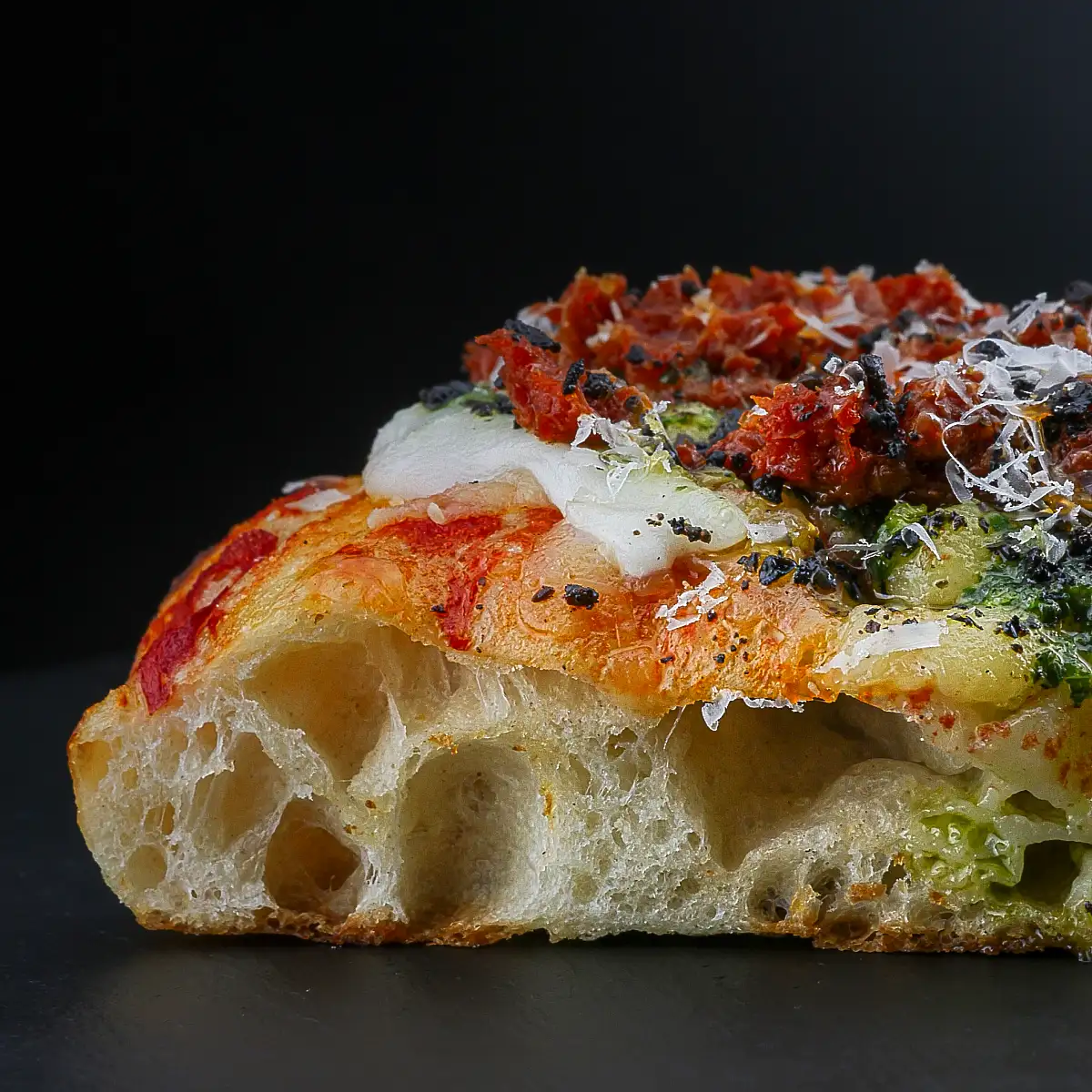
You don't need to be an expert in Italian cuisine to tell a good piece apart. Start with the exterior. It should look golden, with natural irregularities and a surface that suggests real crunch, not dryness. Upon opening it, the crumb should display small cavities and feel light, never compact like a non-fermented bread.
Next comes the aroma. You should perceive toasted cereal, olive oil, and oven, even before identifying the filling. That fragrance is a sign that the dough has presence. If all you smell is sauce or cheese, the bread is probably playing too secondary a role.
In the mouth, look for contrast. The crust should break lightly and the crumb should yield without becoming gummy. The filling must be evenly distributed, with enough moisture to accompany it, but without turning the base into a soggy dough. It seems like a small detail, but it is the line between a memorable schiacciata and any ordinary filled bread.
When to order it and how to enjoy it best
Schiacciata has a powerful advantage: it adapts to different moments without losing its premium feel. It is ideal for an office lunch that wants to avoid routine, a casual date, an afternoon craving, or an early dinner before continuing with the plan. It is also a great gateway for anyone who wants to try Italian cuisine beyond the usual round pizza.
Order it freshly prepared and eat it without too much delay. The crunchiness is part of the experience, and the bread is at its best when it comes out of the oven or finishes heating just before serving. If you are going to share, choose different flavors to compare profiles: an intense one with cured meats, another vegetable, another with a prominent cheese. That way, the table becomes more entertaining.
The next time you want to eat something with true Italian identity, don't settle for a sandwich that could exist anywhere. Look for a schiacciata that respects the bread, the time, and the product. A good croccante bite can be the perfect excuse to try something new and return for that sound of the crust you won't forget.