May 19, 2026
Italian pizza for real foodies
There's a huge difference between grabbing a pizza and trying a pizza that really says something. For anyone looking for Italian pizza for foodies, melted cheese and a decent crust are not enough. There has to be technique, character, texture, and a clear identity from the very first bite. If it doesn't surprise you, if it doesn't speak to tradition, and if it doesn't leave you wanting to come back, it's falling short.
That is the real foodie filter. Not ordering “pizza” out of habit, but looking for an experience with craft behind it. A well-worked fermentation, a base with structure, ingredients that taste like what they are, and formats that don't pretend to be Italian, but actually are. Che buono when it all comes together.
What does a foodie expect from Italian pizza
A true foodie is not chasing only what looks good on Instagram, though a good pizza clearly does catch the eye. What they are looking for is judgment in execution. The first sign is in the dough. If the base is flat in flavor, heavy, or gummy, the experience falls apart even if the toppings are premium.
Well-made Italian pizza starts from a logic different from generic pizzerias. Here the dough is not just a vehicle. It is the star. It should have developed flavor, air, resistance, and a bite that feels alive. In styles like the Roman pizza, that expectation goes even higher: it should be crispy, light, and have a texture that contrasts with the ingredients without stealing the spotlight.
Moderation matters too. A foodie doesn't need a pizza overloaded with toppings to feel they got value. In fact, often it's the opposite. When everything competes, nothing stands out. Italian tradition understands this very well: fewer ingredients, better chosen, with precise execution.
Italian pizza for foodies: texture leads
Let's be clear. Texture is often what separates a memorable pizza from an average pizza. And it's not a minor technical detail. It is the heart of the experience.
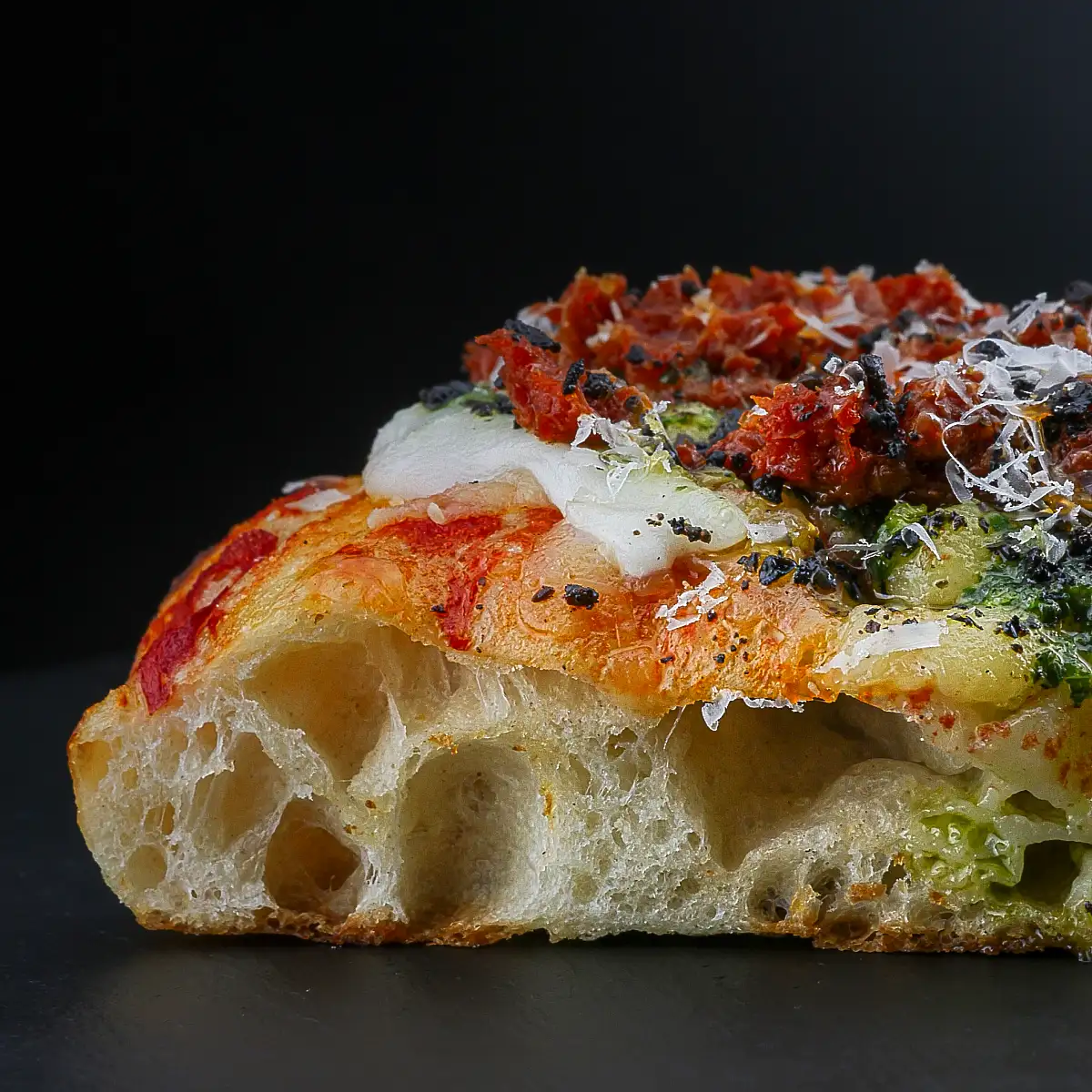
In a good Italian pizza, the sound when you bite matters. That light crack, that edge that doesn't feel dry but well baked, that base that holds without folding like wet cardboard. The right texture makes every ingredient perform better. The sauce tastes fresher, the mozzarella creamier, and the cured meats or vegetables keep their role without sinking into a heavy dough.
That's why Roman pizza in teglia has earned a special place among people who eat attentively. Its square shape is not just a visual oddity. It responds to a technique, a different hydration, and a bake designed to achieve a base that's airy inside and crispy outside. It is a very different experience from the more commercial round pizza, and that is precisely where its charm lies.
Not everyone is looking for the same thing, of course. Some prefer a softer, more elastic, more familiar pizza. But if the plan is to try something with personality and craft, Roman texture carries enormous weight. It's the kind of detail that turns a casual meal into a table conversation.
Fermentation is not a trend, it's flavor
When a place talks about long fermentation, it shouldn't sound like menu decoration. For a foodie, that detail matters because it truly changes the result.
A dough with extended fermentation develops flavor, improves structure, and usually offers a lighter eating experience. It's not magic. It's technique. Time allows the dough to evolve, gain complexity, and reach the oven in better condition to produce a crispy crust and a more delicate interior. You can notice it in the first bite and also at the end, when you finish satisfied but not defeated.
In the Costa Rican market, where many offerings still bet on the obvious, finding a pizza made with patience is already a sign of specialty. And for a foodie audience, that difference is worth a lot. Because it's not just about tasting good. It's about understanding why it tastes that way.
Formats a foodie actually wants to try
Part of the excitement of eating well is getting beyond the repetitive. Italian pizza has much more to offer than the classic round pie cut into triangles. And when a restaurant dares to show that breadth authentically, it elevates the whole experience.
Pizza in teglia, for example, has immediate appeal for anyone who appreciates Italian baking. Its rectangular shape, airy crumb, and crispy base make it perfect for sharing, sampling several flavors, or simply feeling that you are eating something less mass-produced and more carefully crafted. It's not a modern reinterpretation just for the sake of it. It's a tradition with real weight.
The same goes for the stuffed focaccia or schiacciata. These are formats that connect with Rome and Florence from another angle: bread as a noble product, the star, crafted with respect. For a foodie, that opens a very interesting door. It's no longer just about “going out for pizza,” but about approaching a broader, more specialized, and much more conversation-worthy culinary culture.
That kind of offering has special value for couples, groups of friends, or people who enjoy ordering several things to share. Each format brings a different texture, a different logic, and a different experience. Eating like that feels more alive, more curious, more memorable.
Good ingredients, but with judgment
A common mistake is to think a premium pizza is defined only by putting expensive ingredients on top. It doesn't work that way. Real quality is in how they are combined and how much they are respected.
Italian cuisine has a reputation for simplicity, but that simplicity requires a lot of precision. A tomato with good acidity, well-handled mozzarella, mortadella that adds richness without covering everything up, a cream or a vegetable that adds texture and aroma. Everything has to be measured. Excess kills elegance.
For the foodie, that's part of the pleasure. Finding a pizza where every component has intention. Where the cheese doesn't smother, the sauce doesn't take over, and the dough doesn't disappear. When the balance is well resolved, the product feels premium in a more honest way.
The experience matters too
There are tasty pizzas you forget quickly. And there are others that stay in your head because the whole thing was spot on. The format, the aroma when it reaches the table, the product's aesthetics, the feeling of trying something less common. It all adds up.
For an urban audience that values going out to eat for more than just getting the meal sorted, that matters a lot. People look for a place with identity, with a message, and with an offering that doesn't seem copied. In that sense, a pizzeria specialized in Italian baking tradition plays in another league than the generic spot that wants to please everyone.
When there is a clear vision, it shows. It shows in how the product is presented, in how the dough is talked about, in how each piece has a defined personality. That's where a brand like Bianka® Pizza Romana connects so well with the foodie audience: it doesn't try to be “just another pizzeria.” It stands behind a specific category, executes it confidently, and turns it into a plan.
How to recognize an Italian pizza that's actually worth it
You don't need to get academic to eat better, but it does help to look a little beyond the topping. If you want to choose with judgment, pay attention to three things: dough, texture, and focus. If the place speaks clearly about its technique, if the format responds to a real tradition, and if when you eat it you feel lightness, contrast, and flavor, you're on the right track.
It's also worth noticing whether there is specialization or whether the menu is trying to do too much. Places that do everything rarely master anything. On the other hand, when an offering is built around a specific style, like Roman in teglia, there is usually more rigor in the details.
And yes, craving matters too. Because eating like a foodie doesn't mean becoming solemn. It means enjoying with more attention. Ordering something that excites you, that has history, that looks brutal on the table, and that also truly delivers in the mouth.
The next time you crave pizza, ask for more than the usual. Look for a dough with time, a texture with intent, and a format that has something to say. That's where the Italian pizza that is truly worth trying begins.