Sep 10, 2026
Guide to pizza bianca for eating like in Rome
A good pizza bianca doesn't need tomato sauce to make its presence felt. A golden base, a rim full of bubbles, olive oil perfuming the air, and that first croccante bite yielding to a light crumb are more than enough. This pizza bianca guide is for those who want to understand why an apparently simple preparation can be one of the most memorable expressions of Italian baking.
It is not an "unfinished" pizza. Nor is it a timid version of traditional pizza. Pizza bianca has its own identity, a deeply Roman history, and a very particular way of winning people over: with dough, technique, temperature, and balance.
What is pizza bianca?
In Italy, and especially in Rome, pizza bianca usually refers to a dough baked without tomato sauce. Its appearance is pale, golden on the surface, and marked by olive oil, salt, and, in some versions, rosemary. It is a cousin of the focaccia, but they are not exactly the same: Roman pizza bianca usually aims for a lighter base, a firm crust, and a structure with large air pockets.
The magic lies in what seems basic. Flour, water, yeast, salt, and oil can produce radically different results depending on the fermentation, kneading, resting, and the oven. When everything is executed correctly, the dough is crispy on the outside, airy on the inside, and has a flavor that requires no excess.
There is also a difference in terminology worth knowing. On some menus, "white pizza" can mean a pizza without tomato, topped with cheeses, mushrooms, potatoes, cured meats, or vegetables. That is valid. But Roman pizza bianca, in its purest version, puts the dough at the center of the stage. The topping accompanies, it does not cover up.
The secret is in the dough, not in the amount of ingredients
A memorable pizza bianca begins long before entering the oven. Doughs with long fermentation develop deeper aromas, a lighter texture, and a digestion that feels gentler. This is not just a pretty phrase on a menu: time transforms the dough.
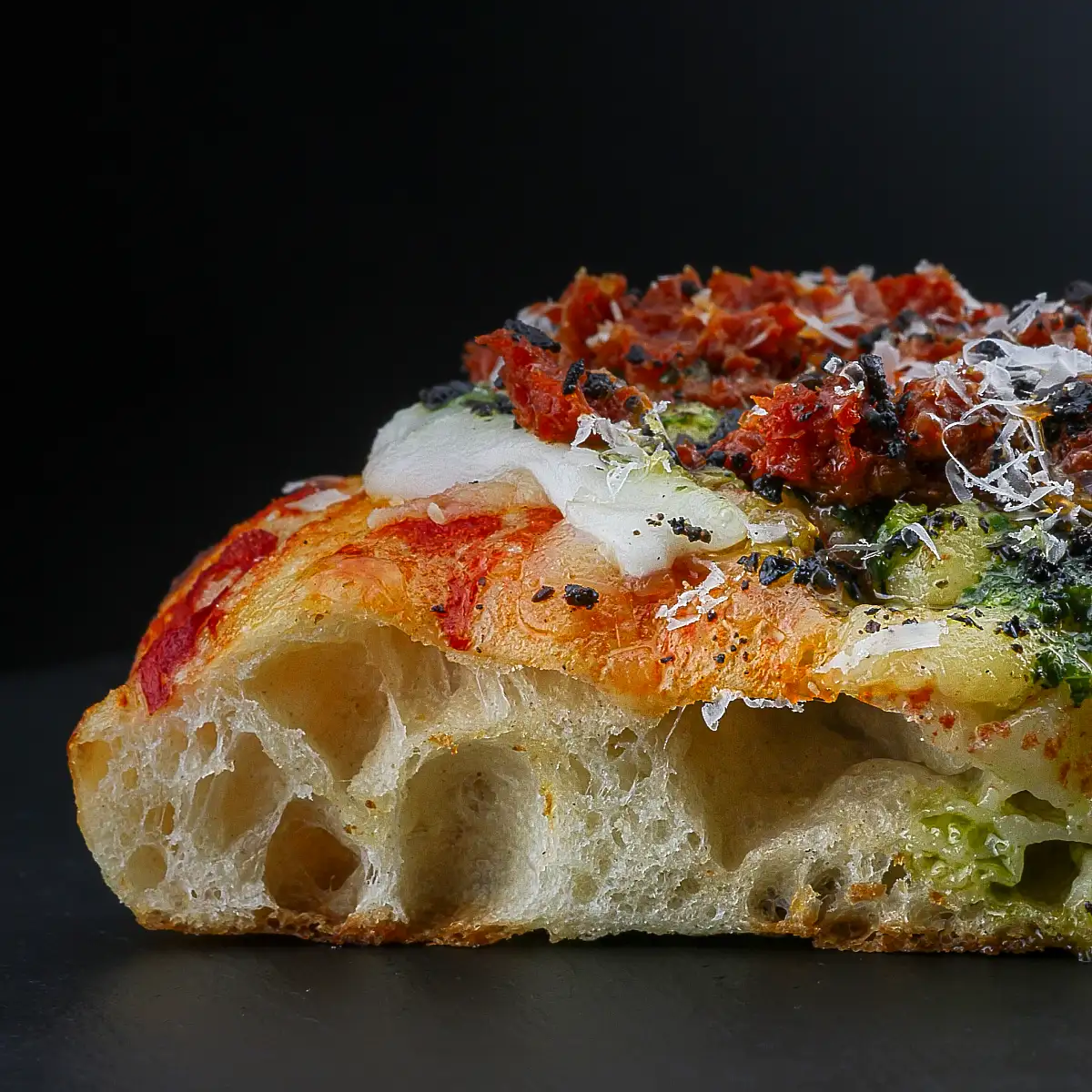
During an extended fermentation, the yeast works slowly and the gluten network matures. The result can be a more open crumb, with irregular cavities, and a crust that makes a sound when broken. That combination of lightness and character is what makes a good pizza romana in teglia so difficult to imitate.
Hydration also matters. A dough with enough water can create those generous air pockets that attract so much attention when cutting a slice. But more water does not always mean a better pizza. If the dough is not handled with precision or does not have the necessary time to develop, it can end up wet, weak, or without structure. Technique rules.
The oven completes the job. You need a bake that dries and browns the base without sacrificing the softness inside. The bottom must have firmness but not taste burnt. The surface must be golden, not dried out. That is the fine line between a correct dough and one that makes you say: che buono.
Oil, salt, and rosemary: three elements that change everything
The olive oil is not there for decoration. It provides aroma, helps to brown, and leaves a silky sensation that balances the toasted character of the dough. The salt should make itself felt without dominating. The rosemary, when used in moderation, adds a herbal perfume that immediately connects you to an Italian bakery.
It may seem like little, but that is precisely the test. When there are few ingredients, there is nowhere to hide a poorly made dough or an oil without personality. Pizza bianca demands an honest product and precise execution.
Pizza bianca guide: how to recognize an excellent slice
The eyes give the first clues. Look for an evenly golden surface, with darker toasted spots that speak of intense baking. The base should look firm, not pale or greasy. When lifting the slice, it should hold up well without drooping flaccidly in the center.
Then there is the sound. A freshly baked pizza bianca should crackle slightly when broken or bitten. It is not about being as hard as a cracker. The beauty lies in the contrast: croccante on the outside, soft and airy on the inside.
The aroma also counts. You should perceive baked wheat, olive oil, and a pleasant touch of fermentation. If the smell is flat or the only protagonist is the cheese, you are probably looking at a white pizza loaded with toppings, not a pizza bianca where the dough takes the leading role.
Finally, pay attention to the aftertaste. A well-made slice leaves flavor, not heaviness. It is satisfying, yes, but invites another bite. That balance is one of the great luxuries of the Roman tradition.
How it is eaten in Rome and why the cut matters
Pizza bianca is part of Rome's daily culture. It is bought al taglio, which means by the slice and by weight. It is cut with scissors, served on paper, and enjoyed walking, chatting, or sitting down for a moment without turning every meal into a rigid ritual.
The rectangular shape is not a design detail. The teglia, the pan in which it is baked, allows for a particular bake and makes the cutting flexible. You can ask for a small slice to try, a more generous one to share, or various combinations to turn the table into a journey of flavors.
One of the most beloved customs is to split open the pizza bianca and fill it. Mortadella, prosciutto, stracciatella, roasted vegetables, or seasonal ingredients can come into play. The key is not to overdo it: if the filling is too wet or abundant, the texture that makes the dough special is lost.
It also works as an accompaniment. A simple slice can elevate a charcuterie board, complement a fresh salad, or be the base of an informal meal with friends. Its versatility is real, but versatility should not be confused with saturation. Sometimes, oil, salt, and an extraordinary dough are more than enough.
Pizza bianca, focaccia, and pizza romana: similar, but not the same
These preparations share roots and may look similar at first glance, but each has its own personality. Focaccia is usually thicker, oilier, and focused on a soft crumb. It can have deep dimples and toppings baked directly on the dough.
Pizza romana in teglia, on the other hand, seeks lightness, a crispy base, and a clean cut. Pizza bianca can express itself within that tradition, especially when baked in a pan and prioritizing a long-fermentation dough. Not all white pizzas are Roman pizza bianca, and not all focaccia pursues the same result.
That distinction matters because it changes expectations. If you are looking for a soft piece of bread to accompany a meal, a focaccia can be perfect. If you want a slice with more crunch, air, and oven character, pizza romana in teglia plays in another league.
What to pair it with to truly enjoy it
A simple pizza bianca calls for drinks that refresh and do not hide its aromas. A light and dry beer works very well by contrast. An Italian white wine with lively acidity can also accompany it elegantly, especially if there are soft cheeses or fresh vegetables on the table.
If the pizza is filled with mortadella or creamy cheeses, it is best to look for something with bubbles or acidity. If it has potatoes, rosemary, or more intense cured meats, a medium-bodied beer might respond better. There is no single rule: it depends on the filling, the time of day, and whether the slice is a quick craving or part of a long meal.
In San Pablo de Heredia, Bianka® Pizza Romana celebrates this tradition with 72-hour fermentation doughs, a croccante texture, and the Roman spirit of eating a square pizza that feels different from the very first cut.
The next time you see a white pizza, do not judge it by the absence of tomato. Go closer, look at the crumb, listen to the crust, and let the dough speak. When made with patience, a pizza bianca does not need to shout to stay in the memory.