Sep 22, 2026
Guide to Italian schiacciata, truly crispy
The Italian schiacciata guide starts with a truth felt at the very first bite: it is not a folded pizza, nor is it just any sandwich. It is Italian baking with attitude. An airy dough, olive oil, a thin, crispy crust, and fillings that must respect the balance between flavor, temperature, and texture.
In Costa Rica, where traditional pizza already has its place at the table, the schiacciata arrives to change the game. It is a choice for those who want something more special than a quick bite: an Italian format with artisanal roots, visually irresistible, and made to share, photograph, and remember. Che buono.
What is Italian schiacciata?
Schiacciata is an Italian flatbread whose name comes from schiacciare, which means to flatten or press. Its origin is especially associated with Tuscany and Florence, where it is part of the daily baking tradition. It is baked stretched out, with olive oil on the surface, and develops a firm base, a light crumb, and a crust that crunches without feeling dry.
Its appearance may remind you of a focaccia, but it is best not to treat them as the same thing. Focaccia is usually taller, fluffier, and marked by dimples that hold oil and salt. Schiacciata tends to be thinner, firmer, and crispier. That difference completely changes its purpose: while a focaccia can accompany a meal, the schiacciata is ready to become the star when opened and filled.
There is also no single, untouchable version. In Italy, every region, bakery, and baker can give it their own personality. Some are very thin and brittle; others keep a more generous crumb. What should not be negotiated is its character: good olive oil, precise baking, and a texture that contrasts with the filling.
Italian schiacciata guide: texture is king
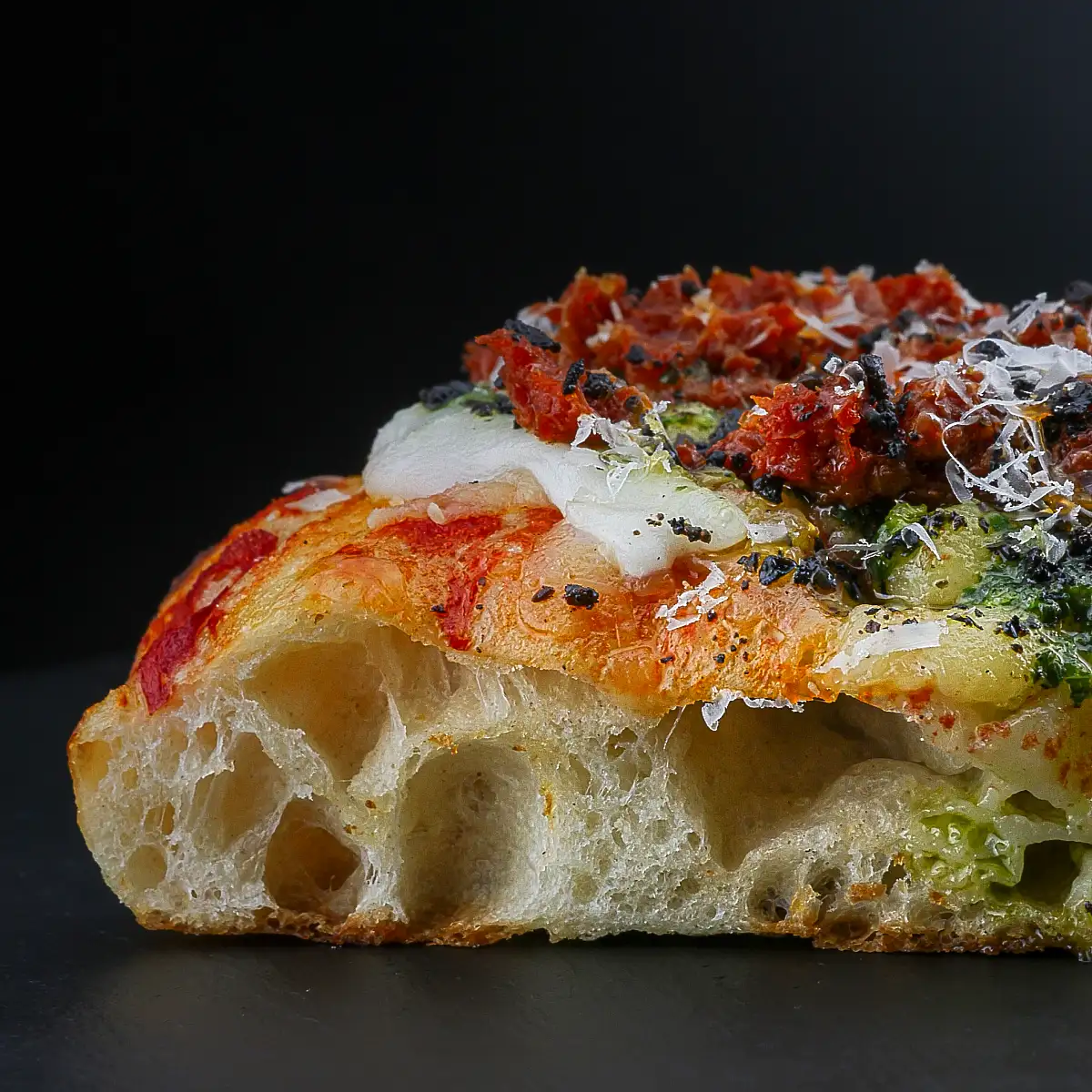
A great schiacciata is recognized before you even taste it. It should have a deep golden hue, slightly irregular edges, and small bubbles on the surface. When sliced, the crust should make a sound. Not like a hard cracker, but like a well-baked bread that retains moisture and elasticity inside.
The secret is not in adding ingredients without measure. It is in controlling the process. The dough needs time to develop flavor, a well-managed hydration, and enough rest to create that structure filled with air. Slow fermentation adds depth, improves digestibility for many people, and allows the oven to transform a simple dough into something memorable.
Olive oil is another key player, not just a decorative finish. It brings aroma, color, and that toasted feel that appears at the edges. If oil is lacking, the dough can turn out pale or dry. If there is too much, it becomes heavy and loses its definition. The technique lies in finding the point where the crust shines, but the bread still feels light.
Baking also demands attention. A very hot oven quickly sets the base, puffs up the bubbles, and creates the contrast that defines this format. A poorly baked schiacciata turns out soft, fragile, or excessively oily. An overbaked one becomes difficult to bite and completely overpowers the fillings. There are no shortcuts here: crispiness is earned with dough, time, and temperature.
The ideal filling: contrast, not excess
Schiacciata is usually sliced open horizontally and filled right before serving. This detail matters. If filled too far in advance, the moisture from the ingredients can soften the crust and erase the best part of the experience.
Classic fillings make use of clear contrasts. Italian cured meats like mortadella, prosciutto, or salami find balance with creamy cheeses, arugula, fresh tomato, artichokes, mushrooms, or roasted vegetables. The key is to give each ingredient its space. The bread should not disappear under a mountain of cheese, nor should the filling feel scarce.
Mortadella with pistachio and a soft cheese is a beloved combination for a reason: it mixes saltiness, delicate fat, creaminess, and a toasted touch. Prosciutto works beautifully with arugula and a clean-tasting cheese. For a vegetarian version, roasted vegetables, pesto, and mozzarella can be spectacular, provided the vegetables are well-drained.
There is a simple rule: if the filling is intense, the schiacciata should be cleaner. If the filling is fresh and mild, you can play with a more expressive cheese or a seasoned spread. The goal is not to impress with quantity, but to ensure that every bite has crust, crumb, filling, and the aroma of olive oil.
How to eat it to truly enjoy it
Schiacciata is best enjoyed freshly assembled and preferably warm. Not necessarily piping hot, because too much heat can mask the nuances of the cured meats, cheeses, and oil. Warm, the dough retains its crunch and releases its aromas better.
It is an excellent option for a different kind of lunch, a casual dinner with friends, or a dining experience that asks for something more interesting than the usual. Pairing it with a cold drink and letting it be the center of the table usually works better than loading it down with heavy side dishes.
It is also a generous format for sharing. It can be cut into halves or portions, but it is worth taking a complete first bite without taking the filling apart. That is where the contrast that wins the Italian schiacciata so many fans appears: the crack of the crust, the softness inside, and the fresh filling in a single bite.
Signs of a well-made schiacciata
Not just any flatbread with filling deserves to be called schiacciata. If you are looking for an authentic experience, observe the bread before choosing. A good piece has structure and does not immediately bend under the weight of its ingredients. The base should support the filling without becoming rigid, and the crumb should show air pockets, those small cavities that reveal a well-managed fermentation.
The aroma offers another clue. It should smell of toasted bread and olive oil, not just melted cheese. In the mouth, the dough should not taste sweet, greasy, or leathery. It must have its own flavor, because the bread is not just a container: it is half of the recipe.
At Bianka® Pizza Romana, this logic stems from a clear obsession with Italian baking and textures that are never improvised. A slow fermentation, precise baking, and intentionally chosen fillings turn every schiacciata into an alternative with identity compared to generic pizzerias. In San Pablo de Heredia, it is an invitation to taste Italy from a less expected and much crispier perspective.
When to choose schiacciata and when to choose focaccia
It depends on what you want to eat. If you are looking for an airier, softer piece designed to accompany or share at the table, focaccia may be the right choice. If you want a star filling, a pronounced crust, and an experience closer to an artisanal panino, schiacciata has the upper hand.
It also depends on the occasion. For a light yet satisfying meal, schiacciata works wonderfully. For a table with several dishes in the center, focaccia can be more versatile. It is not about deciding which is superior in all cases, but recognizing that each has its own territory and texture.
The next time you see a schiacciata on the menu, do not treat it like a simple sandwich. Order it freshly prepared, listen to the crunch when you cut it, and give the bread room to speak. When the dough is well-made, Italy does not need an explanation: it is tasted.