May 9, 2026
Guide to Italian slow fermentation
The difference between a good pizza and a truly memorable pizza almost never lies on top, in the topping. It lies below, in the base. That's why this Italian slow fermentation guide doesn't begin with sauce or cheese: it begins with time. Real time. Well-worked time. Time that transforms a simple dough into a crisp, light experience with depth of flavor.
In the Italian baking tradition, slow fermentation is not a trendy trick or a pretty label to sell at a higher price. It is technique, judgment, and patience. It is also a quality decision. When dough ferments for more hours, its structure changes, it develops more complex aromas, and it behaves differently in the oven. The result is noticeable at the first bite, but also in something less obvious: how you feel after eating it.
What Italian slow fermentation means
Talking about Italian slow fermentation means talking about control. It's not simply about leaving a dough forgotten in the cold and waiting for magic. It's about adjusting flour, hydration, yeast amount, room temperature, and resting time so the dough matures in balance.
In practical terms, slow fermentation usually lasts between 24 and 72 hours, often under refrigeration. That time allows the yeasts to work gradually and the enzymes to do their part on starches and proteins. The dough gains flavor, character, and a much more refined texture than an accelerated fermentation.
Not all Italian pizzas are fermented the same way. A classic Neapolitan follows one logic. A Roman-style in teglia, another. A well-made focaccia, yet another. But all of them share one principle: quality isn't improvised.
Why 72 hours change a dough so much
The 72-hour figure has become almost a symbol, and for good reason. Not because it is a rigid rule, but because it marks a very interesting point between flavor development, workability, and structure. In a Roman-style pizza in teglia, for example, that time helps achieve an airy crumb inside and a distinctly crispy base outside.
With less time, the dough can work, of course. But often it ends up flatter in flavor or harsher in texture. With more time, if the formula isn't well calibrated, it can also lose strength. Here's the detail that separates craftsmanship from empty talk: more hours do not always mean better pizza. It means better pizza only when there is technique behind it.
Long fermentation also allows for digestion that many people perceive as lighter. It is not a miracle promise, nor does it apply equally to everyone, but there is usually a clear difference in how a well-matured dough feels compared with one made in a rush.
The Italian slow fermentation guide in practice
If one were to summarize this Italian slow fermentation guide in a single idea, it would be this: time does not replace technique, it reveals it. Flour matters. Water matters. The oven matters. But the way the dough rests and evolves ends up defining much of the final result.
First comes the choice of flour. In Roman styles, you usually look for a flour with enough strength to handle higher hydration and long fermentation without collapsing. If the flour is weak, the dough becomes hard to handle and loses structure. If it is too strong and not worked well, it can produce a less delicate texture.
Then comes hydration. A Roman-style pizza in teglia usually works with high percentages, which favors an open, light crumb. But more water does not automatically mean better results. It means a more demanding dough, more technical and less forgiving of mistakes. That is part of the charm and also the challenge.
Yeast, for its part, is reduced when the process is extended. It makes sense: if the dough will ferment for many hours, there is no need to force it. A small, well-measured amount allows a more elegant and stable evolution. When too much is used, the dough can overferment, lose control, and develop less clean notes.
Finally, there is temperature. A slow fermentation in the cold helps organize the process and gain consistency. That does not completely eliminate the influence of the climate, something especially relevant in Costa Rica, where room temperature can speed up reactions more than expected. That is why Italian technique, applied here, needs real adaptation and not simple copying.
What you notice on the plate
This is where everything stops being theory. A dough with well-executed slow fermentation offers a crisp crust without becoming hard, an airy crumb without a chewy sensation, and a flavor that does not depend entirely on the toppings to stand out.
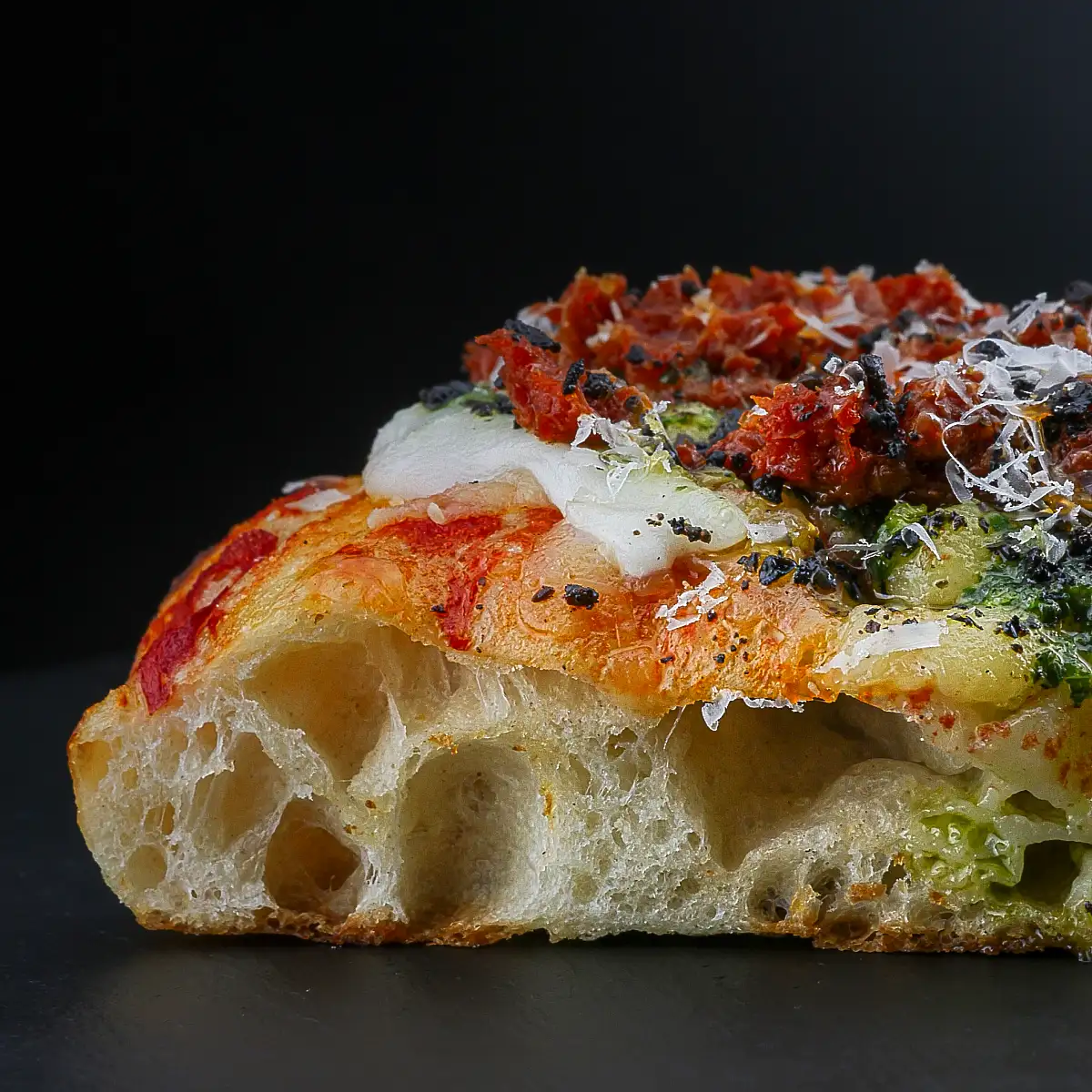
There is also a visual difference. The internal structure looks alive, with well-formed alveoli and a lightness that does not seem accidental. When it comes to square pizza or formats like the stuffed schiacciata, that well-developed base is a central part of the experience. It does not accompany the filling: it supports it and lifts it.
In a premium offering, this matters a great deal. Because when a pizza is sold as artisanal and authentic, the dough has to speak first. If the base has no identity, everything else feels decorative.
Slow fermentation does not always mean excellence
It is worth saying clearly. The expression sounds good and sells well, but by itself it guarantees nothing. A slow-fermented dough can turn out heavy, sour, or underbaked if the recipe is poorly balanced or if the baking does not match it.
There is also the mistaken idea that any pizza with many hours of resting is automatically superior. It doesn't work that way. The result depends on the style being sought. An authentic Roman pizza needs a fermentation designed for its own identity: drier base, crisp bite, airy structure, and a great deal of precision in the tray and oven.
That is the big difference between a specialized kitchen and a generic pizzeria that borrows Italian words to sound interesting. Real technique shows in consistency. Not one day yes and the next no. Always.
What makes it ideal for Roman pizza
Roman-style pizza in teglia has a very clear personality. It is light, airy, crisp, and deeply bread-like. It does not try to copy Neapolitan pizza or compete in the same format. It plays a different game. And it wins it through texture.
Slow fermentation suits it especially well because it gives the dough time to develop that very Italian combination of lightness and character. In addition, it allows high hydration to be worked with a more noble structure, which is key to achieving a base that stays firm even with generous toppings on top.
In Costa Rica, where for years the dominant reference has been the more traditional round pizza, coming across a well-made Roman-style one changes the conversation. It feels different. It looks different. It tastes different. And yes, it makes you want another slice.
How to recognize good slow fermentation when eating
You don't need to be in a professional kitchen to notice it. There are very clear signs. The first is the aroma: a well-fermented dough has the scent of bread, toasted grain, serious work. It does not smell only baked; it smells developed.
The second is texture. The base should break elegantly, not snap like a dry cookie or bend as if it were raw. The crumb should feel light, airy, but structured. And the third sign is the overall balance: after eating, the sensation should be one of satisfaction, not unnecessary heaviness.
When that happens, it becomes clear why in Bianka® Pizza Romana the 72-hour fermentation is not a side detail, but part of the heart of the concept. Very good, yes, but also very precise.
More than a trend, a way to respect the dough
Italian slow fermentation keeps gaining attention because it responds to something very simple: people can tell when a pizza is made with skill. Maybe they don't always explain it in technical terms, but they feel it. They feel the difference between a rushed dough and a thoughtfully made dough.
That is why this guide does not seek to romanticize time for its own sake. It aims to highlight a technique that truly changes the result. In an era where everything competes to be fast, a good pizza reminds us of something essential: some things need hours to reach their best version. And when they do, you can tell from the very first bite.