Jul 8, 2026
How to choose a good gourmet stuffed focaccia
There is a huge difference between a stuffed focaccia that only looks good in photos and one that actually delivers flavor, texture, and technique. If you are wondering how to choose gourmet stuffed focaccia, the answer does not start with the filling. It starts with the dough, the fermentation, the balance, and that first bite that sounds croccante before becoming airy and full of character.
In Costa Rica, where quick proposals and improvised versions of Italian cuisine abound, a well-made gourmet stuffed focaccia is recognized immediately. It doesn't need an excess of sauces or outrageous combinations to impress. Its thing is something else: precision, ingredients with intention, and a structure that holds every layer without becoming heavy.
How to choose gourmet stuffed focaccia without falling into the generic
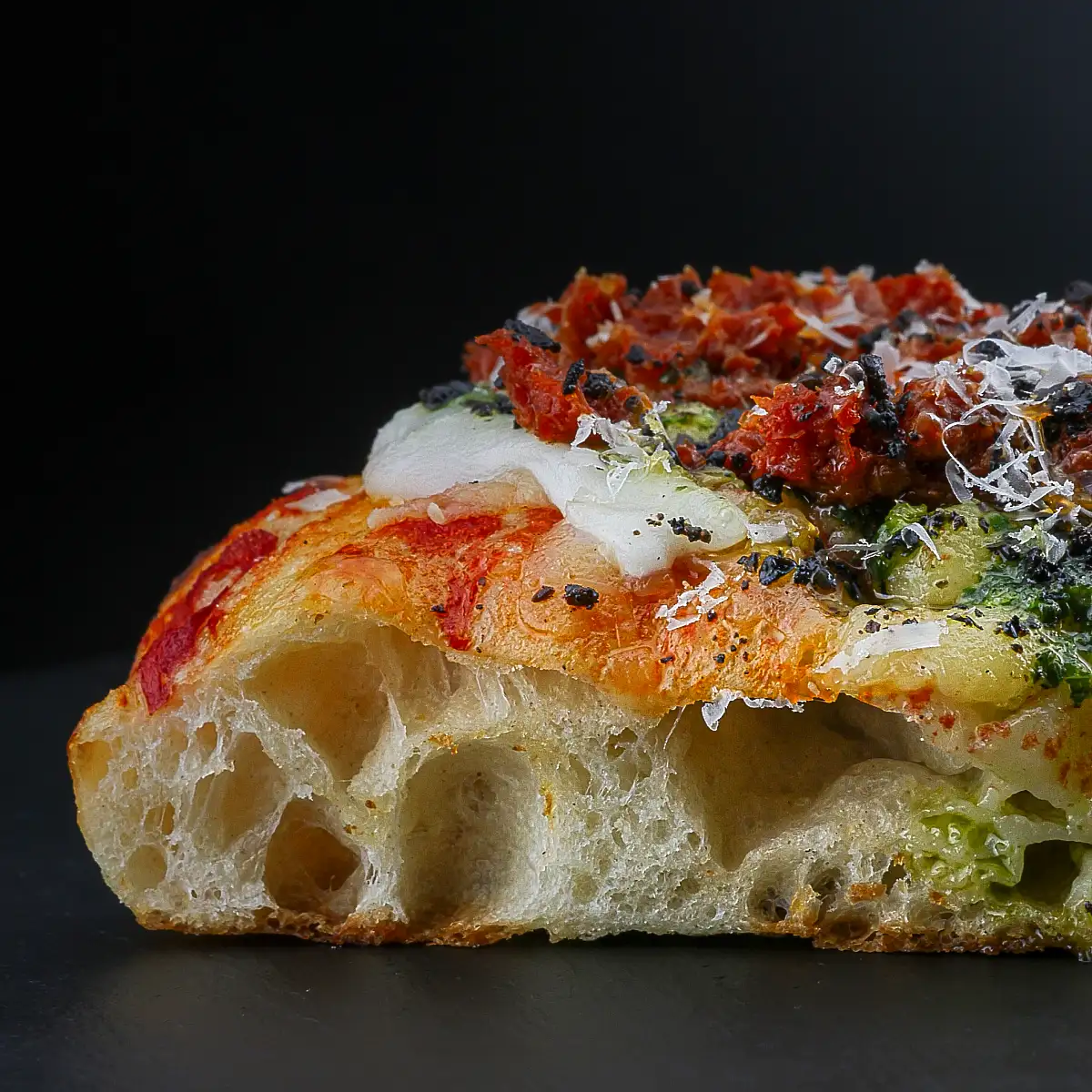
The first clue is in the base. If the focaccia looks like any ordinary bread cut and stuffed at the end, you are probably not looking at a premium proposal. A gourmet focaccia must have its own identity: a dough with real development, visible alveoli, a firm crust, and a light interior. When that is missing, the filling ends up doing all the work, and that is never a good sign.
It is also worth looking at the establishment's approach. There are businesses that understand stuffed focaccia as an artisanal product with baking technique behind it, and others that treat it like a sandwich disguised as Italian. The difference is noticeable in the result. A serious piece has structure, aroma, controlled moisture, and a texture that doesn't fall apart or get clumpy.
Furthermore, gourmet does not simply mean expensive. It means criteria. A combination of ingredients can be simple and still feel superior if it is well-executed. Mortadella, stracciatella, pesto, or roasted vegetables can shine much more than a saturated mixture of five cheeses, three sauces, and proteins without harmony.
The dough decides more than you think
If there is one thing that separates a memorable focaccia from a forgettable one, it is the dough. It should have a golden, slightly crispy exterior and a light crumb that doesn't feel chewy. When there is a long fermentation, the flavor changes completely. The dough gains depth, becomes easier to digest, and stops being a simple vehicle to become a central part of the experience.
This point matters a lot because the filling adds weight, moisture, and fat. If the base does not have enough development, it collapses. The result is usually a soggy piece, difficult to eat, and without contrast. On the other hand, when the dough is well-worked, it holds the filling without losing personality. That is where that very Italian balance between craftsmanship and immediate pleasure appears.
It is worth paying attention to the edge and the base. A good stuffed focaccia should not feel raw on the inside nor excessively toasted on the outside. Nor should it be dry. The ideal spot lies in that fine contrast between croccante and softness. It sounds simple, but achieving it requires real technique.
The filling: less volume, more intention
One of the most common mistakes when choosing is getting carried away by the idea that more filling equals a better product. Not always. In fact, when a focaccia is overloaded, the balance is often lost. Everything becomes heavy, greasy, or difficult to finish.
Gourmet filling is distinguished by how it converses with the dough. It must provide flavor, creaminess, freshness, or intensity, but without covering up the base. The ingredients also have to feel distinct. If everything tastes the same because of a dominant sauce or an excess of cheese, there is a construction problem.
A good criterion is to think in layers. A quality protein, a creamy element, something vegetable or herbal that provides contrast, and a final touch that ties the whole together. That sounds much more elegant and flavorful than an aimless accumulation. Premium stuffed focaccia does not seek to overwhelm you; it seeks to leave you thinking about the next bite.
How to read a menu and detect real quality
The menu says a lot. When a menu clearly describes the style of the product, the origin of the inspiration, or the technique behind the dough, there is usually a more serious gastronomic intention. If everything is written in a generic and repetitive way, with empty descriptors like "delicious," "special," or "super loaded," the real value is probably less worked.
It also bloody helps to look at the selection of ingredients. Italian cold cuts, cheeses with personality, roasted vegetables, well-thought-out creams, and regional combinations usually indicate a more specialized proposal. This is not about elitism. It is about coherence. If the place is committed to baking tradition and Italian identity, that should be felt right from the menu.
Another key detail is the number of options. A shorter, well-executed offering usually inspires more confidence than an endless menu that wants to cover everything. Specialization is almost always noticeable in the focus.
The perfect texture is non-negotiable
If you could only evaluate one thing, let it be the texture. A gourmet stuffed focaccia must have contrast. The ideal bite combines a light resistance in the crust, air in the crumb, and a filling that accompanies the experience without making a mess. If everything gets squashed and drips when you eat it, the construction failed.
This also influences how it is enjoyed at the table or to go. Some pieces come out flawless fresh-made, but lose all their charm after a few minutes because they have no structure. Others maintain their character and continue to look and taste good. This detail is not minor, especially if you value a premium experience and not just a quick meal.
The right texture also elevates the visual. A well-baked focaccia with marked alveoli and an orderly filling looks as good as it tastes. And yes, that matters. For a foodie, urban, and curious audience, the experience also enters through the eyes. But the photo alone is not enough. Che buono when the aesthetic is indeed backed by technique.
Context matters: lunch, dinner, or a craving to share
Choosing well also depends on the moment. Not all stuffed focaccias work the same for every occasion. If you are looking for lunch, you are probably better off with an option with fresher, more balanced, and clean-tasting fillings. If it is dinner or an outing with friends, you can go for more intense and indulgent profiles.
Sharing also changes the decision. Some combinations are perfect for cutting in the middle and trying among several people, while others are better enjoyed as a personal choice because they have more defined flavors or sharper contrasts. Thinking about this greatly improves the experience and prevents impulsively ordering something that later feels too heavy or too flat.
In a specialized place, this versatility is usually well-understood. Not everything has to be extreme to be memorable. Sometimes the best choice is the one that feels tuned to the moment, not the one that looks most striking on the menu.
Signs that you are indeed looking at a premium focaccia
There are small indicators that are worth gold. The dough has its own aroma, it doesn't just smell like cheese or toppings. The cut reveals a developed, not compact, crumb. The filling is distributed with criteria. Each ingredient retains its identity. And when you finish, you feel satisfied, not defeated.
The technique is also perceived in the consistency. If a place maintains that standard time and time again, there is craftsmanship behind it. That is precisely what makes a niche proposal special: it doesn't rely on tricks, it relies on execution. At Bianka® Pizza Romana, for example, that vision is felt in the artisanal approach, in the croccante texture, and in a way of understanding Italian cuisine with more precision and less cliché.
What you are really looking for when you want something gourmet
In the end, learning how to choose gourmet stuffed focaccia is learning to order with more criteria and less noise. It is not about looking for the most exaggerated option, but the best-constructed one. The one that respects the dough, takes care of the filling, and delivers an experience that feels special from the very first bite.
Because a real stuffed focaccia does not compete on quantity. It competes on memory. And when you find one that combines fermentation, texture, balance, and identity, it is noticed immediately. Next time you have a craving, choose that one. The one that sounds croccante, tastes authentic, and makes eating out feel like an occasion worth repeating.