Jul 12, 2026
How to recognize an authentic Roman pizza
A pizza arrives at the table and, before you even taste it, it already says a lot: the rectangular cut, the golden edges, the firm base, and that slight sound as you break it. But how to recognize authentic Roman pizza goes far beyond it being square. It is about technique, time, texture, and a very Roman way of understanding dough: light, croccante, and ready to hold ingredients with character.
In Costa Rica, versions of Italian pizza abound, but not all of them follow the same tradition. Roman-style pizza in teglia has its own identity. It does not try to look like the round Neapolitan, with its high border and soft center. It seeks a precise contrast: a crispy crust on the outside, an airy crumb on the inside, and flavors that feel defined in every bite. Che buono.
How to recognize authentic Roman pizza at first glance
The most visible sign is usually the format. Roman pizza in teglia is baked in a pan, usually rectangular, and cut into square or rectangular portions. That detail is not a simple aesthetic decision or a trend for the photo: it responds to the traditional way of selling and sharing pizza in Rome, especially in al taglio formats, that is, by the slice.
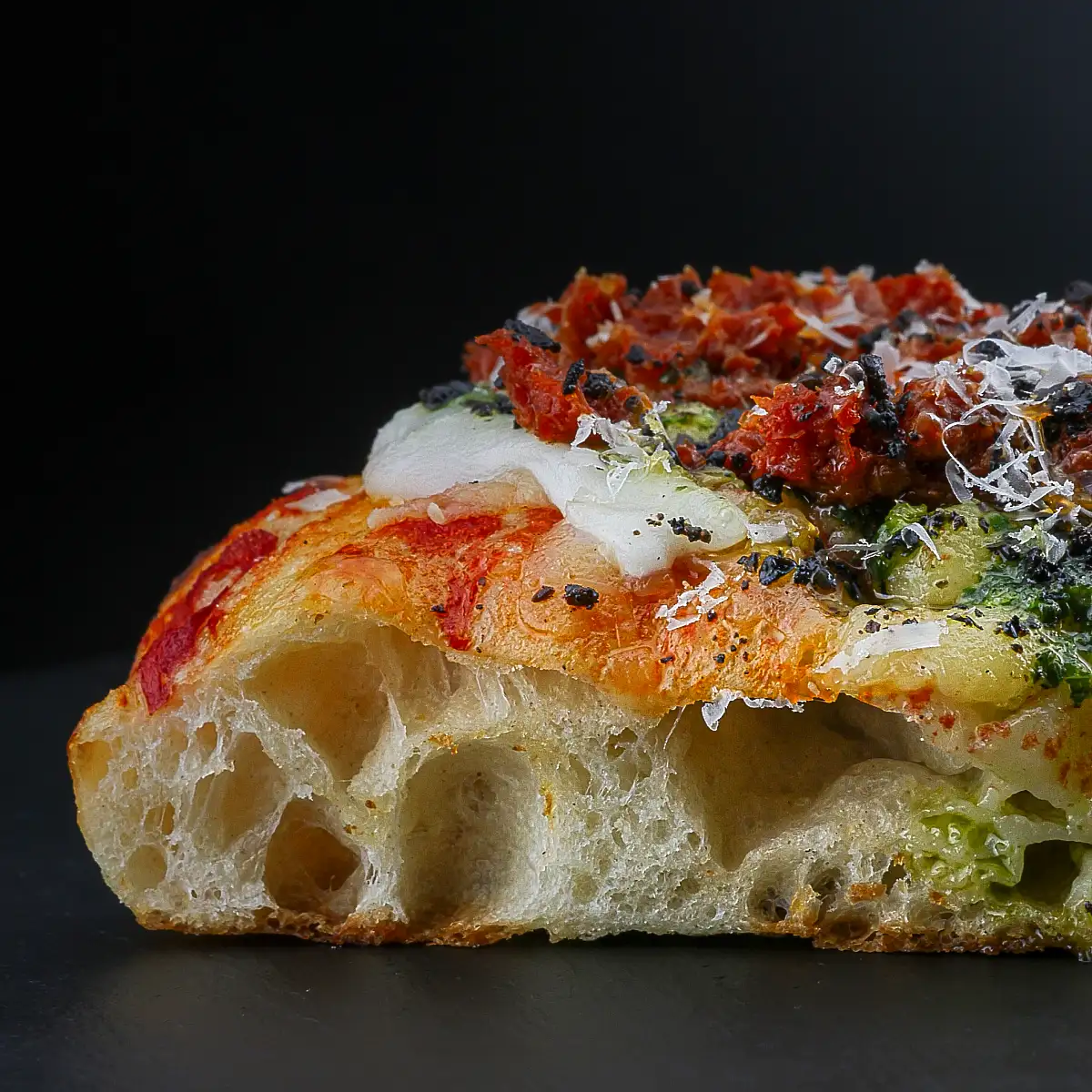
However, the rectangle by itself does not guarantee authenticity. A pizza can come in a pan and still have a heavy, doughy crust, or a poorly executed bake. What you need to look for is a golden, even surface with small, irregular bubbles, a firm base, and a moderate thickness. When lifting a slice, it should hold its shape without bending completely or falling apart under the weight of the ingredients.
The correct appearance has something artisanal about it. It is not perfectly uniform, because a live and well-fermented dough does not behave like an industrial product. Every cell, every bubble, and every toasted edge tells a story of rest, temperature, and craft.
The dough rules: fermentation, hydration, and patience
The true difference lies beneath the toppings. Authentic Roman pizza is born from a dough worked with attention to detail, generally with high hydration. That means it contains a higher proportion of water than conventional dough, which helps create a light, open, and air-filled crumb.
A good pizza in teglia should not feel like bread with cheese on top. When biting into it, the crust has to be light, with visible cells and an almost ethereal feeling in the center. Underneath, the base must offer resistance and croccante without becoming a hard cracker. That balance is the heart of the Roman proposal.
Fermentation is not just a menu ornament
When a pizzeria talks about long fermentation, it is worth understanding what actually changes. Giving the dough time allows it to develop flavor, structure, and a more pleasant texture. In a well-executed Roman pizza, that rest is noticeable: the taste of the wheat comes through more clearly, the crumb does not feel dense, and the result does not leave behind that typical heaviness of rushed doughs.
There is no single number that defines all Roman pizza. There are master pizza makers who work with different times, flours, and methods. But a fermentation of 48, 72 hours or more, when managed correctly, is a very serious sign of commitment to the product. It is not automatic magic. Temperature, flour quality, kneading, and baking also matter. Time without technique does not save a dough; technique with time can transform it.
At Bianka® Pizza Romana, the 72-hour fermentation is part of that search: building a dough with depth, air, and the croccante that distinguishes real Roman pizza.
The croccante must be heard and felt
In Italy, croccante is not just a nice word to describe food. It is a promise of texture. In Roman pizza, the first bite should have a clean break at the base. It doesn't need to sound like toast, but it must deliver an obvious crispy layer before reaching a soft, airy crumb.
The key lies in the contrast. If the whole pizza is hard, it is overcooked or dry. If the whole pizza is soft, it probably lacked temperature, oven time, or a good dough structure. The authentic version lives in the middle ground: firm below, light inside, golden on top.
Also watch the underside. A pale, wet, or greasy base does not have that Roman character sought in a well-baked teglia. It should show an even toasted color and retain its texture even after a few minutes on the table. It is a simple but revealing test.
The ingredients accompany, they do not hide the dough
An exceptional Roman pizza can feature creative combinations, cold cuts, vegetables, intense cheeses, or a simple tomato sauce. Authenticity does not depend on having the exact same toppings served in a Rome neighborhood. It depends on respecting the logic of the product.
The ingredients should look fresh, well-distributed, and in proportion. A mountain of cheese can impress, but it can also make the dough soggy and erase its texture. In a good Roman pizza, every element serves a function: the tomato provides acidity, the cheese adds creaminess, the vegetables offer contrast, and the cold cuts deliver intensity. None of them should cover up the work of the dough.
There is another interesting detail: some ingredients are added after baking or at different stages. This protects delicate flavors and prevents specific leaves, hams, or cheeses from losing their personality under too much heat. When the product is thought out, it shows in that care.
Roman pizza does not mean just one pizza
Here is the nuance that many overlook. Rome has more than one pizza style. Pizza in teglia is rectangular, airy, and croccante. Pizza al taglio shares that spirit of being sold by the slice. There is also round Roman pizza, thinner and crispier, often recognized by its very thin base.
Therefore, saying that an authentic Roman pizza must always be square would be oversimplifying. If you are talking specifically about Roman-style pizza in teglia, yes: the pan format and the rectangular cut are highly recognizable features. But Italian cuisine is not a frozen recipe. It is tradition, region, technique, and evolution.
What should be maintained is respect for the announced style. If it promises to be Roman in teglia, expect a pan dough, good fermentation, an open crumb, and a croccante base. If it promises thin Roman, look for a round, very thin piece with a more pronounced crunch. Each style has its rules and its charm.
Red flags before ordering
Not everything presented as artisanal actually is. If the pizza looks excessively uniform, with a compact crumb and no bubbles, it may be closer to an industrial focaccia or a conventional pan-baked dough. If it bends completely, gets soggy quickly, or leaves an oily feeling, the balance is probably not working.
Don't confuse a thick pizza with a Roman pizza either. Thickness is not the goal. A teglia can have volume, but it must feel light. The difference appears when you finish a slice and want to keep trying another, not when you feel like the dough sat heavy on your palate.
The best sign, in the end, is consistency. A specialized pizzeria can explain its dough clearly: how long it ferments, what texture it aims for, and why it serves its pizzas in a certain way. When there is technique behind it, there is no need to disguise it with empty words.
The next time you see a rectangular pizza, don't just focus on the shape. Look at the base, break the edge, observe the cells, and listen to that croccante. If the dough is light, golden, and full of character, you are much closer to Rome than you thought. Book a table, gather your people, and make the next bite count.