Jun 24, 2026
Opening of Italian restaurant in Heredia: what to expect
When an Italian restaurant opening in Heredia is announced, the question is not just where to go for dinner. The real question is whether it is just another pizzeria or a concept with identity, technique, and an experience that is truly worth going out for. In a province where there is a growing interest in eating better, Italian food is no longer measured solely by large portions and abundant mozzarella. It is measured by authenticity, texture, fermentation, craft, and character.
Heredia has an increasingly curious audience. People who want to sit in front of something different, take a photo because it looks incredible, taste it, and notice that there is actual work behind it. That completely changes what it means to open an Italian restaurant today. It is no longer enough to decorate nicely, put Italian names on the menu, and serve soulless pasta. If the concept lacks substance, it shows quickly.
Italian restaurant opening Heredia: why it generates anticipation
Not every opening sparks conversation. But when an Italian concept appears with a more specialized vision, interest grows because the market has also matured. Diners from Heredia and the GAM want novelty, yes, but not just any novelty. They want an experience that feels well thought out, has history, technique, and a consistent execution.
This becomes even more interesting when the restaurant does not take the obvious route. Instead of repeating the same old round pizza or a generic trattoria menu, an opening with a more niche focus can change the conversation. That is where less massive formats, long-fermentation doughs, Italian bakery products with more personality, and a concept that feels premium without needing to exaggerate come into play.
The appeal of this type of concept is that it turns a casual outing into something more memorable. You don't just go out for dinner. You go to discover a different way of understanding Italian cuisine. And when that is done well, it is noticeable from the very first bite.
What differentiates an authentic Italian restaurant from a generic one
The difference is rarely in the pitch. It is in the product. An authentic Italian restaurant does not need to fill the experience with clichés because the cuisine speaks for itself. The dough has structure, the crust has criteria, the ingredients are placed with intention, and the texture makes it clear that there was technique before it reached the table.
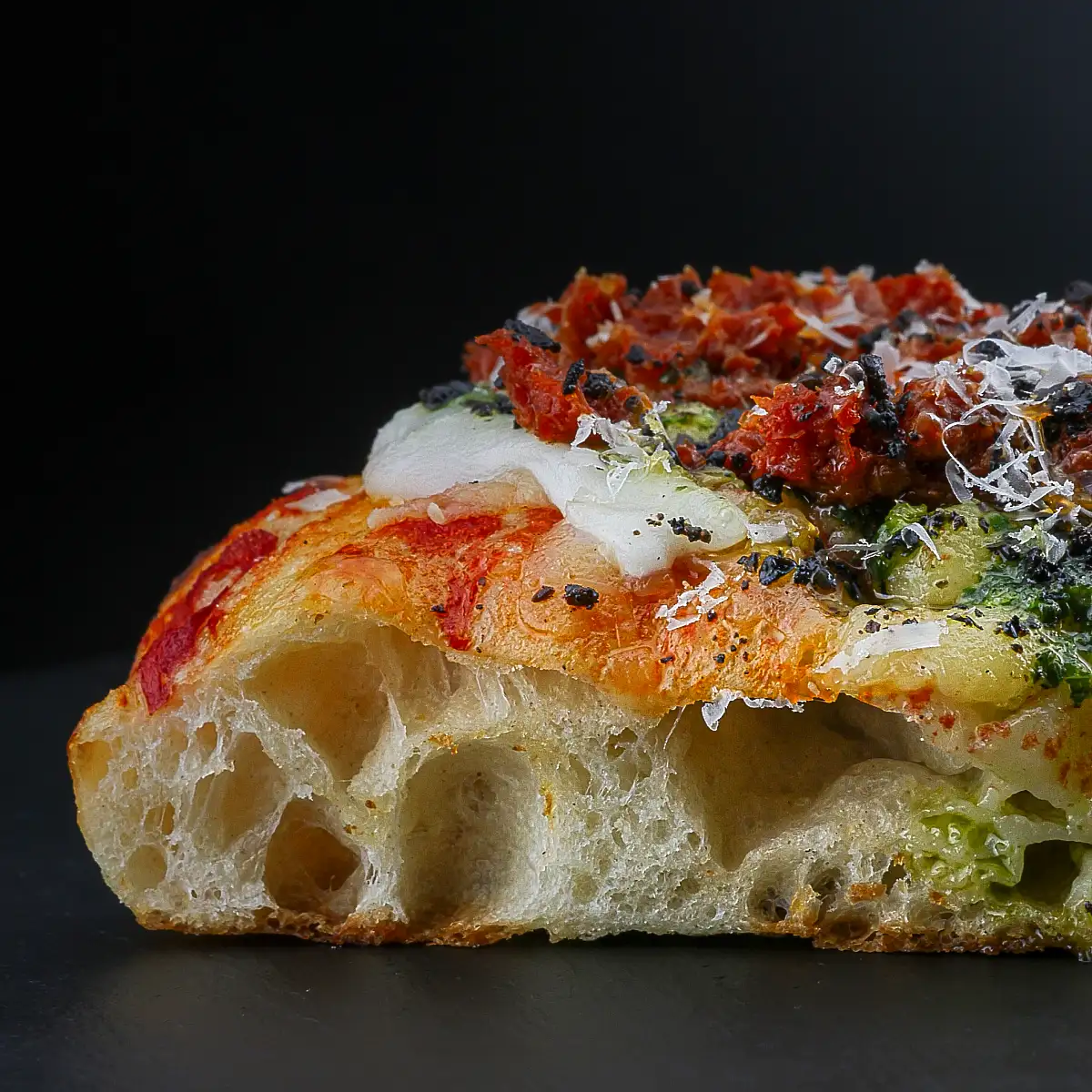
In pizza, for example, there is a huge gap between a dough made to serve quickly and one worked with a long fermentation. The second develops flavor, digestibility, and a much more interesting texture. That combination of croccante on the outside and lightness on the inside does not happen by accident. It is the result of time, knowledge, and patience. And that is valuable.
The focus also matters. There are concepts that want to cover everything and end up without an identity. In contrast, concepts that specialize usually offer a much clearer experience. If a restaurant decides to delve deeper into a specific tradition, such as pizza romana in teglia, stuffed focaccia, or schiacciata, it is saying something important: you are not coming here to eat a diluted version of Italy. You are coming to taste an interpretation with real roots.
The audience's new expectation in Heredia
Going out to eat is no longer just about solving a meal. For many people, especially young couples, groups of friends, and foodies, it is also about choosing a place that provides a topic of conversation. A place with careful aesthetics helps, of course, but it sustains nothing if the dish does not deliver.
That is why a promising opening in Heredia has to offer more than just a pretty menu. It has to give reasons to return. And those reasons are almost always born in the details: a well-made dough, a truly crispy crust, a focaccia with character, a balanced filling, a product that feels hand-crafted and not assembled.
The public also values something else: that the experience has personality. That it doesn't look copied. That a vision is apparent behind the venue, the menu, the language, and the service. When all of that aligns, the restaurant stops competing on price and starts competing on desire. That is where a premium concept gains strength.
Italian restaurant opening Heredia with real specialty
If there is one thing that makes an Italian restaurant opening in Heredia exciting, it is the possibility of finding an uncommon specialty. Not an endless menu, but a precise selection of products that represent a specific and well-executed tradition.
That detail changes the experience significantly. Roman-style square pizza, for example, offers another relationship with dough, crispiness, and sharing. A well-made stuffed focaccia does not compete with just any sandwich. It plays in a different league. And the schiacciata, when worked with respect for the bread and its times, becomes one of those things that surprise even those who think they have tried it all.
This type of cuisine connects very well with a consumer who wants to discover something new without falling into empty eccentricity. There is innovation, yes, but with a foundation. It is not about inventing for the sake of inventing. It is about bringing a more specific part of Italian gastronomic culture and presenting it with superior quality.
That generates a clear effect: the brand becomes memorable. Not because it shouts louder, but because it offers something that is not everywhere.
What is worth observing before choosing where to go
When a new Italian restaurant appears, there are very simple signs that can tell you if the concept has real weight. The first is the clarity of the concept. If everything feels defined, from the type of pizza to the style of the bread and the way the menu is presented, there is a strong identity. If everything seems mixed without criteria, the experience will probably be the same.
The second sign is how they talk about the product. When a restaurant understands what it does, it talks about fermentation, texture, technique, tradition, and origin naturally. Not as an ornament, but as an essential part of its concept. That transmits confidence and, more importantly, usually reflects a better-resolved kitchen.
The third is visual and sensory consistency. A premium Italian product must not only look good. It must have structure, aroma, contrast, and an execution that holds up bite after bite. Mapy people can make something visually appealing. Fewer people manage to make it memorable as well.
And yes, the environment counts. But it counts more when it accompanies. A place with an attractive design adds a lot if the dish is at the same level. If not, the excitement of the opening is short-lived.
When the experience surpasses the novelty
There are openings that work as brief trends. Everyone goes once, posts a story, and moves on. The concepts that stay are different. They are the ones that turn the first visit into a habit because they deliver something the market didn't have or wasn't doing at that level.
In Italian cuisine, that happens when there is baking craft, respect for times, and an aesthetic that does not sacrifice taste for a photo. It also happens when the service understands that it is presenting something special and transmits it with real enthusiasm.
That is the ground where a brand like Bianka® Pizza Romana manages to stand out. Not from the generic promise of "Italian pizza," but from a very clear, proud, and uncommon specialty in Costa Rica. Its strength lies in that identity: pizza romana in teglia, stuffed focaccia, 72-hour fermentation, and a croccante texture that needs no long explanation when it reaches the table. Che buono.
What this trend says about Heredia
That Heredia receives more specialized Italian concepts with interest speaks well of the area's gastronomic moment. There is an appetite for better-built concepts. There are customers who value detail, origin, and real difference. And there is room for brands that do not want to look like all the others.
That also raises the bar. A new opening no longer competes only against other Italian restaurants. It competes against experiences. Against weekend plans. Against places that people recommend because they felt they discovered something. That is the current measure of success.
Therefore, when you hear about a new Italian opening in Heredia, it is worth looking beyond the initial noise. See if there is a concept with a backbone, if the product has technique, and if the experience promises more than just a nice night. When those pieces fit together, you are not facing a trend. You are facing a place you will want to return to hungry and looking forward to it.