Jun 18, 2026
Authentic artisan Florentine schiacciata
There are breads that accompany, and there are breads that steal the show at the table. Handcrafted Florentine schiacciata belongs to the second category. As soon as it comes out of the oven, you can tell by the aroma of well-worked wheat, the golden surface with that olive oil sheen, and the exact sound when tearing it: crunchy on the outside, airy on the inside, with its own character and zero unnecessary filling.
For someone in Costa Rica who is already tired of generic options, this format is easy to fall in love with quickly. It doesn't try to look like something else. It doesn't compete on volume or excess. It wins on technique, texture, and identity. That is the difference between just any flatbread and a piece that truly honors the baking tradition of Florence.
What makes handcrafted Florentine schiacciata special
The word schiacciata comes from "schiacciare", which refers to pressing or flattening the dough. But reducing it to a simple flattened bread would be falling extremely short. In its best version, handcrafted Florentine schiacciata is an expression of craft. It has structure, aroma, beautiful irregularity, and a bite that changes from one edge to another.
In Florence, schiacciata is part of a baking culture where simplicity was never synonymous with carelessness. On the contrary. When a preparation has few ingredients, every detail matters more: the flour, the hydration, the fermentation time, the oven temperature, and the hand that works the dough. There is nowhere to hide mistakes.
That is why a well-made schiacciata feels honest from the first bite. It doesn't rely on exaggerated toppings to impress. Its strength is in the base. In that combination of thin crust, light interior, and a clean flavor that leaves room for the olive oil, salt, and, if applicable, thoughtfully chosen fillings or accompaniments to shine.
Not every flatbread is handcrafted Florentine schiacciata
This point matters. A lot. In the gastronomic market, any baked, rectangular dough runs the risk of being labeled as "handcrafted" just because it looks rustic. But aesthetics alone are not enough.
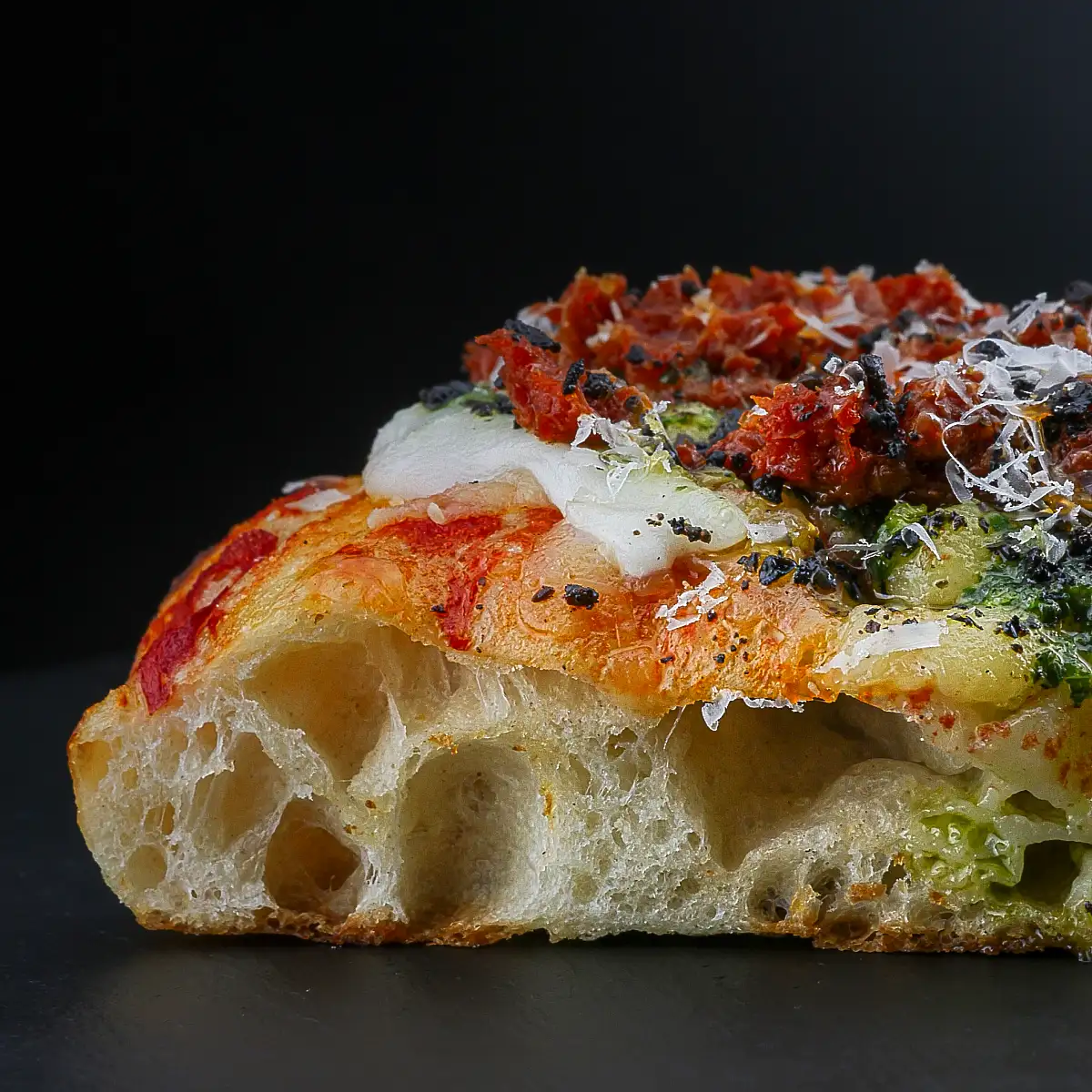
A real schiacciata shouldn't feel heavy or dense. Nor excessively oily, dry, or gummy. The surface may have small indentations, areas more golden than others, and a naturally irregular appearance, but all that is the result of a process, not improvisation. Real craftsmanship is noticed in the consistency of the result, not in the messiness.
There is also a clear difference between a schiacciata designed with technique and a bread that was simply stretched before baking. The first develops flavor. It has fermentation. It has tension in the dough. It has air pockets that speak of time and patience. The second just fills space.
The technique behind the flavor
If something separates a premium offering from an average one, it is respect for processes. In a good schiacciata, long fermentation is not a marketing luxury. It is part of the heart of the product. Giving the dough time transforms the texture, improves the flavor, and allows for a gentler digestion. In addition, it builds that light crumb that opens up naturally, without becoming fragile or crumbling.
Hydration also plays a decisive role. A more hydrated dough can offer a more airy structure and a much more delicate experience, but it demands expert hands. It is not the easy route. It requires control, knowledge, and a well-calibrated oven. That is where you can tell who is replicating a trend and who really masters the craft.
Then there is the olive oil. In handcrafted Florentine schiacciata, it doesn't appear to disguise. It appears to provide aroma, color, and a subtle layer of richness. Well used, it enhances. Badly used, it overwhelms. That balance is part of the charm.
Texture: where everything is decided
The great promise of this format is in the texture. And yes, here it's worth being demanding. Because a memorable schiacciata not only tastes good: it sounds good when biting, yields softly, and leaves a clean sensation in your mouth.
The crust should have a thin resistance, never hard like a cracker. The crumb, for its part, has to be moist but not raw, light but not empty. That contrast is the point. If everything feels soft, it loses personality. If everything feels rigid, it loses pleasure.
That is why this product connects so deeply with those looking for more authentic gastronomic experiences. It has something profoundly satisfying in its balance. It is baker-style, yes, but also sophisticated. Casual in appearance, premium in execution. Che buono.
How to recognize a good schiacciata at the first bite
You don't need to have lived in Tuscany to know if a schiacciata is well made. The product speaks for itself. First, through the aroma. If when bringing it close you perceive toasted flour, olive oil, and well-developed fermentation, it's already winning points.
Then comes the sight. A good schiacciata shows color. It shouldn't look pale or uniform like it came off an industrial line. Its edges can be a bit more toasted, the surface can look lively, and the indentations should look like a natural part of the dough.
Upon touching it, there is another clue. It should feel light for its size. When cut, it ideally offers some resistance at the base and reveals an irregular crumb. If the inside looks like a tightly packed sponge, something went wrong. If it falls apart completely, same thing.
And finally, there is the flavor. The salt must be present, but without dominating. The oil must accompany, not overwhelm. The dough must have its own taste. If everything relies on the filling, then we are not looking at a great schiacciata, but rather just any base.
The value of handcrafted when it truly is handcrafted
Today, "handcrafted" is used for everything. Sometimes too much. But in specialized baking, the word can still mean something grand when backed by technique, time, and criteria.
In a handcrafted Florentine schiacciata, craftsmanship is not a menu ornament. It is a way of working. It means respecting fermentations. It means accepting that each dough responds differently depending on the climate, the flour, and the resting process. It means choosing flavor and texture over speed.
Of course, that has implications. A product made this way won't always be the cheapest or the fastest to produce. And that is fine. The difference is worth paying for because it can be felt. In the quality of the crust. In the lightness of the crumb. In that feeling of eating something that didn't come from a generic formula.
Why this format wins over the foodie public in Costa Rica
There is a reason why more specialized offerings are gaining ground among those who value dining out as an experience and not just a chore. Schiacciata offers real novelty. It is not the same old round pizza by another name. It has its own logic, its own texture, and its own language.
For an urban, curious public with a good eye for the authentic, that carries a lot of weight. It also helps that it is visually powerful. It has presence, character, and that baker look that looks as good on the table as it does in a photo. But the best part is that it doesn't just stop at being photogenic. It delivers where it matters most: in flavor.
In that field, a specialized brand like Bianka® Pizza Romana has a clear advantage. When a kitchen works from niche Italian tradition, it understands that these formats are not menu accessories. They are the stars of the show. And it shows.
Schiacciata, focaccia, and Roman pizza: similar, but not the same
It is normal for them to be confused, because they share a baking family. Even so, each offers a different experience. Focaccia is usually taller and fluffier. Roman pizza in teglia aims for a crunchy base with a structure designed for toppings and al taglio cuts. Schiacciata, on the other hand, occupies a very specific position: thinner than a classic focaccia, more focused on the bite of the bread itself, and with a very Florentine identity.
That doesn't mean one is better than another in absolute terms. It depends on the moment and the craving. If you are looking for more volume and softness, focaccia might win. If the priority is a crispier experience designed as a pizza, the Roman pizza is a strong contender. But if what you want is a piece of bread with soul, elegant in its simplicity and outstanding in texture, schiacciata stands in a class of its own.
When it is worth ordering it
The short answer: when you want to eat something made with true craftsmanship. It works perfectly for sharing, to accompany a table with personality, or to turn a casual meal into a much more memorable experience. It is also ideal for those who enjoy comparing doughs, fermentations, and textures. Yes, there are people who eat that way, and our numbers are growing.
Moreover, it has that rare virtue of feeling special without becoming pretentious. It can fit into a weekday lunch or a more celebratory outing with friends. The context changes, but it doesn't lose its charm.
If you are going to look for one, look for one made by hands that understand tradition and do not simplify it. Because handcrafted Florentine schiacciata, when well executed, doesn't need to exaggerate to stand out. It is enough for it to be what it is: Italian bread with technique, identity, and a crunchiness that leaves an impression.