Jun 20, 2026
Roman Pizza Texture Guide: Real Croccante
The difference is heard before it is explained. When a Roman pizza in teglia is well made, the first bite crackles. There is a croccante base, lightness in the crumb, and a structure that supports real ingredients without becoming heavy. That is the promise of this Roman pizza texture guide: to understand why this pizza feels so different and why, when properly executed, it is incomparable to the usual generic pizza.
In Roman pizza, texture is not a detail. It is the center of everything. It's not just about it being crispy. It's about achieving a precise contrast between a golden exterior and an airy interior, with a clean, light, and deeply satisfying bite. Che buono when it happens that way.
What defines the texture of Roman pizza
Roman-style in teglia pizza has a very clear identity. Its shape is usually rectangular or square, its dough works with high hydration, and its baking aims for a croccante result on the outside and an open crumb on the inside. This means we are not talking about a soft, elastic pizza focused solely on melted cheese as the only experience. Here, the dough has a real leading role.
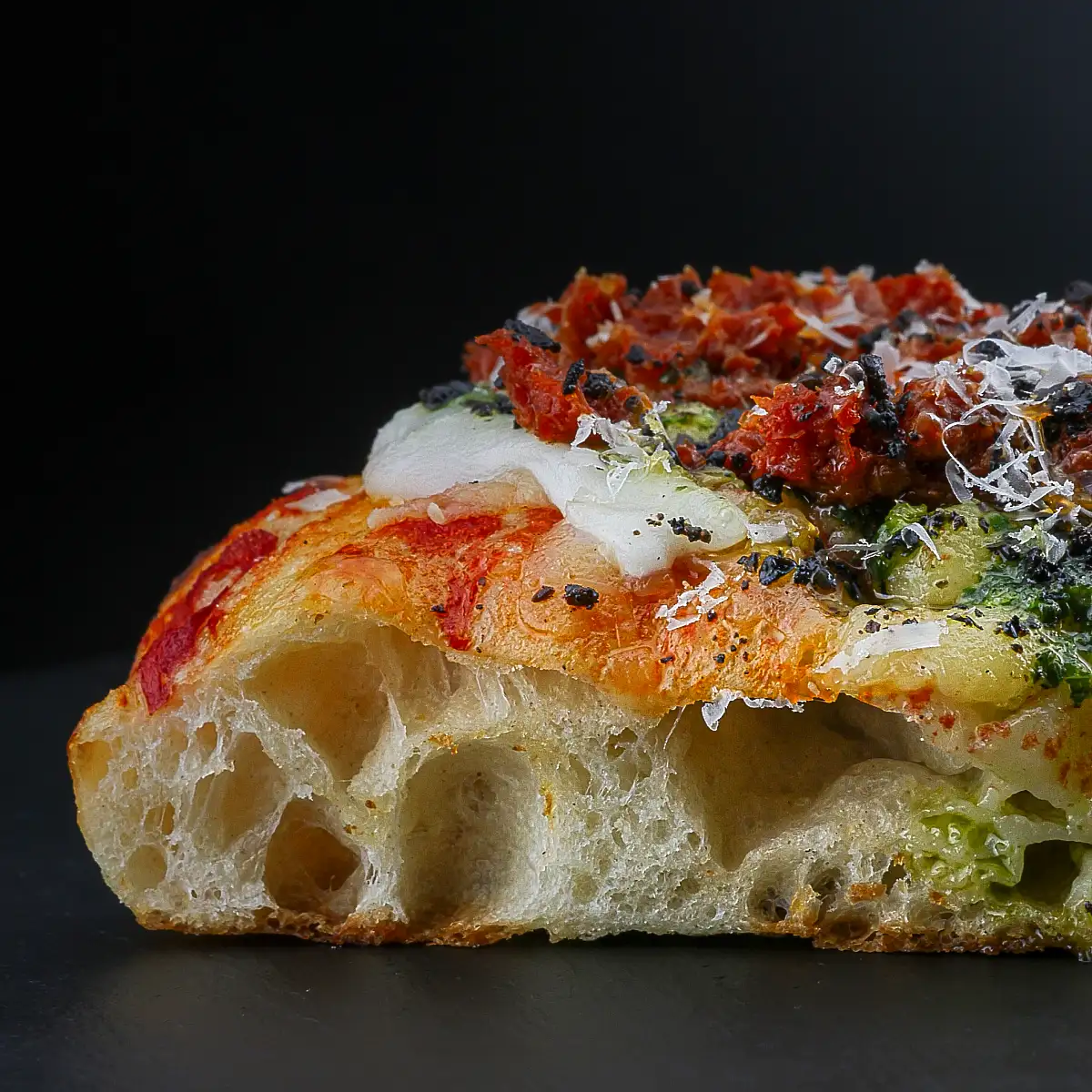
The correct base must be firm without hardening. Upon biting, it has to crack slightly, not sound like a dry cracker nor fold like damp bread. The crumb, for its part, must look alive: irregular, with bubbles, light, almost ethereal. That combination makes a slice feel artisanal, premium, and much more interesting in the mouth.
That is why the texture also communicates class. A well-made Roman pizza speaks of technique, patience, and judgment. It does not happen by accident.
Roman pizza texture guide: how it is truly achieved
Reaching that texture requires concrete decisions. The first is fermentation. A dough with prolonged fermentation, like the 72-hour ones, develops flavor, structure, and digestibility. It also allows for a more complex crumb and a more delicate crust. It is not a marketing trick. It is a difference you can feel.
The second decision is hydration. A Roman dough usually works with more water than a common pizza. That helps form those wide alveoli and that light sensation that makes sure a slice does not feel heavy. Of course, more hydration also complicates the handling. The dough becomes more technical, less docile, and that is where you can tell who masters the craft and who is just improvising.
The third is the baking. The heat must dry the base enough to create croccante, but without punishing the internal moisture. If it goes too far, the pizza loses elegance and becomes hard. If it falls short, it feels raw or gummy. The exact spot is where the magic lives.
Croccante is not dryness
This is one of the most common mistakes when talking about texture. Many people believe that a croccante pizza is simply a hard pizza. No. The croccante of a good Roman pizza is thin, sharp, and light. It breaks well, but does not fight with the teeth. It has a pleasant resistance, not rigidity.
Dryness, on the other hand, kills the experience. A base that is too dry dulls the flavor of the dough, steals the spotlight from the ingredients, and leaves a rough sensation. The best Roman pizza finds that balance where the exterior crunches and the interior remains alive.
That contrast is part of its visual and sensory charm. It looks airy, sounds crispy, and feels refined. Therein lies the difference between an artisanal product and an industrial product disguised as artisanal.
The airy crumb: the detail that changes everything
When talking about pizza, many brands push toppings, stuffed crusts, or excessive combinations. Roman pizza goes another way. Here, the crumb matters. A lot.
A well-developed crumb must be light and open, with visible alveoli and a soft elasticity. It must not look compact or tight. If the slice feels dense, heavy, or doughy, the texture has already lost one of its most valuable attributes.
That lightness also changes how the ingredients are perceived. A stracciatella, a mortadella, roasted vegetables, or a well-made sauce sit better on a base that breathes. Everything looks cleaner, more precise, more elegant. The dough stops being a neutral vehicle and becomes part of the luxury of the bite.
What ruins the texture of a Roman pizza
Not everything that looks like Roman pizza really is. Sometimes the square format is copied, but not the technique. And you can tell quickly.
One of the most common problems is an excess of wet toppings. If the base receives too much sauce, excess cheese, or ingredients that release water uncontrollably, the croccante disappears. The slice loses structure and the crumb gets squashed. More ingredients do not always mean better pizza. In this style, it often means less texture.
Another mistake is cutting or serving too soon without respecting the resting point. A pizza fresh out of the oven needs to stabilize for a few moments so that the structure finishes settling. If handled poorly, the base sweats, the crumb collapses, and the quality of the result drops.
Regeneration also has an influence. A well-made Roman pizza can retain its character if reheated correctly, but if treated like any common slice, it can be ruined. The heat must bring back the croccante without drying out the crumb. That balance always matters.
How to recognize a premium Roman texture
If you want to identify a superior Roman pizza from the very first glance, there are very clear signs. The base must look golden, never pale or oily. The crumb must show irregular cavities, not an even and tight structure. When picking up the slice, it must hold its shape securely. And when biting, there has to be contrast.
There is also a less obvious sign: the clean finish. When the texture is well achieved, the bite ends lightly. It doesn't leave a greasy sensation, it isn't cloying, and it asks for no excuses. That is worth gold to those who truly appreciate a well-constructed gastronomic experience.
In a specialized concept like Bianka® Roman Pizza, that standard is not an accessory. It is part of the product's DNA. Because when a brand says it offers real Roman pizza, the texture has to back it all up.
Why this texture captivates those looking for something different
There is a reason why Roman pizza connects so well with a foodie, curious, and demanding audience. It has personality. It does not try to look like all the others. It feels more technical, more modern, and, at the same time, more faithful to an Italian baking tradition that deserves respect.
For those seeking memorable experiences, texture plays a huge role. It makes the pizza more photographic, more conversational, and more desirable. That croccante base with an airy crumb looks good, sounds good, and tastes better. It doesn't just fill you up. It defines the occasion.
And yes, there is also a matter of personal preference. There are those who are always going to love a softer or more loaded pizza. Perfect. But if what is sought is craftsmanship, structure, real fermentation, and an elegant bite, the Roman style has very strong arguments.
The Roman pizza texture guide in a single idea
If we had to summarize this experience in one image, it would be this: a square slice that crunches just as it enters, then gives way with a light crumb, and ends by leaving flavor, not heaviness. That is the texture that distinguishes well-made Roman pizza. It doesn't depend on a single factor. It is born from fermentation, hydration, dough handling, baking, and the judgment not to overload what is already perfectly designed.
That is why the next time you try a Roman pizza, don't just look at the topping. Listen to the base. Look at the crumb. Feel the contrast. Therein lies the true luxury of this style, and when it truly appears, it becomes hard to settle for less.