Sep 4, 2026
Roman restaurant in Heredia: pizza that tastes like Rome
There are pizzas that are eaten quickly and forgotten just as fast. And there are experiences that begin upon hearing the croccante of a well-baked base, continue with an airy crumb, and end with the desire to order another square. If you are looking for a Roman restaurant in Heredia, the difference lies in looking beyond the usual round pizza: Rome has another way of understanding the dough, the oven, and the craving.
Roman pizza in teglia does not arrive at the table to imitate what is known. It arrives square, light, crispy, and with a personality that is recognized from the first bite. It is niche Italian cuisine, made for those who enjoy discovering products with real technique, texture, and origin.
What distinguishes a Roman restaurant in Heredia
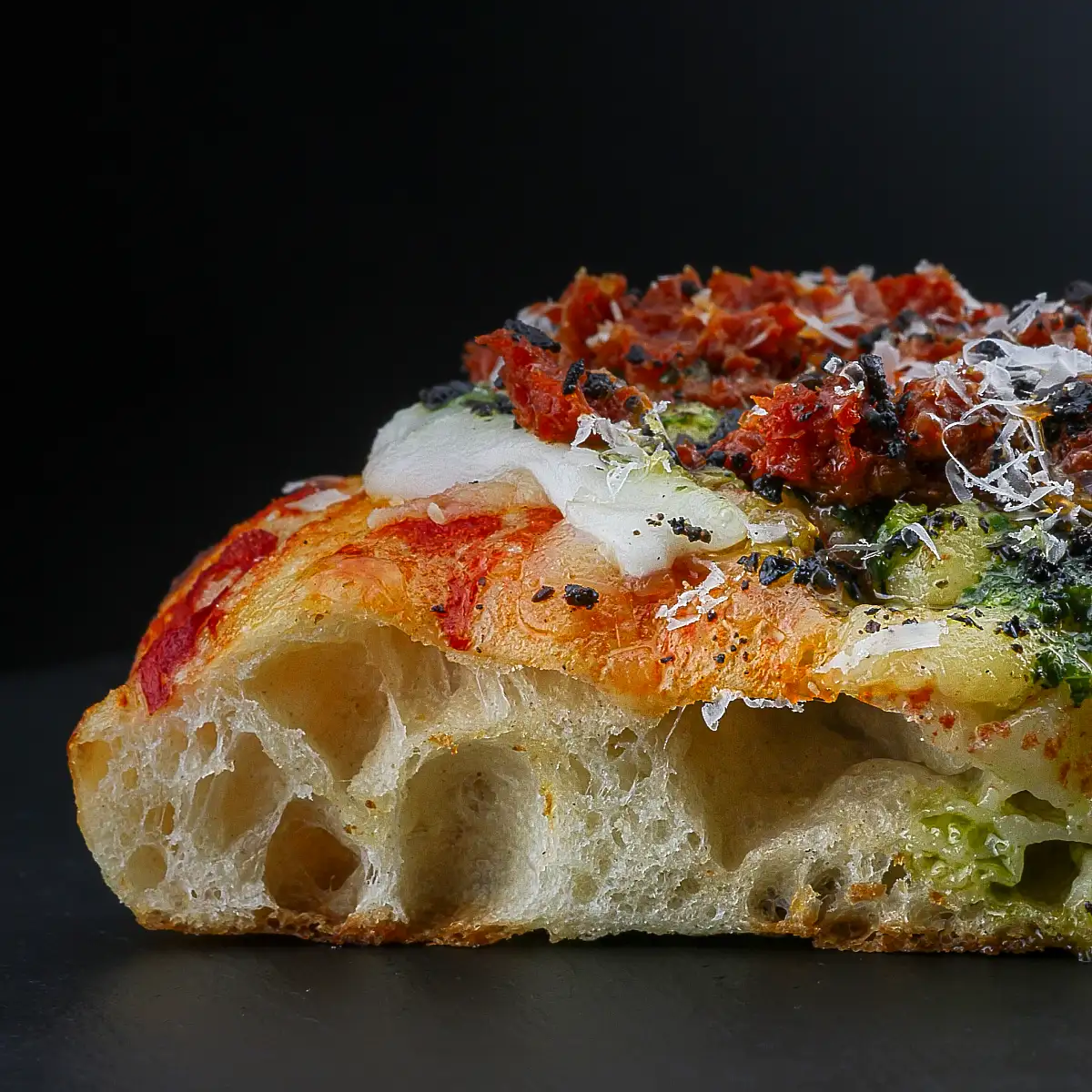
The expression "Italian pizza" covers many regions, styles, and traditions. Not every pizza from Italy is Neapolitan, and not every pizza seeks a high, soft, and round crust. In Rome, pizza in teglia is prepared in a tray, with a high hydration dough that, when fermented and baked correctly, develops a firm and croccante base, a light structure, and a surface full of small bubbles.
That texture is not a decorative detail. It is the point where the craftsmanship is felt. A dough with slow fermentation, like the 72-hour one, has time to develop flavor and a more complex crumb. The result may feel light when eaten, but it does not happen by accident: it requires precision in timing, temperature, handling, and baking.
A true Roman restaurant should not limit itself to putting Italian ingredients on just any dough. Authenticity lives in the technique. In how it is stretched without mistreating the dough. In the balance between crispiness underneath and softness inside. In the decision to use a tray and cut into squares because that format is part of the experience, not an afterthought to look different.
Pizza in teglia changes the way we share
Square pizza has an immediate advantage: it adapts to the table. For a date night, it allows trying two combinations without turning dinner into a negotiation. For a group of friends, it makes it easier to order different flavors and truly share. For a young family, it offers practical portions without losing the feeling of eating something special.
But the shape also serves a culinary function. The tray helps create that golden, crispy base that supports generous ingredients without becoming heavy. Each square has contrast: the snap of the crust, the moisture of the crumb, the flavor of a well-chosen sauce, the correct melting of the cheese, and the character of the toppings.
It is not that one style is better for all occasions. If what you want is an individual, round, and very fast-cooking pizza, perhaps another format fits that craving better. Roman pizza in teglia shines when you are looking for a meal to converse, share, discover, and remember. It has presence. It looks good on the table, photographies incredibly, and, above all, delivers on the palate.
Croccante on the outside, airy on the inside
The word croccante is not just a pretty way of saying crispy. It describes a precise sensation. The base must crack slightly when bitten, not feel dry or hard. The crumb must retain air and elasticity, without turning into heavy bread. That balance is one of the great challenges of this Roman style.
That is why a well-made pizza in teglia does not need to hide under excesses. It can carry intense ingredients, of course, but the dough must still have a voice. When the baker has done their job well, even a simple square feels complete.
Stuffed focaccia and schiacciata: another side of Italy
Sticking only to pizza would mean missing a delicious part of the Italian baking tradition. The stuffed focaccia takes the experience towards a more abundant and comforting format: soft-textured breads, fillings that feel generous, and combinations that work just as well for a different lunch as they do for an informal dinner.
The schiacciata, inspired by Florence, brings another language. It is thinner, marked by a firm crust and designed to embrace ingredients with personality. It has a more direct, almost street-food charm, but with the same respect for a good dough. It is perfect for those who want to get out of the routine without needing a long dinner.
In a Roman- and Florentine-inspired menu, these formats are not fillers. They are an invitation to eat Italy from a perspective less repeated in Costa Rica. There is room for tomato, cheese, and the flavors everyone loves, but also to discover that Italian gastronomy does not fit into a single shape of pizza.
How to choose the experience well
When looking for where to eat Roman pizza in Heredia, it is worth looking for concrete signs. A specialized proposal explains its style clearly and does not try to be everything to everyone. It talks about fermentation, dough, tray, and texture because that is its foundation.
Consistency also matters. The dough must hold the ingredients, the flavors must have intention, and the product has to arrive at its best. Pizza in teglia is made to be enjoyed freshly baked, when the base retains that irresistible contrast between crispy and crumb. Ordering to-go can be a very good idea, especially if the trip is short, but eating at the restaurant allows you to experience it exactly as it was intended from the oven.
The occasion dictates. For a date, a table with several squares and a focaccia to share creates a relaxed experience filled with conversation. For a night out with friends, the ideal is to combine flavors and let everyone try more than one. For an office lunch that deserves an upgrade, a schiacciata can solve it with style and plenty of flavor.
In San Pablo de Heredia, Bianka® Pizza Romana has put this specialty at the forefront: Roman pizza in teglia, 72-hour fermentation, and a proposal that does not seek to look like a generic pizzeria. It is a choice for those who enjoy noticing the difference between eating pizza and encountering an Italian baking culture crafted with intention.
The value of trying something less obvious
Choosing a Roman restaurant is betting on an experience rich in details. The pizza might arrive in squares and not in triangles. The crust might not be what you expected. You might end up talking more about the dough than the toppings. That is precisely part of the charm.
Memorable gastronomy is not always about looking for the most familiar thing, but about trying a well-executed version of something that is not yet part of the routine. Rome has a lot to say beyond traditional pizza, and Heredia already has the space to listen to it with an appetite.
Next time the plan is pizza, request a table or put together the order with sharing in mind. Choose variety, approach with curiosity, and let the first croccante do the rest. Che buono.