Apr 9, 2026
Roman-style pizza in Costa Rica: what makes it special
If you still lump all Italian pizza into the same box, you’re missing one of the most interesting offerings of the moment. Talking about Roman-style pizza in Costa Rica is no longer about a rarity for connoisseurs: it’s about a category with its own identity, unmistakable texture, and a different way of experiencing Italian cuisine.
The difference is felt from the very first bite. It doesn’t arrive in a round, predictable format meant to go unnoticed. It comes with structure, with a crust that crackles, with a light dough inside and a personality that doesn’t need to disguise itself with excess. So good. When it’s made well, Roman-style pizza doesn’t compete on volume. It wins on technique, balance, and memory.
What Roman-style pizza in Costa Rica really means
In Costa Rica, many people know Italian pizza in its most common version: round, with a thin or medium base, served whole and meant to be shared in the classic way. Roman-style pizza in teglia plays in another league. It comes from a very precise baking tradition, where the dough matters as much as the topping, and where time is not a detail: it’s a central part of the flavor.
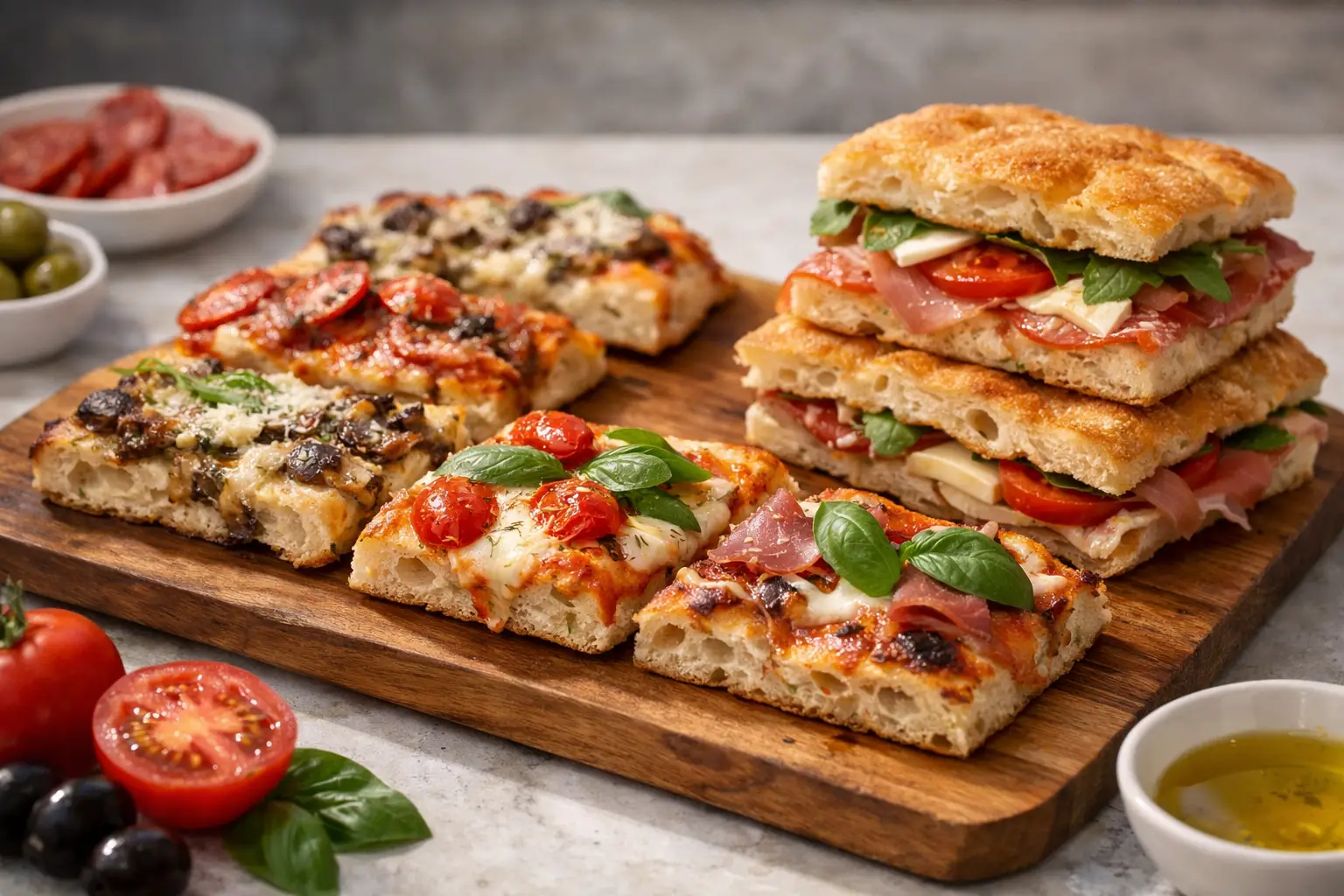
The in teglia version is prepared on a tray, usually in a rectangular or square format. That changes several things at once. It changes the baking, because it allows for a deeply crisp base. It changes the experience, because each slice has a different relationship between crust, center, and topping. And it also changes the perception of quality, because when a dough ferments patiently and is worked with technique, the result shows without needing much explanation.
That’s why, when someone looks for Roman-style pizza in Costa Rica and expects just any pizza with an Italian name, they’re often surprised. This is not about slapping Italian words onto something generic. It’s about respecting a style that has its own logic, craftsmanship, and a level of detail that elevates casual food into a much more interesting experience.
Texture changes everything
Some pizzas win you over with quantity. Roman-style pizza wins you over with texture. That’s one of the reasons it connects so well with an urban audience that no longer just wants to eat well, but to try something with character.
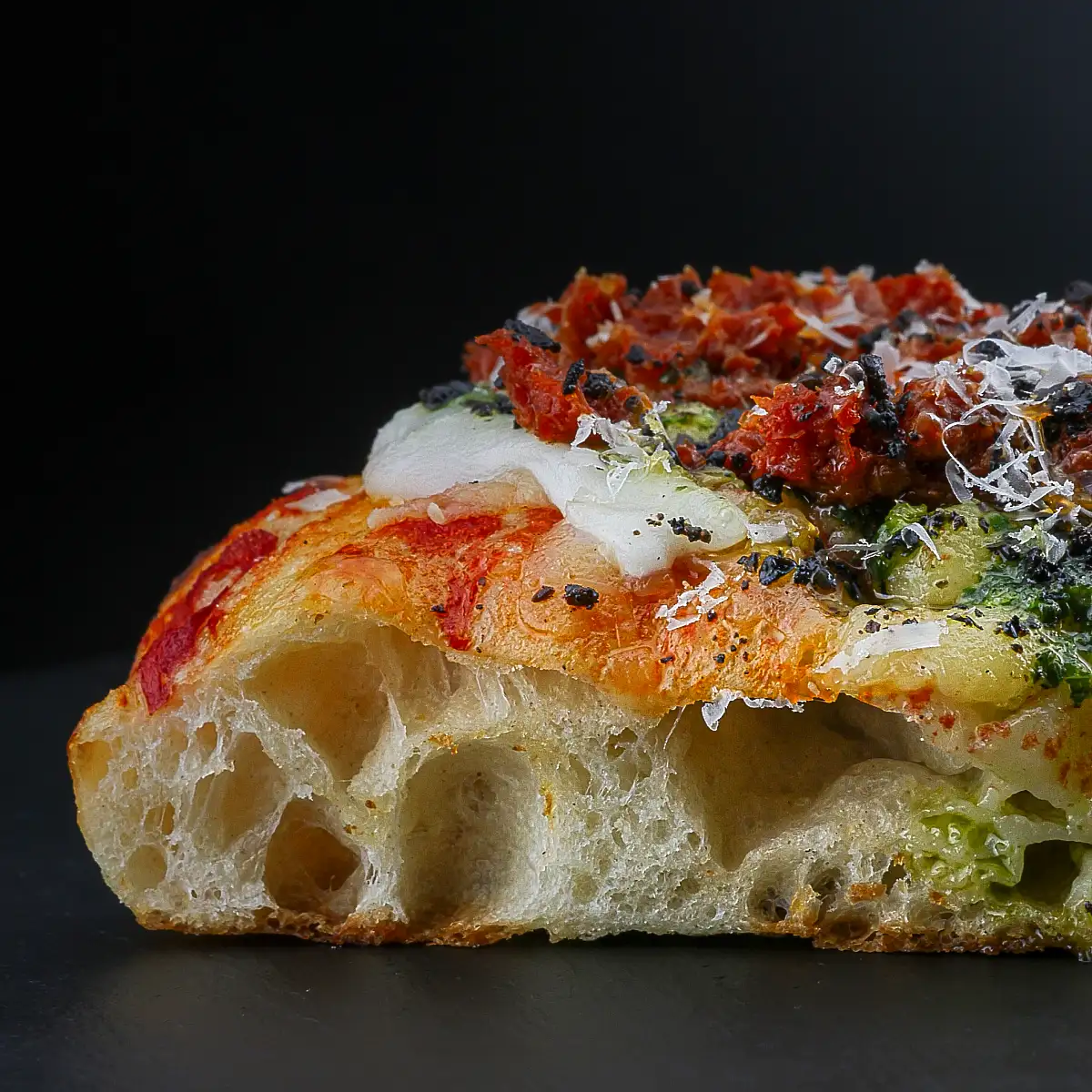
The right base has real crunch, not a dry toastiness. It should break slightly when bitten, while still remaining airy inside. That contrast between a firm exterior and a light interior is part of the charm. If the dough ends up heavy, gummy, or overloaded with ingredients, the style loses its appeal.
Here’s a simple truth: not every rectangular pizza is Roman-style pizza. The format helps, but it’s not enough. Technique rules. Long fermentation, carefully managed hydration, precise baking, and toppings placed with judgment. When those elements align, the result has that profile that becomes addictive without feeling excessive.
Why 72-hour fermentation matters
Sometimes long fermentation is used as a slogan. But in this style, it’s not decoration. It’s a decision that affects flavor, digestibility, and texture.
With 72 hours of fermentation, the dough develops greater complexity. It doesn’t taste flat or rushed. It has depth, aroma, and a lighter structure. In addition, it responds better in the oven and achieves that airy interior crumb and crisp base that make Roman-style pizza so special.
Of course, it’s not just a matter of waiting three days and calling it done. Long fermentation requires control, knowledge, and consistency. If the process fails, the dough gives it away. That’s why this kind of offering usually doesn’t show up well executed in mass-scale or under-specialized operations. It requires an almost baker’s eye, more artisanal, more obsessive, and much truer to its origins.
For anyone who values detail, that difference is felt immediately. You eat it and understand that there was craftsmanship behind it. It’s not chance. It’s method.
Not just pizza: a broader Italian oven culture
One of the most attractive things about this category is that it opens the door to a universe that goes beyond traditional pizza. The baking tradition of Rome and Florence includes formats that still feel new to much of the local market, and that’s a big part of the appeal.
The stuffed focaccia, for example, has a different logic. It doesn’t try to imitate a sandwich or remain a decorative bread. When done well, it combines softness, structure, and fillings that respect the dough instead of burying it. Schiacciata, on the other hand, brings another texture and another language. More rustic, more expressive, more closely tied to real Italian baking.
That makes the offering much richer. It’s not about ordering “pizza” as a flat category. It’s about choosing among formats with personality, each with its moment, its texture, and its way of being shared. For a night out with friends, a date, or something different without falling into the obvious, that matters a lot.
What people who choose Roman-style pizza in Costa Rica are looking for today
The customer who comes to this offering is not just looking to solve a meal. They’re looking for something that feels special. Something with history, craftsmanship, and an aesthetic capable of matching the expectation. In a market full of repeated options, real differentiation has become part of the value.
That’s why Roman-style pizza connects so well with foodies, young couples, professionals, and groups who enjoy discovering places with identity. It’s not just about flavor. It’s also about the conversation it sparks, the photography it inspires, and that feeling of having found a place that doesn’t try to please everyone in exactly the same way.
There is an aspirational element, yes, but not an empty one. What is celebrated here is not a pose. It’s a way of doing things better. Less generic. More specialized. More honest to Italian tradition and more exciting for anyone who is tired of the usual pizza.
The best Roman-style pizza in Costa Rica isn’t improvised
Saying “The Best Roman-Style Pizza in Costa Rica” sounds ambitious, and it should. But in this category, the promise only matters if the execution backs it up.
The dough has to have identity. Ingredient selection must add value without breaking the balance. The baking has to be exact, because a few minutes too many or too few completely change the result. Even the way it’s sliced and served affects the experience. In such a technical style, there isn’t much room for polished mediocrity.
There’s also an important point: this is not necessarily the pizza for someone who measures value only by size or by the number of ingredients. And that’s fine. Premium Roman-style pizza speaks to a different kind of consumer, one who understands that quality is not piling on toppings, but building flavor with intention. That clarity of purpose is part of its strength.
A different experience in Heredia
In San Pablo de Heredia, Bianka® Roman-style Pizza has pushed this conversation forward with a clearly specialized offering, focused on Roman-style pizza in teglia, stuffed focaccia, and an execution that celebrates Italian tradition with a contemporary attitude. That matters because it’s not common to find in Costa Rica such a defined concept within this category.
For diners, that specialization translates into something very simple: an experience with identity. Not a generic menu trying to do everything, but a kitchen that knows its territory and works it with confidence. That shows in the product, in the messaging, and in the kind of outing it becomes. More memorable, more conversation-worthy, more worth repeating.
What to expect when you try a good Roman-style pizza
Expect real crunch. Expect lightness. Expect dough with its own flavor and toppings that support it without taking over. Also expect a more artisanal, less standardized experience, where the focus is not on mass production but on doing things well.
And yes, expect surprise too. Because when someone tries a well-made Roman-style pizza for the first time, they often realize they weren’t looking for just another pizza. They were looking for a better reason to go out to eat.
That’s the point. In an increasingly crowded culinary landscape, authenticity doesn’t need to shout, but it does need to hold up. Roman-style pizza arrived in Costa Rica for that reason: to remind us that there are still formats capable of exciting us when they’re made with technique, judgment, and a hunger to do things differently. If you like eating with curiosity, this is a bite worth chasing.