Sep 2, 2026
Roman vs. Neapolitan pizza: which one to choose?
The conversation about Roman vs Neapolitan pizza usually starts with a simple question: which one is better? But anyone who has carefully tried both knows they do not compete on the same turf. One seeks lightness, an inflated crust, and softness; the other wins you over with a croccante base, an airy crumb, and that unmistakable sound on the first bite.
Both are deeply Italian. Both require technique. And both can be memorable when done right. The difference is in what you want to feel at the table: a round, delicate, and flexible pizza, or a square slice with structure, texture, and baker's character.
Roman vs Neapolitan pizza: two ways of understanding the dough
Neapolitan pizza was born to be eaten fresh out of the oven, usually whole and with a knife and fork, or folded with your hands depending on the moment. Its dough is stretched into a round shape, has a thin and moist center, and develops a high crust known as cornicione. That crust is not a decoration: it is an essential part of the experience. It must be light, with visible air pockets, soft when pressed, and lightly charred by the high-temperature oven.
Its cooking is fast and intense. In just a few minutes, the dough takes on color, the cheese melts, and the sauce retains its freshness. The result has subtle contrasts: spongy edges, a more tender center, and direct flavors. A good Neapolitan does not pretend to be crispy from end to end. In fact, too much crispness can steer it away from its traditional identity.
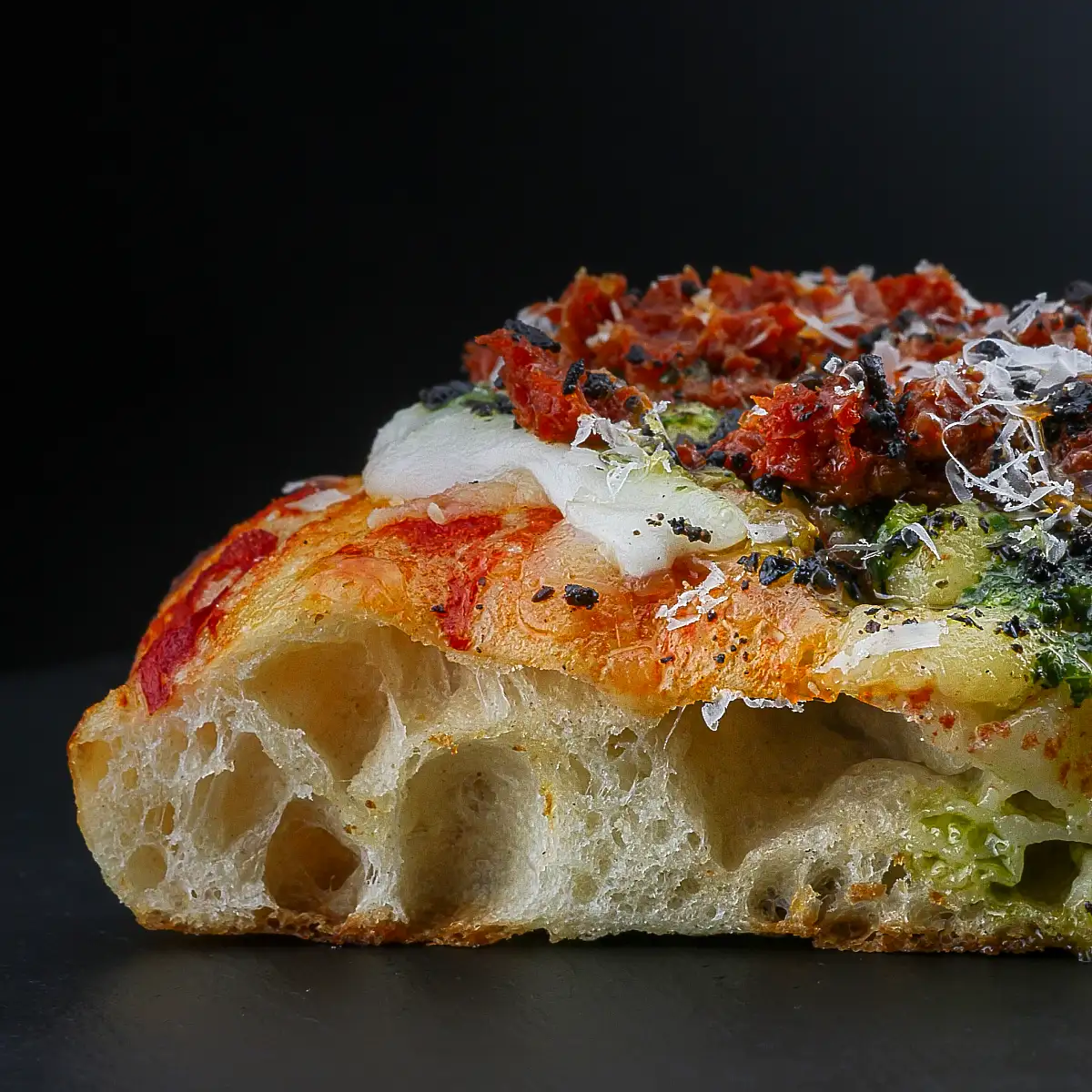
The Roman in teglia pizza follows another logic. It is prepared on a tray, baked in a rectangular or square format, and cut into slices. Here, the dough takes center stage. It is usually crafted with high hydration, long resting periods, and patient handling that builds an open, light, and air-filled crumb.
Below, a firm and croccante base. Inside, a soft texture that doesn't feel heavy. On top, ingredients that have room to express themselves. That combination is the signature of a well-executed Roman pizza: a slice that holds up in your hand, crunches when you bite, and maintains an elegant, never dense crumb.
Fermentation changes everything
It is not enough to mix flour, water, yeast, and salt. Time defines much of the result. Fermentation allows the dough to develop flavor, structure, and a lighter texture. It also requires precision: temperature, hydration, folds, rest, and baking must work as a single system.
In the Neapolitan, fermentation helps achieve an extensible disc, easy to open by hand and capable of inflating quickly inside the oven. The dough must be elastic enough to form the cornicione, but not so resistant that it tears or shrinks when stretched.
In the Roman in teglia, prolonged fermentation allows for handling more hydrated doughs. That is where that crumb full of irregular cavities appears, almost like an artisanal bread taken to its highest expression. The 72 hours of fermentation are not just a pretty phrase for the menu: when the technique is properly applied, you can feel it in the aroma, the flavor, and the lightness of each slice.
That does not mean that every long-fermentation pizza is automatically superior. A dough can rest for a long time and still be poorly balanced, over-fermented, or poorly baked. The quality lies in knowing when to wait and when to act. Artisanal pizza involves science, but also intuition.
Texture: the difference you recognize without seeing the box
If you are served a Neapolitan pizza, expect a softer and more flexible experience. The center may have moisture from the tomato sauce, the mozzarella, and the fast baking. It is a pizza to be eaten hot, without delay, when all the elements are at their exact point.
The Roman in teglia responds with another kind of pleasure. The first bite is croccante. Then, a light, warm crumb with depth appears. The base holds up generous ingredients without collapsing, which is especially valuable when there are roasted vegetables, cured meats, intense cheeses, or combinations with more volume.
The way of sharing also changes. The round pizza is usually an individual decision: each person chooses their pizza or a few are shared among the table. The pizza al taglio or in teglia invites you to try several slices, combine flavors, and build a more dynamic experience. A slice of mortadella and pistachio, another of pepperoni, another vegetarian. Che buono.
Ingredients: less is not always more
The Neapolitan tradition is famous for its apparent simplicity. Tomato, mozzarella, basil, olive oil. When the ingredients are extraordinary and the execution is precise, you don't need much more. The Margherita is proof enough that a few elements can create something massive.
The Roman also respects the product, but opens up a wider field to play with contrasts and layers. Its structure allows for using toppings with greater freedom without losing balance. A good Roman pizza can carry intense, creamy, fresh, or crispy ingredients, as long as each component has a function and is not just excess.
Here, it is best to be honest: more ingredients do not equal a better pizza. An overloaded slice can lose its crispness, hide the dough, and tire the palate. The best combination is the one that lets the base speak, the cheese accompany, and each flavor have a reason to be there.
Which one to choose depending on the moment?
Choose Neapolitan if you are looking for a classic, round, soft pizza focused on the ritual of eating it as soon as it comes out of the oven. It is ideal for those who enjoy the cornicione, the bright sauce, and an experience faithful to the tradition of Naples. It also works perfectly when you want a quiet dinner, with your own pizza and recognizable flavors.
Choose Roman in teglia if you are drawn to artisanal doughs, real crispness, and the chance to try more than one flavor. It is a great option for sharing with friends, for a gastronomic outing, or for those days when you don't want a generic pizza, but one with identity. The square slice has presence, looks spectacular, and, more importantly, delivers when you bite into it.
It is not about declaring a universal winner. There are nights for a Neapolitan with an inflated crust and there are cravings that can only be solved with a properly croccante Roman base. It depends on your hunger, the table, and the texture you need that day.
Roman pizza in Costa Rica has another energy
In a market where round pizza is familiar, Roman in teglia arrives with a different proposal. It is not a superficial variation or a pizza cut into squares for convenience. It is an Italian baking tradition with its own technique, its own timing, and a personality impossible to mistake.
That is why, at Bianka® Pizza Romana, the experience starts from the dough and its 72-hour fermentation. The goal is not to imitate what is known, but to bring to San Pablo de Heredia a more specialized way of eating pizza: square, artisanal, generous, and absolutely croccante.
Next time you have to choose, do not just think about sauce and toppings. Ask yourself what you want the dough to do: hug the ingredients softly or break delicately on the first bite? If the answer sounds like croccante, a square slice, and an airy crumb, you already know where to start.