May 31, 2026
Schiacciata vs stuffed focaccia: which one to order
There are cravings that cannot be solved with just any pizza. When the conversation is schiacciata vs stuffed focaccia, the difference is not just in the name: it is in the bite, in the structure of the dough, and in the complete experience. If you are drawn to the authentic, the croccante, and what truly tastes of Italian tradition, understanding this comparison completely changes what you order.
Schiacciata vs stuffed focaccia: they are not the same
At first glance, both may seem like close cousins. And they are. They share Italian baking DNA, a fermented yeast dough base, and that ability to turn simple ingredients into something memorable. But saying they are the same would mean missing out on the best of each.
Schiacciata is born with an identity focused more on lightness, dough pressure, and a texture that usually feels drier, crispier, and direct to the palate. Its name already gives a clue: it is a "squashed" dough, worked to achieve a more extended shape and a bite with character. In many Italian versions, especially those inspired by Florence, it works almost as a main bread that embraces fillings without losing its personality.
Stuffed focaccia, on the other hand, plays a different game. Here, there is a more generous, more enveloping, more layered logic. It is thought of as a preparation where the bread and the filling coexist in balance, but with a juicier, softer, or airier sensation depending on the recipe. It does not seek the same structural tension as the schiacciata, but rather a softer, more abundant, and comforting experience.
That is why, when someone asks which is better, the honest answer is: it depends on what you want to feel when eating.
The dough makes the difference
If there is a point where this discussion is won or lost, it is the dough. Not the topping. Not the photo. The dough.
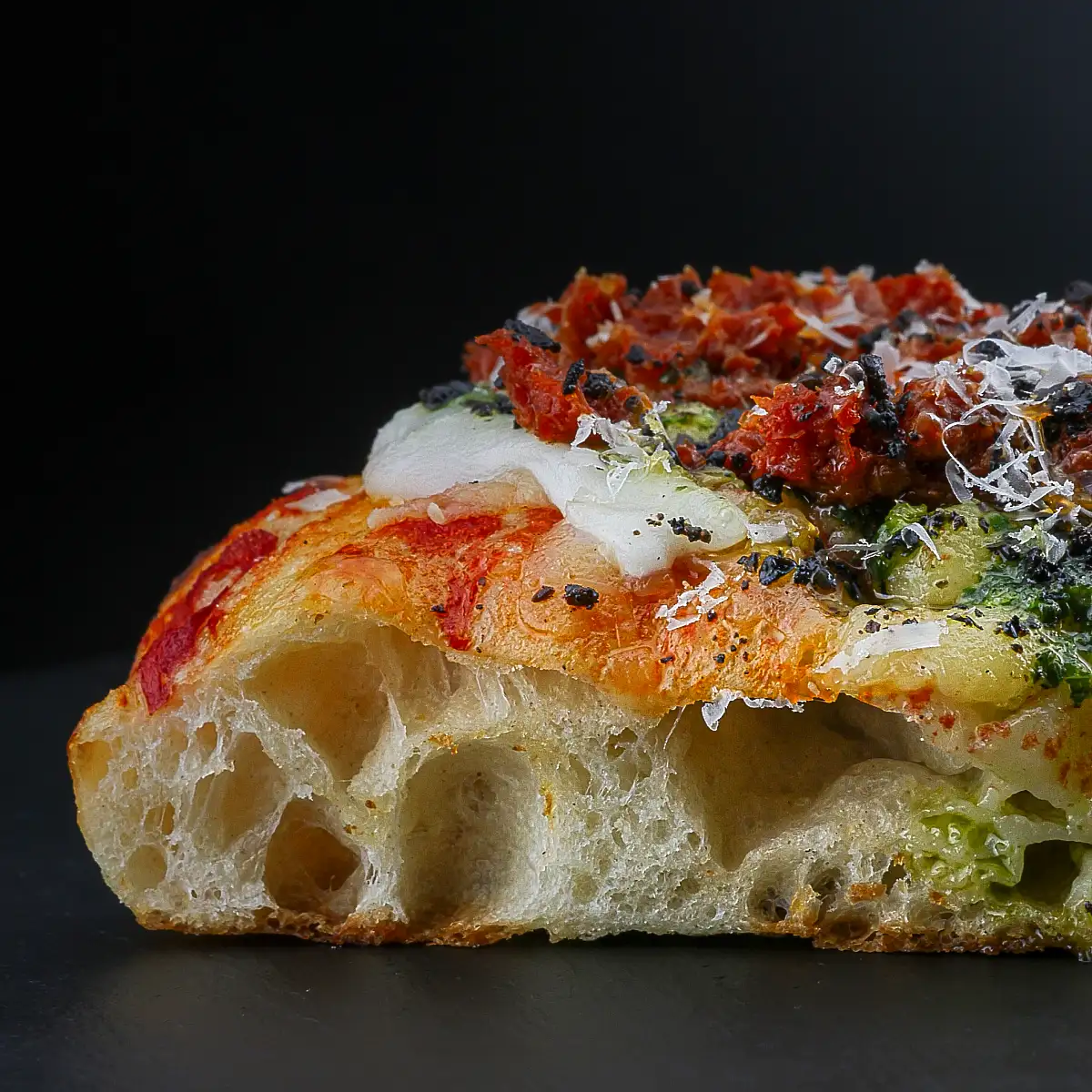
In schiacciata, the structure is usually firmer and more defined. Although there can be variations depending on the baker's technique, it is normal to find a thin or moderately thin base, with a croccante exterior and a less prominent crumb. It is a dough that shines for its tension, for that clean break when biting, and for how it lets the ingredients breathe without turning everything into a heavy bomb.
Stuffed focaccia, for its part, usually starts from a dough with more volume and a hydration that favors a friendlier crumb. When you open it, it feels more like real bread, softer, more pillowy. That texture has clear advantages: it embraces creamy fillings, melting cheeses, and intense combinations without becoming aggressive. It can also feel more filling, more "comfort food," if you will.
Neither of the two is superior by definition. Schiacciata wins you over with precision and crispiness. Stuffed focaccia conquers with abundance and a balance between tenderness and flavor.
What about the filling
Here, the story also changes.
In schiacciata, the filling is usually at the service of the dough, not the other way around. That means the ingredients need real quality, a good cut, and proportion. Italian cold cuts, mortadella, prosciutto, stracciatella, grilled vegetables, or cheeses with character work well because the base does not need disguises. The idea is not to overload, but to build a defined, elegant bite with contrast.
Stuffed focaccia accepts a more generous logic. It can hold more abundant, meltier, more enveloping fillings. The bread protects, absorbs, and accompanies. That is why it lends itself to combinations that feel more substantial. The melted cheese becomes more of a protagonist. Sauces have more room. And the result can be more indulgent, perfect for those who want a rich, complete experience with no half-measures.
This nuance matters a lot. If you are one of those who prefer each ingredient to be clearly perceived, you will probably be more drawn to the schiacciata. If you love that feeling of warm bread with abundant and melty filling, stuffed focaccia has the advantage.
Schiacciata vs stuffed focaccia in texture and bite
Texture defines the memory. Much more than people think.
Schiacciata has a louder bite, drier in the best sense, more croccante. It feels sharper, more precise, with more contrast. There is a particular pleasure in how it breaks, in how it holds the filling without collapsing, and in how it leaves a clean finish in the mouth. It is an ideal option for those who enjoy technical details and recognize when a dough is worked with criteria.
Stuffed focaccia offers another kind of satisfaction. The bite is softer, with more elasticity and more of a fresh-baked bread sensation. Instead of breaking, it embraces. Instead of crunching loudly, it gives way. This makes it very attractive for those looking for a warmer, less tense, and overall more rounded experience.
To put it in a simple image, schiacciata feels sharper and stuffed focaccia pillowier. Both can be spectacular. They just generate different pleasures.
Which is more filling
This question always comes up, and it makes sense.
Generally speaking, stuffed focaccia usually feels more substantial. The amount of bread, the layered structure, and the type of filling often make it perceived as a heavier or more filling meal. This is not a defect. For certain moments, it is exactly what you want.
Schiacciata, on the other hand, can feel lighter, even when it has intense ingredients. Its structure tends to give a less dense feeling. This makes it ideal for those who want to eat something with a lot of flavor, but with a lighter and less overwhelming experience.
Once again: it depends on the moment. A quick lunch looking for something refined and croccante calls for one thing. A relaxed meal, with a big craving and total comfort, may call for the other.
When to choose schiacciata
Schiacciata shines when you want to notice the technique. When you care about the dough as much as the filling. When you are looking for something with real, less common, and more conversational Italian identity. It also works perfectly if you love to share, try different flavors, or eat something that feels premium without falling into excess.
There is also an aesthetic factor that adds to it. Schiacciata has that presence of a special, photogenic product, different from generic offerings. It does not seem improvised. It looks thought out. And yes, that counts when you go out to eat something you want to enjoy with all your senses.
When to choose stuffed focaccia
Stuffed focaccia wins when the craving calls for warmth, volume, and that immediate satisfaction effect that comes from a great combination of bread, cheese, and a well-thought-out filling. It is a great option for those who prioritize a more comforting and abundant experience.
It is also usually the ideal gateway for people who have not yet explored more specialized Italian baking formats. It is familiar, tasty, and easy to understand from the first bite. It does not require context to be liked.
Authentic is not always the best known
In Costa Rica, many people have tried "focaccias" with broad names, adapted versions, or stuffed breads that use Italian references quite loosely. That is why the comparison between schiacciata vs stuffed focaccia becomes so interesting: it forces us to look beyond the generic menu and ask what technique, what texture, and what tradition lies behind it.
When a proposal is well made, it shows. It shows in the fermentation, in the lightness, in the crispiness, in how the filling does not crush the dough, and in that final feeling of having eaten something crafted with expertise. This is precisely the type of experience that specialized brands like Bianka® Pizza Romana have brought to the table in Heredia, raising the standard with a more authentic interpretation of contemporary Italian bakery and pizza. Che buono.
So, which one should you order?
If you want a quick answer, here it is straight to the point: choose schiacciata if you are looking for crispiness, relative lightness, defined structure, and a more refined experience. Choose stuffed focaccia if you want softness, abundance, oven heat, and a more enveloping bite.
But the best answer is another. Try both with criteria. Not as substitutes, but as different formats. Because that is what they are. Two Italian ways of understanding stuffed bread, two valid experiences, and two universes of texture that do not compete so much as they complement each other.
The next time you see these two options in front of you, don't just think about what is inside. Think about how you want the first bite to feel. That is almost always where the correct answer appears.