Mar 29, 2026
Italian stuffed focaccia: what makes it special
There are breads that accompany. And there are breads that steal the table. Italian stuffed focaccia belongs to the second category: a savory bakery piece with character, volume, olive oil fragrance, and an interior that turns each bite into something much more serious than a simple sandwich.
For anyone who's already tired of generic pizza and is looking for a more authentic experience, this format has everything that matters: real technique, memorable texture, and a presence that catches the eye before it finishes winning you over by flavor. It's no coincidence that it's gaining ground among those who know how to appreciate well-made dough, crisp on the outside and airy on the inside.
What Italian stuffed focaccia really is
When people talk about focaccia, many think of a flat bread with rosemary, coarse salt, and olive oil. That exists, of course. But Italian stuffed focaccia goes a step further. It is worked like a living dough, with structure, hydration, and fermentation designed to hold ingredients without losing lightness.
The result should not feel heavy or pasty. A good stuffed focaccia maintains balance: firm base, airy interior, clean cut, and integrated filling. It's not about opening any old bread and stuffing ingredients into it. It's about building layers that respect the dough and elevate it.
In Italy, depending on the region, this universe changes name, shape, and style. In Rome and Florence there are close references such as the schiacciata and other bakery expressions where the star remains the same: artisanal dough + real filling. That detail matters, because here the topping alone doesn't rule. The bakery does.
Why Italian stuffed focaccia tastes different
The difference starts much before the oven. A well-fermented dough develops flavor, aroma, and better digestibility. It also creates that texture you can't improvise: crisp on the surface, soft in the center, and with enough strength to embrace generous fillings without collapsing.
That point completely changes the experience. If the dough is rushed, the result is usually flat, gummy, or excessively dense. If it's well worked, each bite has contrast. You taste the olive oil, the subtle caramelization from baking, and that slightly complex background that only appears when there was time and technique.
That's why a well-made Italian stuffed focaccia doesn't rely on excess. It doesn't need ten ingredients competing. An intelligent combination is enough to shine. Mortadella with stracciatella, prosciutto with arugula, roasted vegetables with Italian cheeses, to name a few classic paths. Less noise, more intention.
Texture is what leads
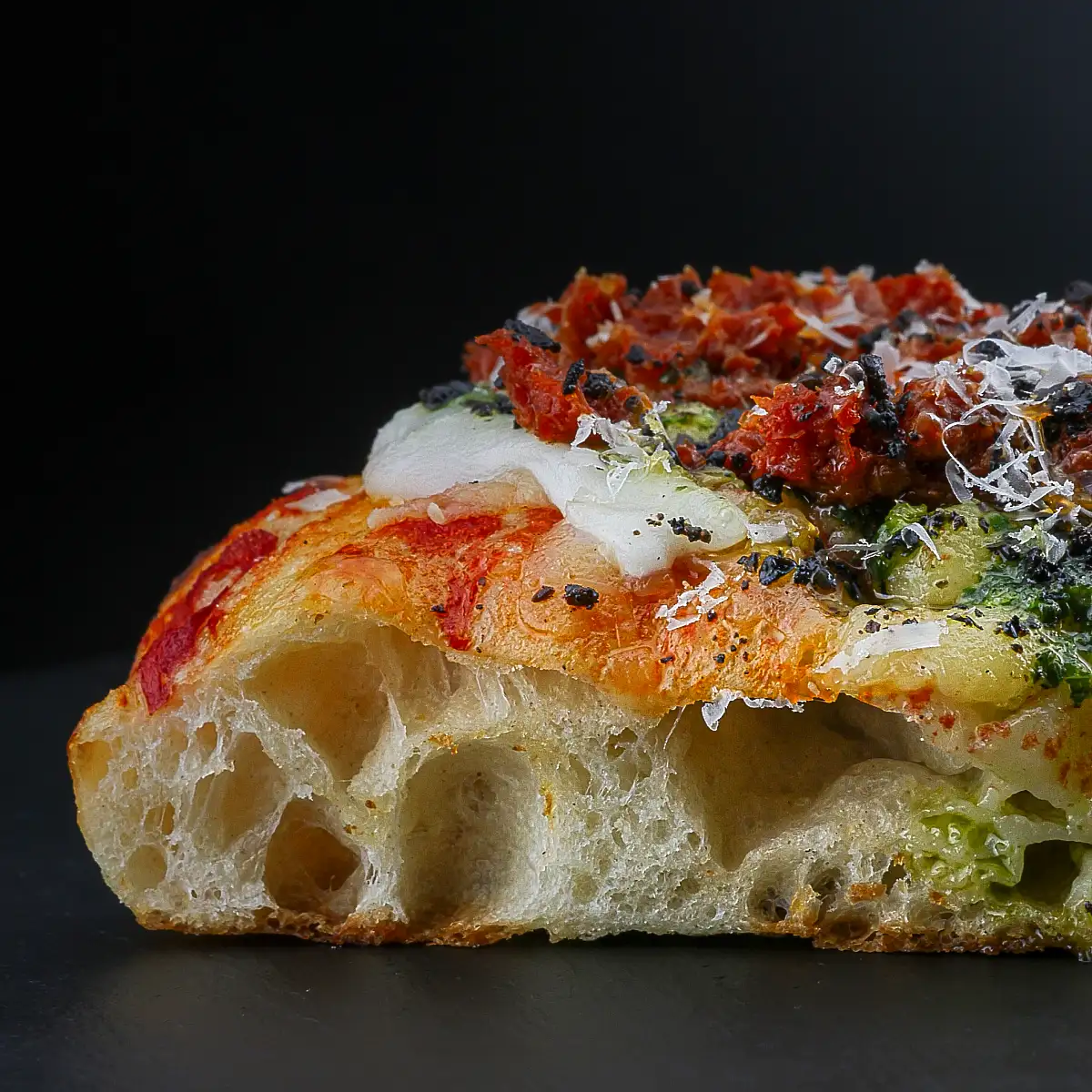
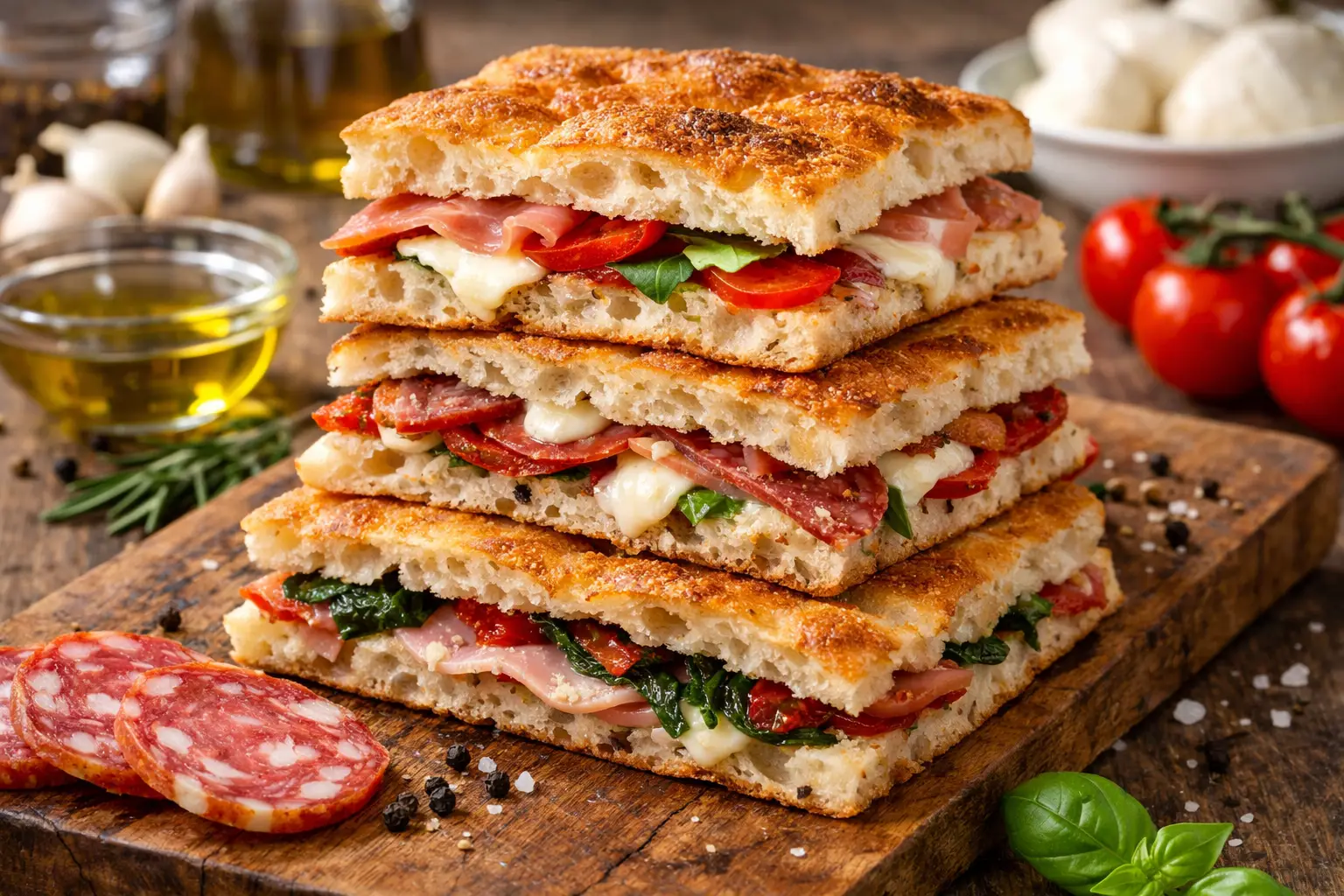
In products like this, texture is not a secondary detail. It's the difference between something correct and something you want to order again. The surface must have color, small bubbles, defined edges, and that golden touch that announces crispness. The interior, on the other hand, has to stay moist, light, and elastic.
That contrast makes Italian stuffed focaccia especially photogenic, yes, but also much more satisfying to eat. There is real pleasure in hearing the crust just barely crunch before reaching a soft center and a filling that doesn't spill over uncontrollably.
There's another key point: balance. If the filling is too wet, it ruins the structure. If the dough is too thick, it hides the flavors. If everything is measured with skill, the piece feels premium from beginning to end.
It's not pizza, it's not a sandwich, and that's its charm
Part of its appeal is that it doesn't fit neatly into a single category. It has something of the pizza world because of its relationship with fermentation, baking, and Italian ingredients. It has something of the sandwich because of its stuffed, practical format. But reducing it to either would sell it short.
Italian stuffed focaccia has its own identity. It's eaten differently, assembled differently, and enjoyed with a different expectation. It's more bakery-driven, more structured, and, when done well, more elegant. It works for a lunch with a serious craving, for sharing, or for turning a casual outing into a plan with more style.
That's why it connects so well with an audience that no longer wants to eat just to get it over with. They want to try something with narrative, with origin, and with a technique you can notice. They want something that looks good, yes, but above all something with substance behind the aesthetics.
What fillings work best in an Italian stuffed focaccia
Not just any combination does it justice. The best fillings are the ones that bring defined flavor without saturating the dough. In Italian tradition, that usually means quality cured meats, cheeses with personality, well-treated vegetables, and sauces used with restraint.
Italian cured meats work especially well because they bring intensity without needing excessive volume. Mortadella, prosciutto cotto, salame, or porchetta find an ideal base in focaccia. Creamy cheeses add contrast, while fresh leaves like arugula or basil lift the whole.
There is also room for more vegetable-based options, as long as they maintain structure and flavor. Roasted eggplant, zucchini, mushrooms, caramelized onion, or sun-dried tomato can deliver spectacular results. The secret is not to turn the filling into a heavy mixture. Here every element should add, not get in the way.
The value of artisanal technique
Talking about Italian stuffed focaccia without talking about process would mean losing half the story. A memorable piece is born from very specific technical decisions: proper hydration, controlled rests, slow fermentation, careful handling, and baking at the right temperature.
That explains why artisanal versions feel so different from quick solutions. The dough develops more personality. The air distributes better. The final color has depth. And the flavor stops depending only on the filling.
When a brand works from that specialty, the experience changes. You notice it in the cut, in the aroma, in the way the focaccia keeps its texture even after being served. In a market full of options that look alike, that precision is worth gold.
Italian stuffed focaccia in Costa Rica: why it's getting attention
The Costa Rican palate has become much more curious. It's no longer enough to offer 'Italian food' in a generic way. More and more people want less common formats, products with history, and proposals that feel authentic, not adapted until they lose their soul.
There, Italian stuffed focaccia has a huge advantage. It's novel for a large part of the market, but at the same time it feels familiar in the best sense: bread, cheese, cured meats, vegetables, oven. It goes down easily, but makes it clear that it's no ordinary thing.
Also, it responds perfectly to what many people are looking for when they go out to eat: something shareable, craveable, premium, and different. Something that looks brutal on the table and that, once tasted, confirms it was worth it. So good.
In that space, specialized proposals such as Bianka® Pizza Romana have helped move the conversation toward a less obvious and much more interesting Italy, where dough has real protagonism and formats like stuffed focaccia stop being a rarity and become a desire.
How to recognize a good Italian stuffed focaccia
You don't have to be a baker to spot quality. You notice it quickly. The crust should look golden and alive, not pale. The base has to support the filling without feeling stiff. When you bite into it, there has to be a slight resistance, not hardness. And the interior can't look like compressed sandwich bread.
It's also worth looking at how the ingredients are integrated. A good Italian stuffed focaccia isn't a messy mountain. Everything is designed so that the first bite and the last one both make sense. If it only tastes like fat or salt, something went wrong. If the dough disappears behind the filling, that's wrong too.
The best sign is usually the simplest: you finish eating and keep thinking about the texture. Not the excess. Not the heaviness. About that precise combination of crispness, air, and well-delivered flavor.
When to choose it
There are meals that serve to get the job done. And there are others that elevate the moment. Italian stuffed focaccia falls into the second category, even though it keeps a practical format. It works for lunch, for a casual dinner, for sharing with friends, or for that craving for something Italian with more personality than the usual.
It's also a great entry point for anyone who wants to explore niche Italian baking without jumping straight into more technical concepts. It's approachable, but it has character. Easy to enjoy, hard to forget.
If what you're looking for is an experience with real dough, well-thought-out fillings, and that exact balance between craftsmanship and pleasure, this format deserves your full attention. Sometimes the difference isn't in inventing something weird, but in doing something that seemed simple extraordinarily well.