Jun 22, 2026
What does deep dish pizza mean
If you've ever seen the phrase that means tray pizza on a menu and thought of just any "large" pizza, there's good news: it's quite a bit more interesting than that. It's not just about the pan in which it is baked. It's about a way of understanding the dough, the texture, and even the moment of eating pizza. When well-made, tray pizza has something that traditional round pizza doesn't always achieve: a croccante base, an airy crumb, and a very clear personality.
What tray pizza means
In simple terms, tray pizza is a pizza that is baked in a rectangular or square tray, rather than directly on stone or in an individual round format. But that definition falls short. In practice, the tray format changes the entire structure of the product.
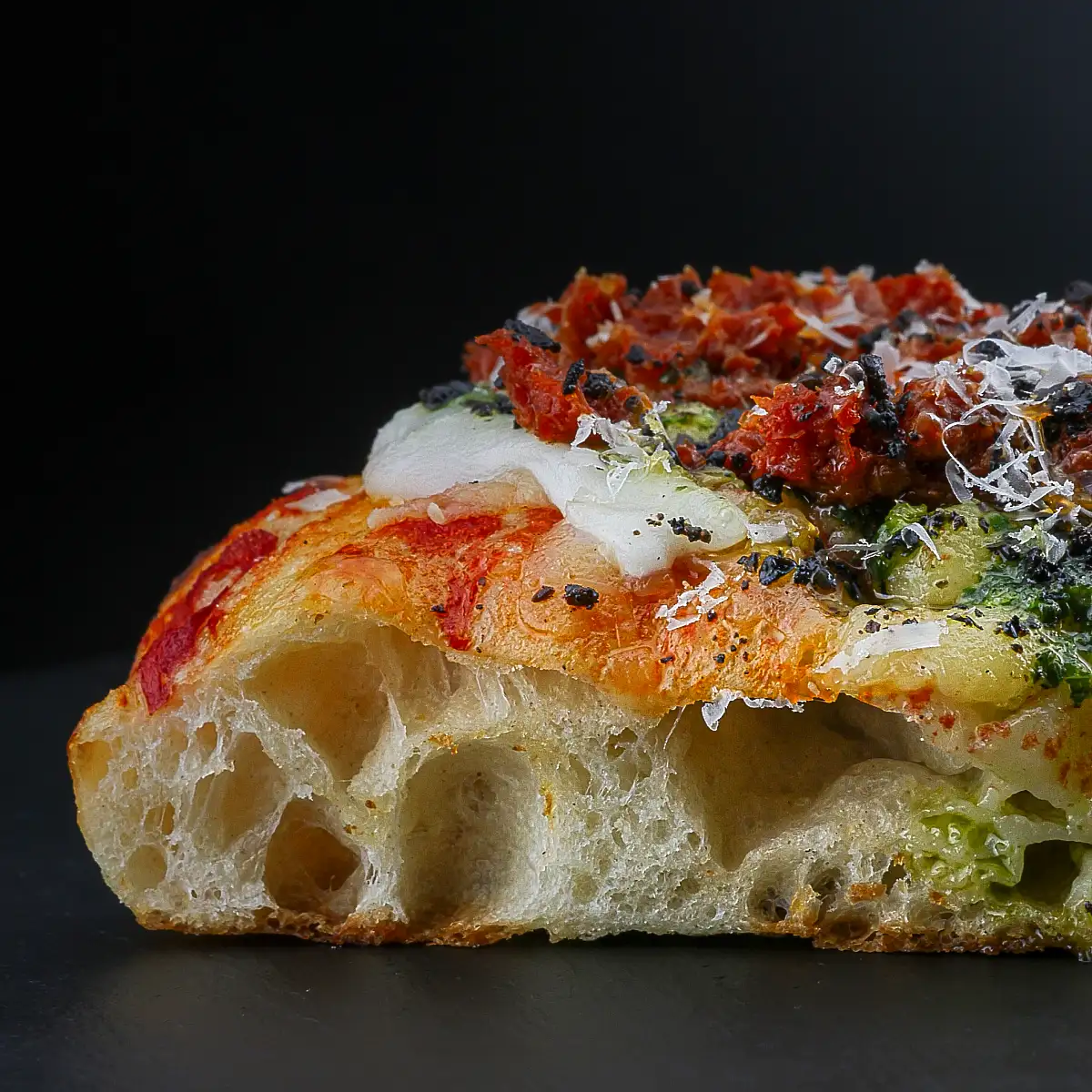
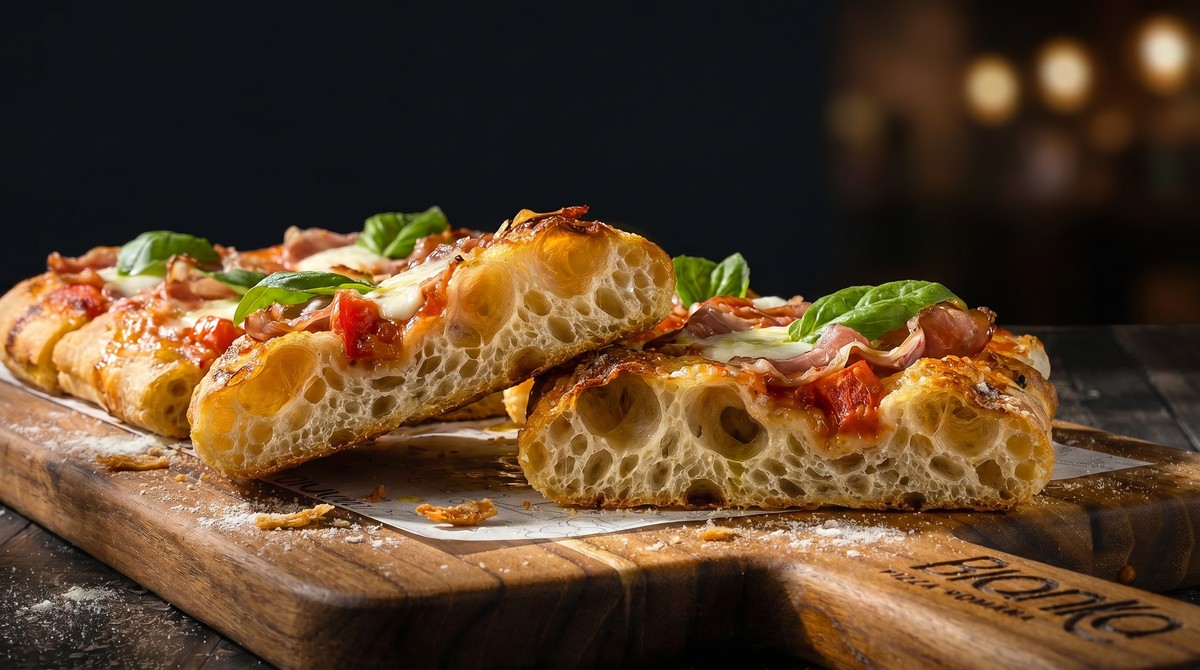
The dough usually has a high hydration, which helps create a lighter texture inside. When baked in a tray, often with oil, it develops a golden and crispy base, while the inside retains volume and softness. The result is not simply a "thicker" pizza. It is a different experience.
That's why, when someone asks what tray pizza means, the correct answer is not just "pizza in a tray." It is a pizza designed to be shared, cut into rectangular slices, and stand out for its contrast of textures. That is where the magic lies.
It is not the same as just any square pizza
This is where it is worth paying close attention. Not every square pizza is a well-understood tray pizza, and not every tray pizza responds to the same tradition. There are breadier versions, lighter ones, some with a highly defined edge, and others with an opener, more delicate crumb.
In Italy, one of the most admired benchmarks of this format is the pizza in teglia romana. "Teglia" means tray. It is a specialty closely linked to Roman baking and to selling by the slice. Its appeal lies in the balance: crispy underneath, airy inside, well-integrated toppings, and a dough that does not feel heavy.
This matters because many people associate tray pizza with school, homemade, or party versions. And yes, that format exists. But when worked with true Italian technique, long fermentation, and controlled baking, tray pizza rises in category with full authority.
The origin of tray pizza has a lot to do with Rome
If you really want to understand what tray pizza means, you have to look at Rome. While Naples took global fame with its round pizza and inflated edges, Rome developed another logic. More bakery-oriented, more urban, more focused on texture and the practicality of cutting by the slice.
Roman pizza in a tray was born from that world where the dough matters tremendously. It is not just any base to throw ingredients on. It is the heart of the product. Proper fermentation, correct maturation, and precise baking make all the difference.
That is why this style usually connects so well with people who are already tired of generic pizza. It has more character. More craft. More conversation. It feels artisanal from the very first bite.
What makes it different in flavor and texture
The most obvious difference is in the bite. A well-executed tray pizza offers a firm and crispy base, but without becoming dry or rigid. On top it can have a generous layer of ingredients, but the dough does not disappear under them. It remains present, with identity.
The long fermentation usually plays a key role. A dough fermented for many hours develops better flavor, easier digestion, and a lighter structure. That is noticeable. Not only on the palate, but also in how it feels after eating.
Another difference is in the cut. The rectangular slices change the sharing experience. It is easier to try various flavors, combine options, and eat in a more casual way, but without sacrificing quality. For dinners with friends, gatherings, or cravings where you want something special, this format makes perfect sense.
Tray pizza does not mean heavy pizza
That is one of the most common misunderstandings. Some people hear "tray" and think of a thick, compact, and heavy dough. Sometimes that happens, of course. It depends on who makes it and with what technique. But in its best version, the opposite is true.
A good tray pizza can be surprisingly light. The key lies in the hydration of the dough, the handling of the yeast, and the exact baking point. If these three factors are well worked, the pizza does not feel heavy. It feels alive, open-textured, and croccante.
This is where the Roman style sets itself apart. It doesn't just seek to fill you up. It seeks to seduce with texture, aroma, and balance. Che buono.
What ingredients work best
Tray pizza accepts many combinations, but not all work the same way. Since the dough takes center stage, the ingredients should accompany it without crushing it. Very wet sauces or excess cheese can ruin the crispiness if not handled with precision.
Ingredients with character and good definition suit it especially well: quality pomodoro, well-drained mozzarella, mortadella, burrata, mushrooms, potatoes, rosemary, prosciutto, zucchini, or white combinations with a more delicate profile. The point isn't to overload just to overload. It's to build layers of flavor.
It also makes highly practical sense in seasonal versions. As it is cut by the slice, it allows for more dynamic offerings and experimenting with toppings that catch the eye without turning each pizza into an excess.
When is it worth choosing tray pizza
It depends on the plan. If you want the classic experience of an individual round pizza, this format does not come to replace it. It comes to offer something else. It works very well when you want to share, try more than one flavor, or experience something a bit more gourmet without losing the comfort of eating pizza.
It is also ideal for those who highly value texture. If you are one of those who always search for a crispy base and dough with real flavor, tray pizza will probably win you over faster than a standard option.
And let's be honest: visually it also has its charm. The rectangular slices, the open crumb, the well-assembled ingredients, and that golden finish make it a very photogenic pizza. But the important thing is that it doesn't stop at the photo. It delivers in the mouth.
What tray pizza means in Costa Rica today
In Costa Rica, the term can still cause confusion because a distinction is not always made between just any rectangular pizza and an offer genuinely inspired by the Roman tradition. That is the detail. Simply changing the shape is not enough to change the level.
When a tray pizza made with long fermentation, careful technique, and a clear vision of the product appears, the market notices. Because it offers something uncommon. A real alternative to the usual mass-produced pizza.
That is why this format has started to attract so much attention among foodies, couples, and groups who want to break the routine. It has novelty, yes, but above all, it has foundation. In a specialized concept like that of Bianka Pizza Romana, that approach becomes even clearer: it is not a trend, it is Italian baking culture brought to detail.
So, what does tray pizza really mean?
It means a pizza where the format is not an accident, but part of the recipe. It means dough with protagonism, a croccante texture, slicing by the portion, and a more bakery-like and refined way of understanding pizza. In many cases, it also means closeness to the Roman tradition, especially when working in the in teglia style.
It won't always be the ideal option for everyone. If someone prefers an ultra-thin pizza or the typical elasticity of certain round styles, they might lean toward something else. But if you are looking for a pizza with more structure, more craftsmanship, and more personality, the tray has plenty of arguments.
The next time you read that name on a menu, don't take it as a technical detail. Take it as a clue. It could be the sign that there is a pizza made with more intention, more craft, and much more flavor than you expected.