May 29, 2026
What goes into a real schiacciata
There is a huge difference between eating just any stuffed bread and tasting something that truly answers the question of what goes into a schiacciata. When it is well made, it is not just about the ingredients. It is about a dough with character, a croccante crust, an airy interior, and fillings that respect Italian tradition without losing appetite or presence.
The schiacciata has that immediate effect of a serious product. It looks simple, but it isn't. Behind it, there is technique, judgment, and a very Italian idea that bread, on its own, must already taste spectacular. The rest adds to it, of course, but the base rules.
What goes into a schiacciata in its traditional version
If we go to the origin, a schiacciata has few elements, but each one matters. The dough starts with flour, water, yeast, salt, and olive oil. Up to that point it might sound familiar, but the result does not resemble any improvised focaccia. The difference lies in the hydration, the resting time, the management of the fermentation, and the baking.
In many Italian versions, especially those inspired by Florence and other areas of Tuscany, the schiacciata is born as a flatbread with a golden crust and light texture. Olive oil plays a central role because it provides flavor, elasticity, and that finish that helps achieve an intense, almost shiny surface, with edges that invite you to break them with your hand before even thinking about the filling.
Coarse salt or salt well-distributed over the surface also counts. It is not there for decoration. It provides contrast and enhances the flavor of a dough which, when well-fermented, has deeper, less flat, and much more memorable notes.
Not everything that looks like schiacciata is
It is worth being clear here. Sometimes any sandwich on flattened artisanal bread is called a schiacciata, and it does not always apply. The name refers to a specific preparation with its own identity. In fact, schiacciata comes from the idea of something pressed or squashed, but that does not mean it is a dry or dense bread. On the contrary, a good schiacciata combines internal lightness with a firm and crispy bite.
It is also often confused with focaccia. They are cousins, yes, but not identical. Focaccia is typically thought of as a thicker, fluffier piece, and often served on its own or with toppings on top. The schiacciata, depending on the area and style, tends to be thinner, more croccante, and more designed to be opened and stuffed.
This nuance matters a lot to anyone looking for an authentic Italian experience and not a generic version with a pretty name.
The dough is the true protagonist
Before talking about mortadella, prosciutto, stracciatella, or grilled vegetables, we have to talk about the dough. Because if the base fails, everything else falls apart. A high-level schiacciata has to feel light, but not fragile; crispy, but not hard; flavorful, but not greasy.
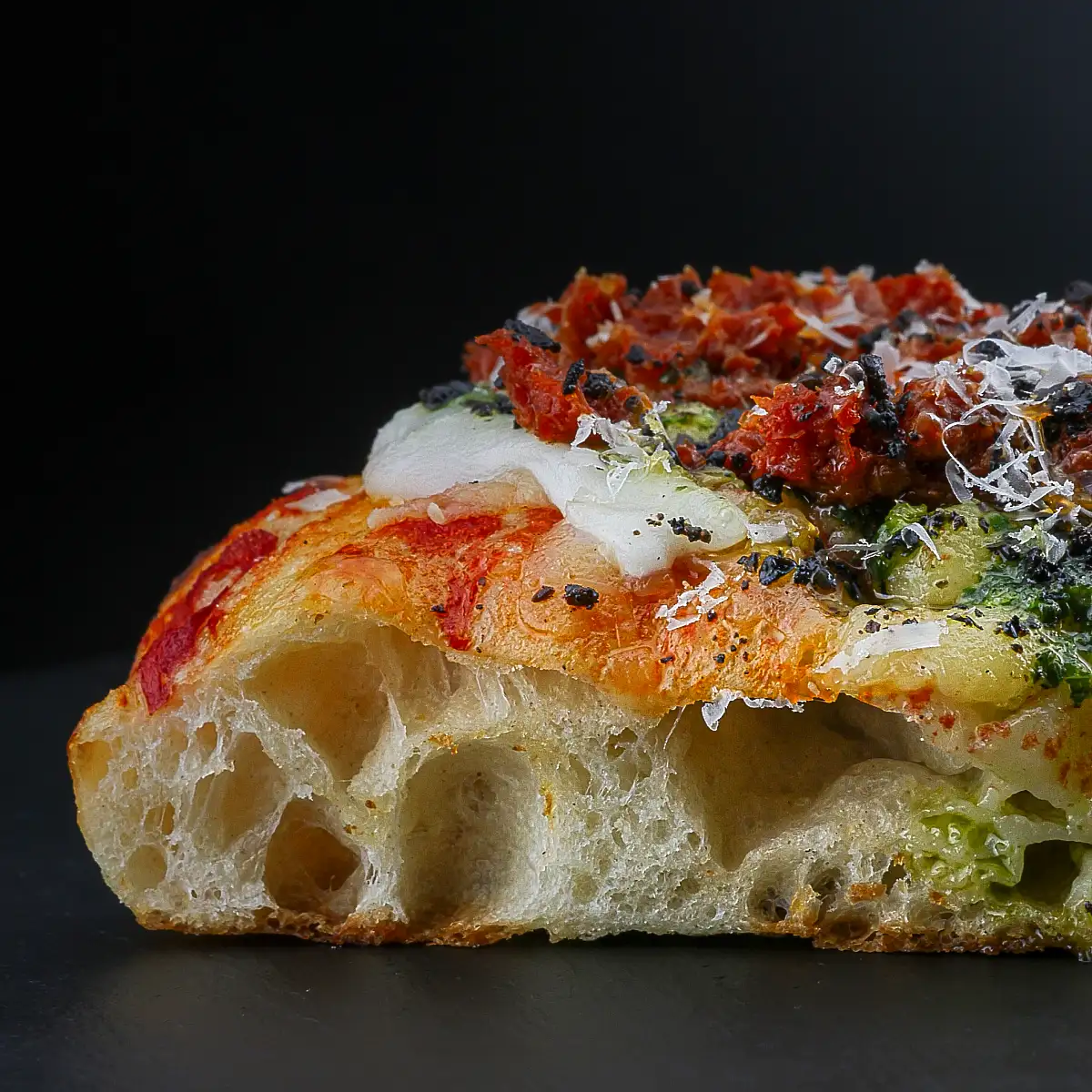
This is achieved with well-crafted fermentation and precise baking. Resting develops flavor and improves texture. Baking defines that much-sought-after contrast between a croccante exterior and an open-crumb interior. And the olive oil, used with judgment, helps the dough have aroma, color, and a more complex bite.
It is no coincidence that in real Italian culinary offerings, so much weight is given to the bread. The schiacciata is not a simple vehicle for putting in ingredients. It is half the experience, or more.
What goes into a schiacciata when stuffed
Once the base is well made, comes one of the most irresistible parts: the filling. Here there is room for creativity, but not for clutter. Italian logic is usually simple: few ingredients, good quality, and balanced combinations.
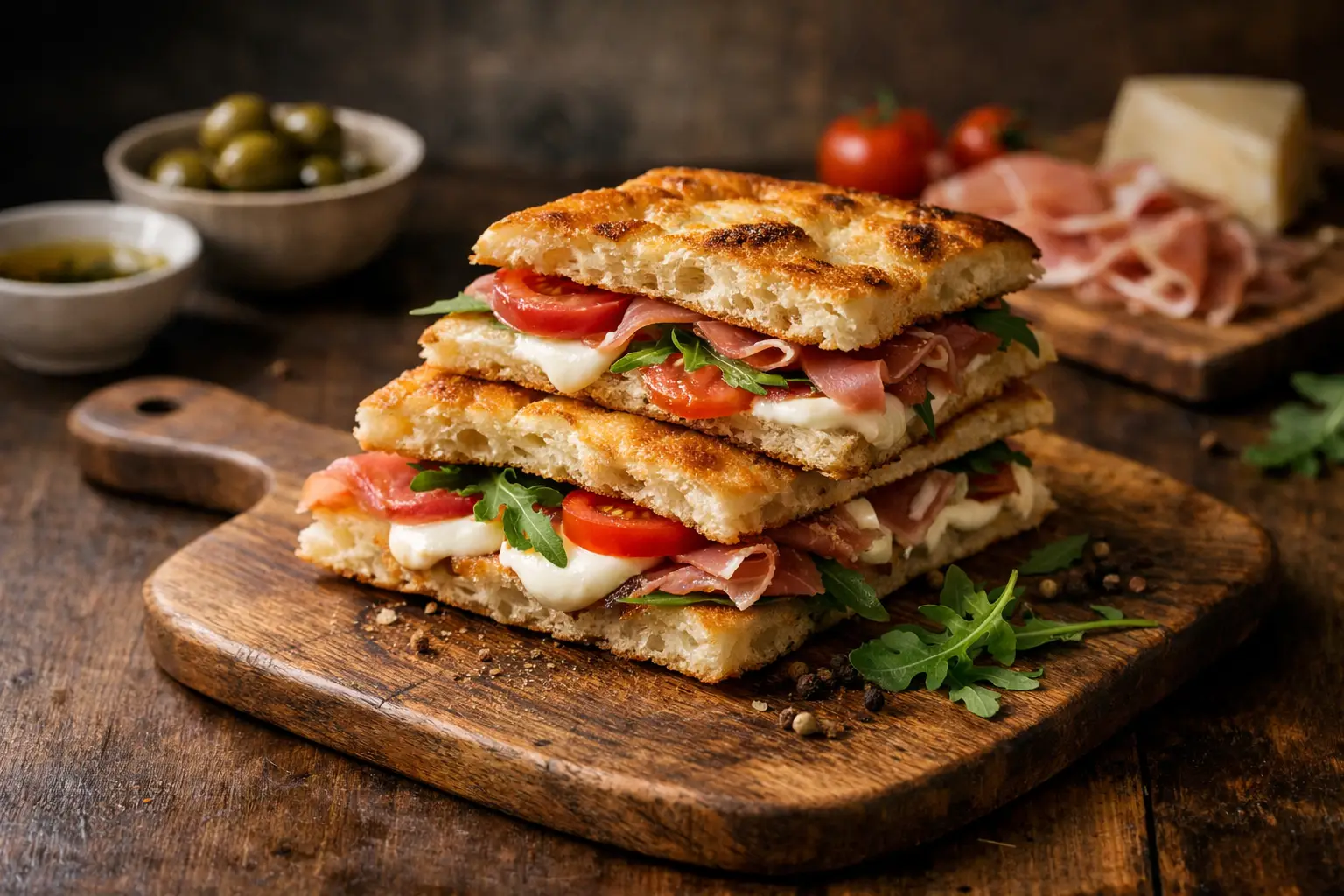
Among the most classic fillings are cured meats like mortadella, prosciutto crudo, salame, or porchetta. To that, you can add cheeses with personality, such as stracciatella, burrata, pecorino, or fior di latte mozzarella. Next come layers that refine the whole: arugula, tomatoes, artichokes, eggplant, zucchini, pesto, truffle cream, or some smooth sauce that doesn't cover up the dough.
The key is to not overload it. A schiacciata does not win by excess. It wins by contrast. The ideal spot appears when the crust remains crispy, the filling feels generous, and each ingredient maintains its identity.
Ingredients that work best
If someone asks what goes into a schiacciata and expects a single answer, the reality is that it depends on the style. But there are combinations that almost always shine.
Mortadella with stracciatella and pistachio works because it mixes creaminess, aroma, and texture. Prosciutto with burrata and arugula offers a fresher and more elegant balance. The versions with roasted vegetables and Italian cheeses are perfect for those who want depth of flavor without resorting to cured meats.
There are also more intense options, with porchetta, baked potatoes, rosemary, or savory creams. And other more delicate ones, where the spotlight is left to a quality mozzarella, ripe tomatoes, and a good olive oil. It all depends on the result you are looking for: heartier, fresher, saltier, or creamier.
What is best to avoid is filling without judgment. If everything competes, nothing stands out.
Texture, aroma, and bite: what defines a good schiacciata
A memorable schiacciata is recognized before the first bite. The aroma of olive oil and baked dough already announces something serious. When splitting it, a slight croccante resistance should be heard. And upon biting, the ideal sensation is that mix of golden crust, airy interior, and well-distributed filling.
It shouldn't feel rubbery. Nor excessively oily. And much less heavy. When that happens, it is usually a sign of poorly worked dough or an assembly that thought more about looking abundant than tasting delicious.
That is why the complete experience does not only depend on what goes into a schiacciata, but on how it is executed. With the same ingredients, two versions can end up light-years apart.
Italian tradition, but with current judgment
Part of the charm of the schiacciata is that it joins tradition and contemporary desire. It has baking roots, regional history, and an aesthetic that feeds the eyes. But it also responds perfectly to what many people look for today when they go out to eat something special: authenticity, texture, artisanal product, and an experience that feels less obvious than a conventional pizza or a standard sandwich.
That is where this format gains ground among foodies, couples, and groups of friends who want to try something with identity. It doesn't just fill you up. It talks to you. It is shared. It makes you crave it again. Che buono.
In Costa Rica, where more generic options dominated for years, well-made schiacciata has extra value. It represents discovery. It is a way of getting closer to a more specific Italy—more focused on baking, more neighborhood-style, and truer to the product.
How to recognize if a schiacciata is worth it
There are clear signs. The first is visual: a good schiacciata has a golden surface, a light structure, and a clean assembly. The second appears to the touch and when cut: it doesn't sink like soft bread nor does it break like dry toast. The third, of course, is in the taste.
If the dough tastes like nothing, something is missing. If the oil dominates everything, there is an imbalance. If the filling soaks the base, the execution was not the best. And if after the first bite the only thing you want is another, you are probably on the right track.
In a specialized establishment, moreover, the intention behind each combination is noticeable. Nothing is placed just because. That is the difference between a passing whim and a schiacciata made with true Italian school training.
More than ingredients, an experience
So, what goes into a schiacciata. It has flour, water, yeast, salt, and olive oil, yes. It has noble fillings, well thought out and with an Italian accent. But it also takes time, technique, and a healthy obsession with the perfect texture.
That is the detail that changes everything. Because when the base is made with respect and the filling accompanies without exaggerating, the schiacciata stops being a pretty stuffed bread and becomes an experience with identity. At Bianka® Pizza Romana we understand this well: the authentic needs no disguise, only impeccable execution.
If you are curious to try a real one, follow that simple rule: look for croccante, balance, and real flavor. When they appear together, you will never settle for less again.