Mar 30, 2026
What is Italian schiacciata and why does it captivate?
If you ever saw a golden, flat loaf, crispy on the outside and full of Italian character, and wondered what Italian schiacciata is, the short answer is this: one of those baking gems that seem simple until you really try them. That’s when everything changes. Because it’s not just baked dough. It’s technique, tradition, texture, and a very Italian way of turning a few ingredients into something memorable.
In a market where many people think that every Italian flat dough falls into the same category, schiacciata plays in its own league. It has identity, history, and a personality that is more rustic, more croccante, and more expressive than other preparations it is often confused with.
What Italian schiacciata really is
Italian schiacciata is a traditional flatbread from Tuscany, especially linked to Florence. Its name comes from the Italian verb schiacciare, which means to crush or press. That idea already says a lot about its shape: a dough stretched by hand, low, irregular, with visible dimples and a surface that usually carries olive oil, salt, and sometimes herbs.
But defining it only by its appearance would be selling it short. Schiacciata has a light crumb, a firm base, and a crust that can range from crispy to delicately crunchy, depending on hydration, fermentation, and the baker’s style. In its most classic version, it is simple. In its filled or reimagined versions, it becomes a complete experience.
The charm lies in that very Italian balance between rusticity and precision. It looks casual, but it isn’t. A good schiacciata doesn’t depend on an excess of ingredients. It depends on a well-worked dough, proper fermentation, and baking that brings out the best in its texture.
The Tuscan origin that explains its personality
Understanding what Italian schiacciata is also means looking at its origin. In Tuscany, and especially in Florence, this bread is part of daily life. It was not born as a luxury product or as a food trend. It was born as real, everyday cooking, deeply connected to traditional baking.
That is why its personality is not pretentious. It is direct. Good olive oil, salt, flour, water, yeast, and skill. That simplicity explains why, when it is well made, it has such an impact. Schiacciata does not need to disguise itself.
It also needs to be said: there is no single universal schiacciata. In Italy, the name can vary in meaning depending on the region. In Tuscany, it is usually associated with this salty, flat, oiled bread. In other places, there may be different preparations with similar names. That detail matters, because it avoids inaccurate comparisons and helps explain why Florentine or Tuscan schiacciata has such a recognizable identity.
Schiacciata vs. focaccia: they are not the same
Here is one of the most common confusions. Many people use schiacciata and focaccia as if they were synonyms. They are similar, yes. Both are baked Italian flat doughs, both can carry olive oil, and both come from a strong baking tradition. But they are not exactly the same.
Focaccia, depending on the area and the style, is usually taller, fluffier, and has a more airy crumb. Schiacciata, on the other hand, tends to be thinner, more defined by hand pressing, and with a crispier feeling when you bite it. It has a less cushioned and more defined structure.
That does not mean one is better than the other in absolute terms. It means they offer different experiences. If you want a dough with more volume, focaccia may be the way to go. If you want a flatbread with more tension in the crust, more rustic character, and a drier, crunchier profile, schiacciata usually stands out.
The way you eat them also changes. Focaccia often works as table bread, a snack, or a soft base. Schiacciata has a very strong vocation for being served on its own, split and filled, or becoming the star without losing its structure.
Texture is the heart of schiacciata
If there is one reason why this product wins people over, it is the texture. Not only because it tastes good, but because it has contrast. And in baking, contrast is worth its weight in gold.
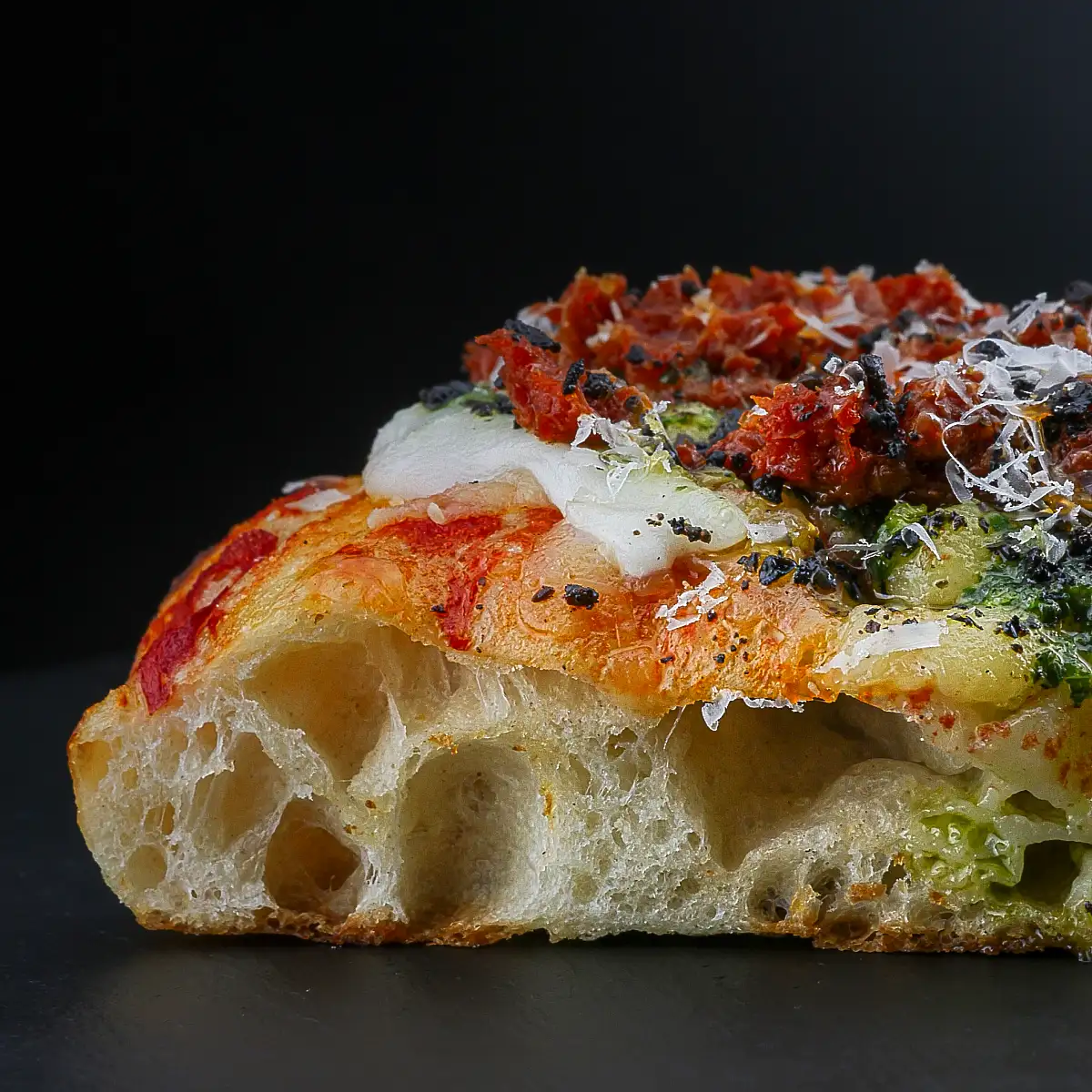
A good schiacciata offers a golden exterior, a surface with oil that enhances aroma and flavor, a light crumb with bite, and edges that can feel intensely crunchy. That play between crispness, air, and elasticity is what makes it so addictive.
Of course, not all schiacciatas are the same. Some are drier and thinner. Others are more hydrated. Some prioritize rustic character. Others aim for a more open crumb. It all depends on the recipe, fermentation time, flour, and oven. That “it depends” does not take away from its value. On the contrary: it shows that there is real technique behind it.
When a dough has a long fermentation, for example, the flavor gains depth and digestibility often improves. When the baking is well executed, that golden crust appears that makes every bite sound and feel satisfying. Che buono.
How to eat it and why it works so well filled
Schiacciata can be eaten on its own, fresh out of the oven, with olive oil and salt. And it works just like that. But one of its biggest charms is how well it holds fillings without becoming heavy or losing structure.
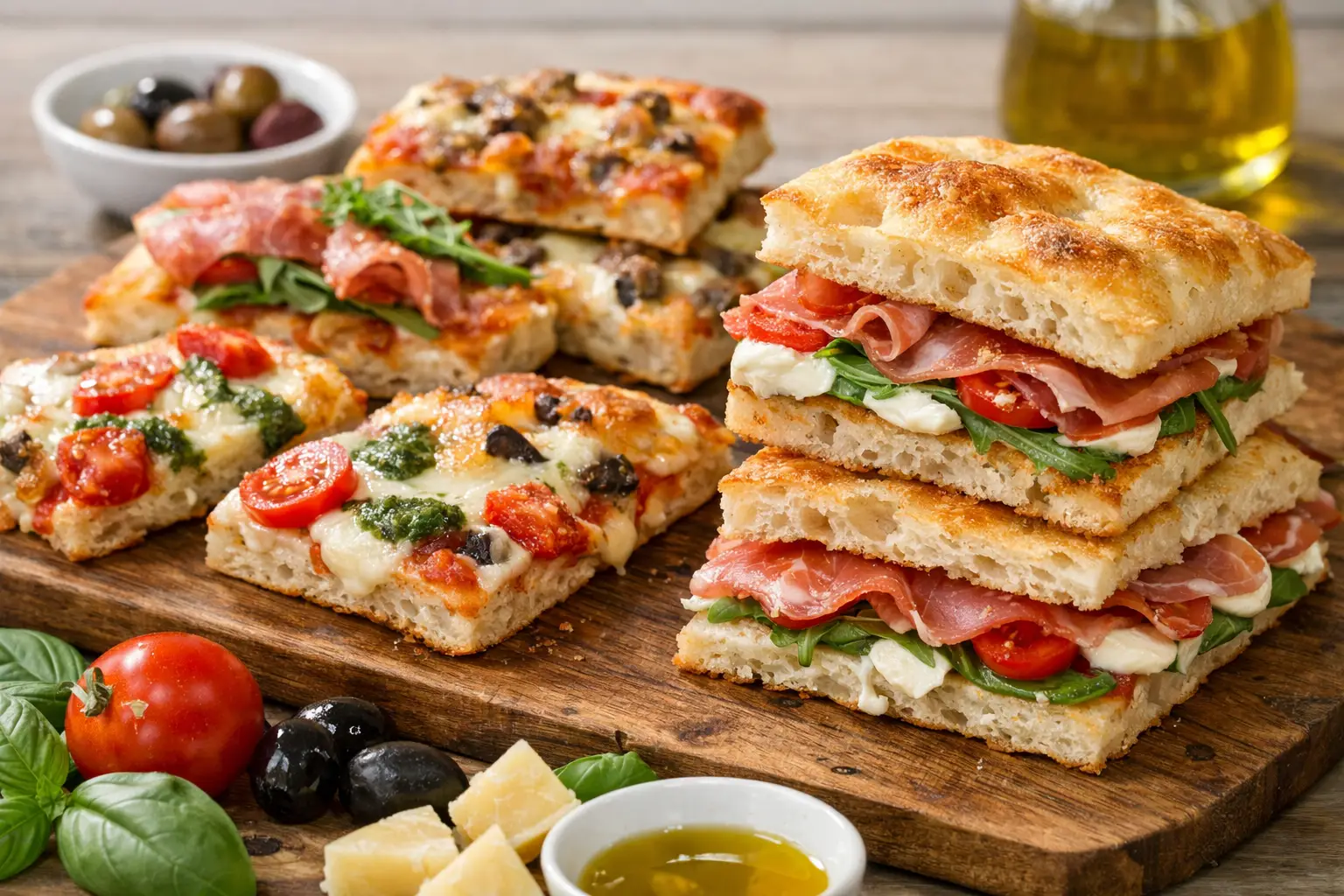
When you open it, its flat and firm shape makes it perfect for adding Italian cured meats, cheeses, roasted vegetables, mortadella, prosciutto, stracciatella, or more creative combinations. The dough does not disappear behind the filling. It supports it, complements it, and adds texture.
That is key. Some breads serve as a vehicle. Schiacciata serves as both a vehicle and the main ingredient. The difference is felt immediately.
That is also why it has become so attractive to people looking for a more special experience than an ordinary sandwich or a generic pizza. It has something of premium street food, something of artisanal baking, and something of sophisticated craving. A winning mix for an audience that truly values authenticity.
Why it is drawing so much attention outside Italy
Partly because people are tired of the predictable. When someone tries a well-made schiacciata, they understand that Italian food is not limited to the traditional round pizza. There is a much broader universe of doughs, techniques, and formats with their own identity.
Schiacciata fits right in there. It is photogenic, yes, but it does not live only on looking good. It has history, texture, and flavor. And that makes it far more interesting than a passing trend.
It also fits perfectly with a consumer who is more curious, more demanding, and less willing to settle for mass-market offerings. Anyone looking for artisanal products, careful fermentation, and premium execution usually connects quickly with this kind of specialty.
That is why in Costa Rica, and especially among those who enjoy discovering food concepts with more craft and less cliché, schiacciata has everything it takes to become a favorite.
What Italian schiacciata is in a contemporary proposal
Today, schiacciata does not live only in the traditional neighborhood bakery in Italy. It also appears in food concepts that understand its cultural value and translate it with respect. That is where it truly shines.
It is not about copying a dough and giving it an Italian name. It is about honoring the technique, caring for the product, and understanding that its appeal lies in authenticity. When that happens, the result feels different. More serious. More flavorful. More memorable.
Into that conversation comes Bianka® Pizza Romana, a proposal that has put on the table a less obvious and much more specialized side of Italian baking in Costa Rica. For anyone who wants to try formats like pizza romana in teglia, filled focaccia, or schiacciata with the level of detail they deserve, there is a clear invitation there.
It is worth trying if you like eating well
Italian schiacciata is worth it for one simple reason: it offers something that is not abundant. It has tradition without becoming rigid, simplicity without feeling basic, and a texture that completely changes the experience of eating baked dough.
If you are drawn to products with history, crispy edges, Italian baking with character, and proposals that feel more curated than improvised, schiacciata is not a foodie whim. It is a must-stop.
And if you were still wondering what Italian schiacciata is, maybe the best answer is not in reading it but in biting into it. Some flavors are understood with the head. This one is better understood with hunger.