Mar 28, 2026
Why Roman pizza is crispy
There is a scene that repeats itself as soon as it reaches the table: someone takes a piece, breaks it with their hands, and you hear that clean crack that needs no explanation. If you've ever wondered why Roman pizza is crispy, the answer isn't in a single trick. It's in a way of making pizza that respects the dough, controls the timing, and understands that texture is also flavor.
Roman pizza isn't trying to be heavy or puffy just to look abundant. It seeks balance. A light base, airy on the inside and crisp on the outside. When done well, that combination completely changes the pizza-eating experience. It's not just about sounding crunchy when you bite it. It's about every bite having structure, character, and that addictive feeling that makes one more slice always seem like a good idea.
Why Roman pizza is truly crispy
The crispy texture of Roman pizza starts with the dough, not at the end. That's the first major difference with other more common pizzas. In the Roman style, especially in teglia, you work with high hydration, long fermentation, and a bake designed to develop a firm, golden base without sacrificing lightness.
That means the dough holds quite a bit of water, but also a lot of control. At first glance it seems contradictory: more water should make for a soft pizza. In expert hands, the opposite happens. A well-hydrated, well-fermented, and well-baked dough develops an open, light crumb, while the outer part turns crisp. The result is neither dry nor hard. It's crispy with elegance.
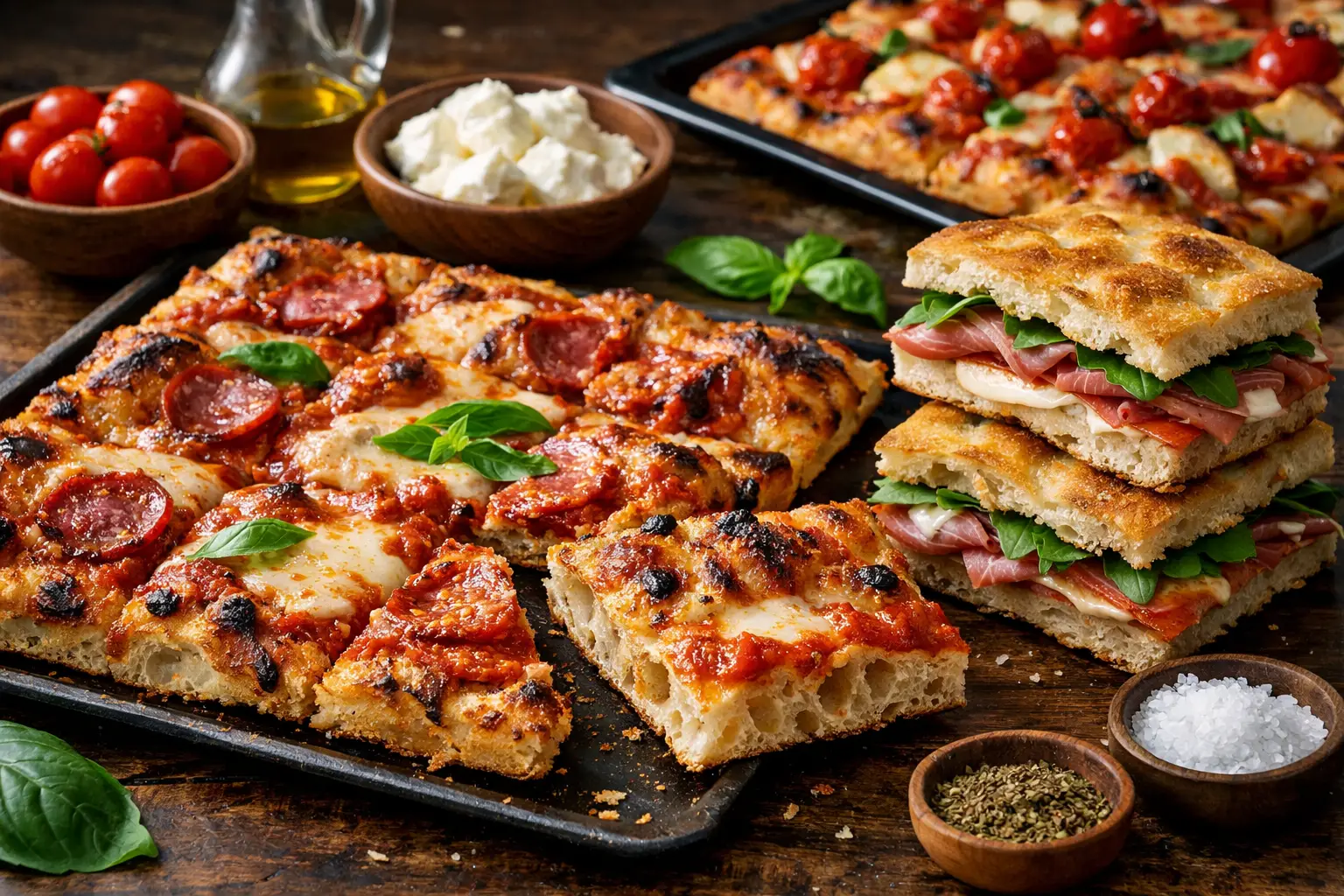
The format also matters. Roman pizza in teglia is baked in a pan, which favors even contact with the heat and a more defined base. That baking helps create a thin, golden, stable crust, ideal for supporting toppings without going limp within a few minutes.
The dough is in charge
If you want to understand why the pizza romana is crispy, you have to talk about flour, water, time, and hands. Not just any dough achieves that level of croccante. Technique matters, a lot.
The flour used in this style must withstand long fermentations and high hydration. That allows gluten to develop in an orderly way, without turning the dough into something heavy or gummy. Then comes kneading and handling. It's not about beating the dough until it tires out, but about building structure with precision.
That's where one of the least glamorous and most decisive secrets appears: resting. A long fermentation, like a 72-hour one, transforms the dough. It improves texture, develops flavor, and helps the pizza have superior digestibility. The dough becomes more complex, lighter, and much better suited to creating that contrast between airy interior and crisp exterior.
That time isn't decoration or empty storytelling. You can feel it in your mouth. When a Roman pizza is well fermented, it's not cloying or heavy. It has a clean bite, a firm base, and a much more refined feel than generic pizza made in a rush.
The oven shows no mercy
There are pizza styles that can survive with a so-so execution. Crispy Roman pizza cannot. The oven determines whether the promise is fulfilled or falls short.
The bake needs enough temperature to evaporate moisture, set structure, and brown the base at the right point. If there isn't enough heat, the pizza comes out pale and limp. If there's too much without control, it burns on the outside and doesn't develop properly on the inside. In a good Roman pizza, the oven works to dry just enough, expand just enough, and brown as needed.
Also, the order of baking changes the result. Some preparations go in with a base first and are then finished with specific toppings. This prevents ingredients with too much moisture from ruining the crunch. Because yes, Roman pizza can carry generous toppings, but never at the expense of texture.
That's a key point. Not every topping pairs with a crispy base if it's added without judgment. Excessive sauces, overly wet cheeses, or poorly handled vegetables can sabotage an excellent dough. That's why, in this style, the selection and timing of each ingredient matter as much as the recipe.
Croccante doesn't mean dry
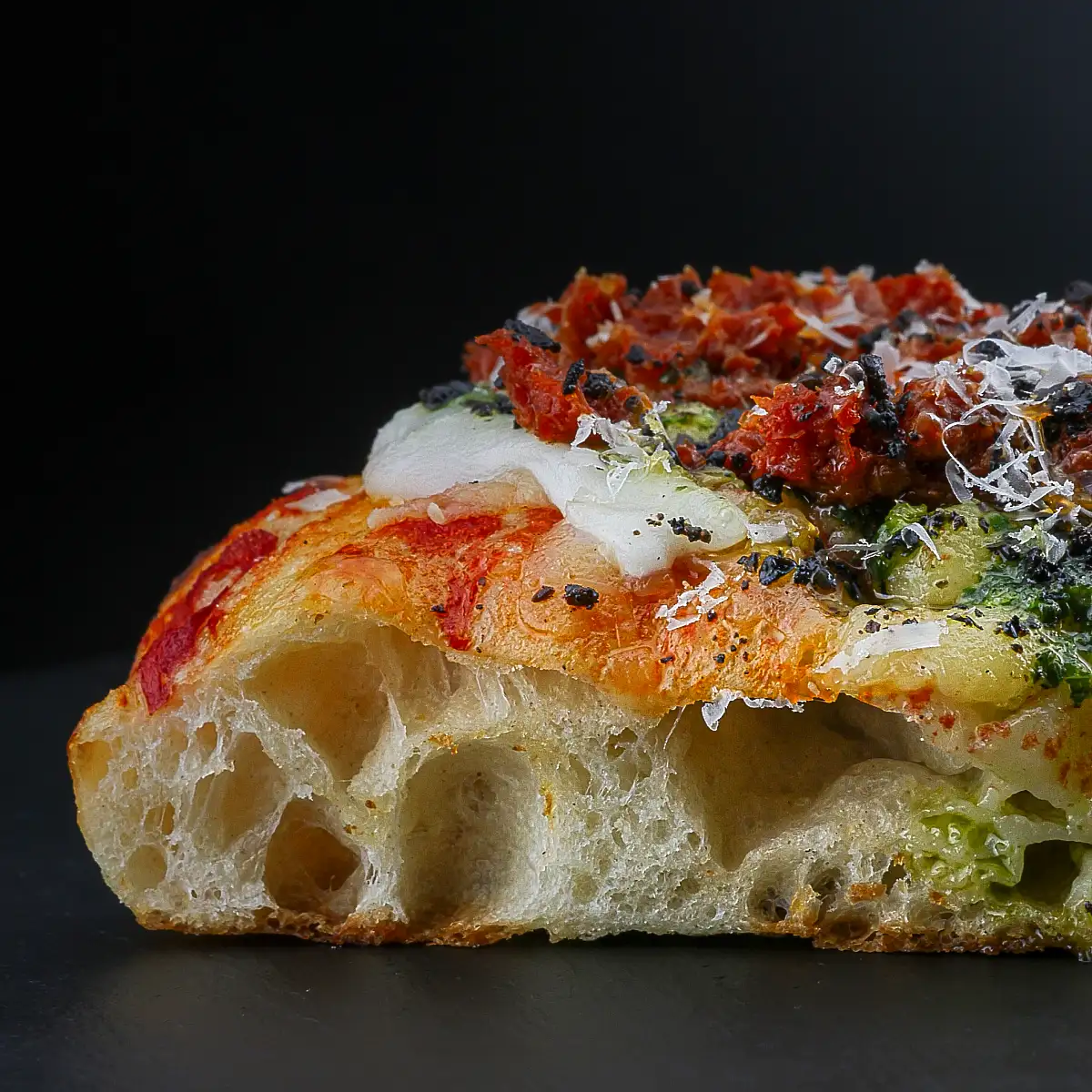
Sometimes crispy pizza is confused with hard pizza. They're not the same. A well-made Roman pizza doesn't feel like a cracker or toasted bread. It has a bite, yes, but also lightness and a crumb with air. The charm is in the contrast.
On the outside, the base offers that thin, golden fracture. Inside, the structure is still alive. There are air pockets, there is elasticity, there is softness. That duality is what makes this style so special. If it were only crispy, it would get tiring quickly. If it were only airy, it would lose personality. The magic is in the middle.
That's why Roman pizza is so enjoyable straight out of the oven. That's when the texture is at its best. Even so, when the dough is well worked, it holds its structure better than many traditional pizzas. It doesn't collapse as easily, it doesn't get soggy in seconds, and it lets you eat a slice with real comfort.
Not all Italian pizzas are after the same thing
Comparing Roman pizza with Neapolitan pizza helps you better understand its identity. Neapolitan pizza goes for a softer dough, with a puffed crust, a more flexible center, and a wetter, softer experience. Roman pizza, on the other hand, goes for definition and crunch.
Neither is better in absolute terms. It depends on taste and the moment. If you want a knife-and-fork pizza, with a delicate center and a more elastic texture, you'll probably lean toward Neapolitan. If you want bite, structure, lightness, and that croccante sound that wins you over from the first bite, Roman has a very clear edge.
There's also an interesting cultural detail. Roman pizza, especially in formats like in teglia or the pizza al taglio, is closely connected to baking tradition. It feels closer to the craft of well-made bread. And that shows in the crust, in the fermentation, and in the way the dough holds everything else.
The artisanal detail changes everything
The real difference is rarely in a single factor. It's in the sum of well-made decisions. Crispy Roman pizza depends on a complete chain: precise recipe, long fermentation, careful handling, the right pan, exact baking, and toppings designed to respect the base.
When one of those steps fails, it shows. Poorly fermented dough can end up heavy. Too many ingredients can kill the crunch. A short bake can leave the base without character. That's why this style doesn't work well when it's industrialized without care. It needs craftsmanship.
And that's where a specialized proposal separates itself from the pack. It's not enough to make a square pizza and call it Roman. You have to understand the technique and defend it consistently. That's the difference between a passing trend and an experience that truly becomes memorable.
In Costa Rica, where for years the conversation revolved more around round, familiar styles, well-executed Roman pizza has something of a discovery about it. It feels new, but not made up. Sophisticated, but not pretentious. It's one of those things that, when you try an authentic version, makes sense immediately. Che buono.
The experience changes from the first bite
Crunchiness doesn't just add texture. It changes how you perceive flavor. A crispy base enhances the contrast with the mozzarella, makes the ingredients feel more defined, and avoids that dense-dough sensation that dulls everything else.
It also makes the pizza more versatile. It works incredibly well in shareable formats, in by-the-slice portions, and in combinations where the dough doesn't disappear under the topping. In a good Roman pizza, the base isn't a vehicle. It's the star.
That's why, when someone asks why this pizza inspires so much obsession, the answer is simple: because it combines technique and pleasure in a way that's very hard to imitate. At Bianka® Pizza Romana, we celebrate it as it should be, with long-fermented dough, croccante texture, and a proposal that feels authentic from the first bite to the last.
If you really like eating well, it's worth paying attention to that golden base that crunches as soon as you lift it. Sometimes, understanding why Roman pizza is crispy ends up becoming something much better than an answer: it ends with a new favorite pizza.