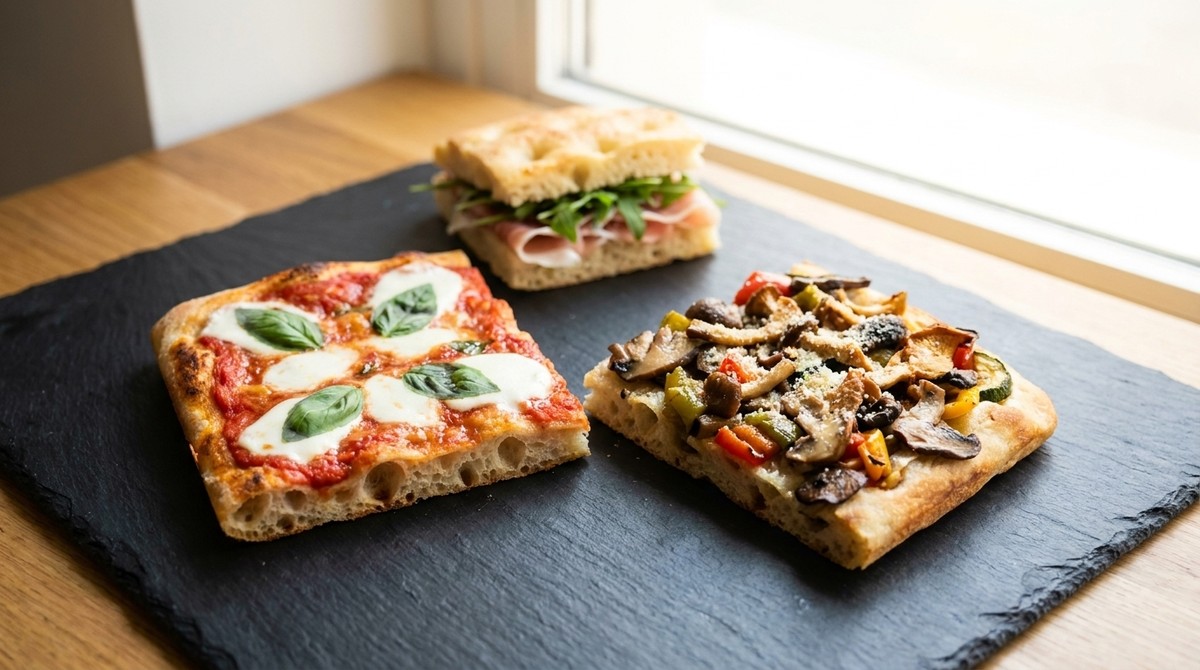
Some lunches take ten minutes and are forgotten before you get back to the office. Others change the pace of your day from the first bite: a croccante base, a light dough, well-chosen ingredients, and an aroma that makes you want to sit down without rushing. An artisanal Italian lunch belongs in the second group.
It isn't about giving Italian names to a fast-food menu. It's about respecting a way of doing things: dough worked over time, patient fermentation, precise temperature, and combinations that let each ingredient speak. In a city where the midday break is usually short, eating something special doesn't have to mean giving up speed. It means choosing better.
What makes an artisanal Italian lunch different
The difference starts long before the food reaches the table. A Roman pizza in teglia or a stuffed focaccia doesn't come from a rushed dough. Its character comes from long fermentation, well-managed hydration, and a bake that goes for contrast: a firm, croccante base, an airy interior, and a light edge.
When the dough ferments for 72 hours, time stops being a technical detail and becomes flavor. The structure develops slowly, the aromas gain depth, and the result feels lighter to eat. It isn't magic or a decorative pitch. It's bakery craft applied to a lunch that deserves more than a generic option.
The format matters too. Roman pizza comes in a teglia, with its square silhouette and a surface that's perfect for generous combinations that stay balanced. It's different from traditional round pizza and doesn't try to imitate it. It has its own personality: more bread-like, crunchier, and more direct in texture.
Schiacciata and stuffed focaccia take the same logic somewhere else. They're ideal if you want a complete, practical lunch with identity, without falling back on the predictable sandwich. Real bread, a filling with intention, and a contrast you can hear when you break it.
Croccante is no small detail
Saying a pizza is crunchy can sound simple. Getting an authentic croccante crunch without the dough ending up dry or hard is another story. The trick is keeping a firm base that holds the ingredients while the crumb keeps its air and stretch. That balance is what makes a bite feel memorable instead of heavy.
A well-made Roman pizza has rhythm. First comes the snap of the base, then the softness of the interior, and finally the flavor of the ingredients. It's a texture that turns a casual lunch into something to talk about, photograph, and repeat.
That's why quality isn't measured only by how much cheese a slice has. It's measured by how the dough behaves, the toasting of the edges, the freshness of a tomato sauce, and the clarity of each flavor. A good combination doesn't need to hide under excess. It needs good product and judgment.
Eating Italian at midday doesn't have to be heavy
There's an idea that an Italian lunch has to be so abundant it leaves you with no energy for the rest of the day. It depends on what you choose and, above all, how it's made. A long-fermented dough with good hydration, in portions meant for sharing or mixing, offers a much more balanced experience.
The key is choosing for the moment. If the plan is a work meeting, a Roman pizza to share lets you eat well and talk without complications. If lunch is quick, a stuffed focaccia or a schiacciata can handle it with more character than any routine option. If it's an outing with friends, several options in the middle of the table turn midday into a small food trip.
Not every lunch should feel light in the same way. Sometimes you want something fresh; other times, a more intense, comforting combination. Artisanal doesn't mean rigid. It means each preparation has a reason to exist, from the base to the last touch of flavor.
Ingredients with something to say
A well-planned Italian lunch doesn't need an endless list of components. In fact, many of the best combinations work because they respect one clear idea. Tomato, mozzarella, roasted vegetables, selected cured meats, herbs, olive oil, and cheeses with personality can create very different profiles when used in moderation.
The tomato should bring acidity and sweetness, not just color. The cheese should melt without erasing the dough. Vegetables need to keep their texture, especially when they go into the oven. And cured meats, when they're there, should add intensity without turning every bite into a salt contest.
That's where the real value of a specialized place shows up: knowing what to leave out. An artisanal Roman pizza doesn't try to impress by piling things on. It wants every element to have a precise place on that croccante base.
For a quick break that still has standards
A weekday lunch comes with real pressure: tasks, commutes, meetings, and little time to decide. But eating fast doesn't mean eating without joy. An artisanal Italian option works especially well because it combines practicality with the feeling of a treat.
It can be the perfect plan to get out of the office, meet someone, or take a break before going on with your day. In San Pablo de Heredia, Bianka® Pizza Romana brings that idea to a concept that's uncommon in Costa Rica: Roman pizza in teglia, stuffed focaccia, and a dough culture you recognize from the first cut.
The difference is that it isn't about filling a slot in your schedule. It's about giving that slot value. A well-set table, a slice with real texture, and an unhurried conversation can do more for your day than another lunch eaten in front of a screen.
How to choose a good artisanal Italian lunch
Before you order, it's worth looking beyond the toppings. Ask about the dough, the type of pizza, and the technique behind the product. If the place talks clearly about fermentation, the oven, and regional style, that's a sign of specialization. If everything looks the same even when the ingredients change, the experience probably will be too.
Think about who you're with, too. For two people, sharing several slices lets you try contrasts and find favorites. For a group, square pizza makes the table look generous and lets everyone choose. For a solo break, a stuffed focaccia can hit the exact point between comfort and flavor.
Budget counts as well. An artisanal product usually costs differently from an industrial one, because there's more time, better ingredients, and a specific technique behind it. The decision isn't always to order more. Often it's to order something that's really worth the break.
The midday break deserves personality
Some meals just get the job done. Others make you want to stretch the conversation five more minutes. A well-made artisanal Italian lunch gives you that: flavor with technique, texture with intention, and a different way to spend your midday.
Next time hunger shows up between tasks, choose something with a story behind the dough. A croccante slice, a focaccia with a generous filling, and a shared table can turn an ordinary break into a che buono moment.