Jul 10, 2026
Different Italian food that really surprises
If every time someone says "Italian" you think of the same round pizza, the same lasagna, and the same plate of pasta with red sauce, you are missing out on a much more interesting part of that cuisine. Different Italian food exists, and it does not live in clichés. It lives in long-fermentation doughs, in regional shapes, in croccante textures, in the work of the baker, and in recipes that were not always made to look the same on every menu.
For those who enjoy eating well, trying something new, and finding places with real identity, that is where the difference lies between just another outing and an experience you actually remember. Because it's not just about "eating Italian." It's about understanding what makes a concept special and why some options taste, feel, and look far above average.
What makes an Italian meal different
The real difference doesn't start with the topping. It starts much earlier, with the technique. Italy does not have just one cuisine, but many regional cuisines, and that changes everything. Rome does not cook like Naples. Florence does not shape bread the same way as other cities. And when a gastronomic concept takes that diversity seriously, the result stops being generic.
A different type of Italian food can be distinguished by the type of dough, the fermentation time, the cut, the way it is served, and even the time of day it was designed for. There are products born from the bakery, others from popular cuisine, and others from street food tradition. That origin matters, because it defines texture, flavor, and experience.
There is also a matter of authenticity. Sometimes "different" is confused with extravagant, but they are not the same. You don't need to add bizarre ingredients to innovate. Often, the most special thing is returning to the correct origin. A well-made dough, a patient fermentation, a light and crispy base, a precise combination of ingredients, and a careful execution can feel much more novel than any overloaded creation.
Different Italian food beyond the usual pizza
When an Italian concept is well-designed, it quickly breaks the idea that everything boils down to repetitive dishes. Pizza, for example, has a much broader universe than what is usually seen in the local market. And that universe completely changes the perception of the product.
Pizza romana in teglia
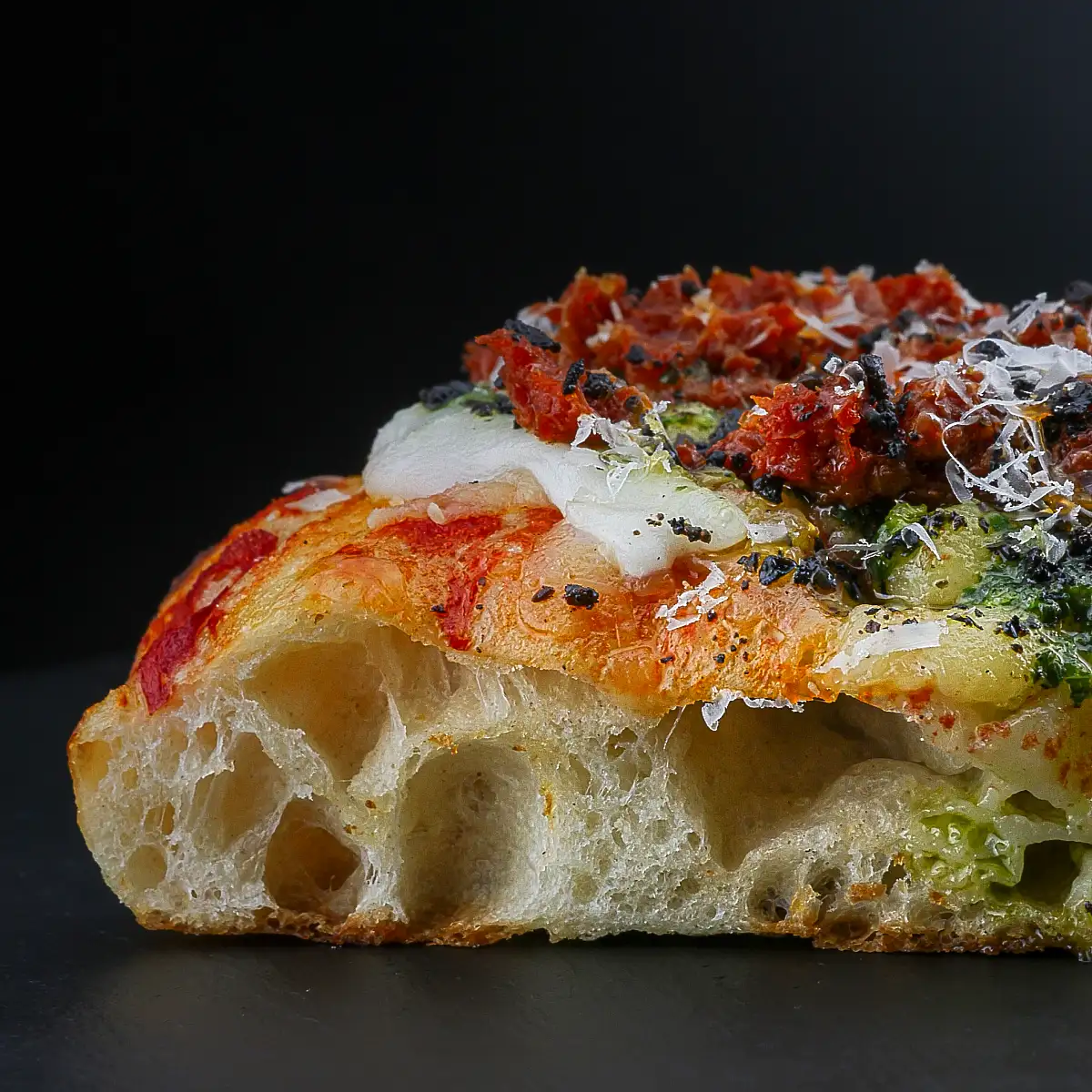
If you have never tried it, the surprise is immediate. Pizza romana in teglia is presented in a square or rectangular shape, baked in a tray, and focuses on a texture that combines lightness with a distinct crispiness. It doesn't try to look like traditional round pizza because it comes from a different logic. It has a different structure, a different bite, and its own personality.
The magic is in the balance. A good in teglia does not feel heavy or oily. On the contrary: when the dough is well-crafted, it feels airy on the inside, croccante on the outside, and very pleasant to eat. It is a pizza that makes texture the protagonist. And that, for those who appreciate details, totally changes the experience.
Stuffed focaccia
The stuffed focaccia also falls into that category of different Italian food worth looking for. It is not just any sandwich or an improvised base. It is a product with identity, where the bread matters just as much as the filling. The crumb, the crust, the olive oil, the salt, and the structure of the dough are all part of the final flavor.
When well-made, every layer makes sense. It's not just about putting ingredients between two slices of bread. It's about achieving balance, contrast, and an artisanal feel that is noticeable from the first bite. It is ideal for those who want something more casual in format, but just as serious in execution.
Schiacciata
The schiacciata deserves more conversation than it normally gets. It comes with that Italian baking essence that captivates those who enjoy noble, crispy doughs with character. Its profile makes it perfect for a different experience, closer to the world of premium artisanal bread than to fast food disguised as Italian.
Here is an important point: not everyone is looking for the same thing. Those who want a fast, abundant meal without much attention to detail might not notice the difference immediately. But those who do value origin, technique, and texture understand why formats like this become memorable.
The technique: where the real difference is born
Talking about different Italian food without talking about technique would be scratching the surface. The big differences are not always visible to the naked eye, but they are clearly felt when eating. Fermentation, for example, changes structure, flavor, and digestibility. A dough with prolonged fermentation develops more complexity and a much more refined texture than one made in a rush.
In Roman or Florentine-inspired products, the baker's craft carries a lot of weight. Here, the winner isn't the one who puts on the most cheese. The winner is the one who masters the process. The hydration of the dough, the resting time, the temperature, the baking, and the management of the internal air holes are details that separate a correct piece from an extraordinary one.
That is why some concepts feel premium even before the first bite. The eyes detect a well-golden crust, a careful alveolar structure, a clean finish. And then comes the bite: croccante, light, deep in flavor. Che buono. That is the kind of detail that turns an everyday item into something that makes you want to return.
Why this trend connects so well with the public of Costa Rica
In Costa Rica, especially among those who enjoy going out to eat as part of a social plan or discovery, there is growing interest in authentic concepts that are less mass-produced. Just "being tasty" is no longer enough. It also matters that it has a story, technique, and an identity that shows.
Different Italian food fits perfectly into this shift. It has the appeal of the familiar, because it is still Italian, but with the surprise factor of the less common. This makes it ideal for dates, outings with friends, small celebrations, or cravings that deserve something better than the usual.
Additionally, it has strong visual value. The square formats, the well-developed doughs, the generous cuts, and the artisanal finishes make the product catch the eye. And yes, that matters. Today, a gastronomic experience is also shared, commented on, and recommended. When something looks different and tastes better, it becomes a conversation starter.
How to recognize a truly different Italian food concept
Not everything sold as special actually is. Sometimes the narrative sounds Italian, but the product remains generic. To distinguish an authentic concept, it helps to look for certain signs.
First, specialization. A place that truly masters a niche does not try to make everything for everyone. It has focus. It knows what style it represents and why. Second, technique. If there is real work behind the dough, that shows in the texture and consistency of the product. Third, the format. When a concept steps outside the standard with cultural coherence, it isn't inventing to grab attention, but rather bringing a specific tradition to the table.
It is also worth observing how the product is talked about. When a brand understands its cuisine, it doesn't need to hide behind empty terms. It speaks clearly about process, origin, and result. That builds trust. And for an audience that has already learned to demand more from their dining experience, that trust carries a lot of weight.
Different Italian food for those who are already tired of the same old thing
There comes a point when you stop looking for just "a good pizza" and start looking for something with more personality. That is where different Italian food gains ground. It doesn't compete just on hunger. It competes on desire, curiosity, and quality.
That is part of the reason why specialized concepts have begun to stand out so much. When a concept appears that brings pizza romana in teglia, stuffed focaccia, and a more authentic vision of the Italian craft, the experience steps up a level. In a market full of similar options, specialization becomes refreshing.
Bianka® Pizza Romana has understood this point very well. It does not try to look like a generic pizzeria. Its path takes another route: croccante texture, 72-hour fermentation, less common formats, and a vision of Italian cuisine with character. For anyone in Heredia who wants to try something with real identity, this type of concept feels like what it is: a difference worth experiencing.
The true luxury is in choosing better
Sometimes, upgrading a routine outing for a better experience does not depend on spending much more, but on choosing with better criteria. Different Italian food offers just that: a more interesting, more careful, and more memorable way to enjoy something that seemed familiar.
If you like to eat with curiosity, attention to texture, and finding concepts that have a story behind what they serve, it is worth making room for that other Italy. The one that doesn't need to exaggerate to surprise. The one that convinces with technique, craft, and real flavor.
The next time you crave "Italian," order something that has a richer story than the usual.