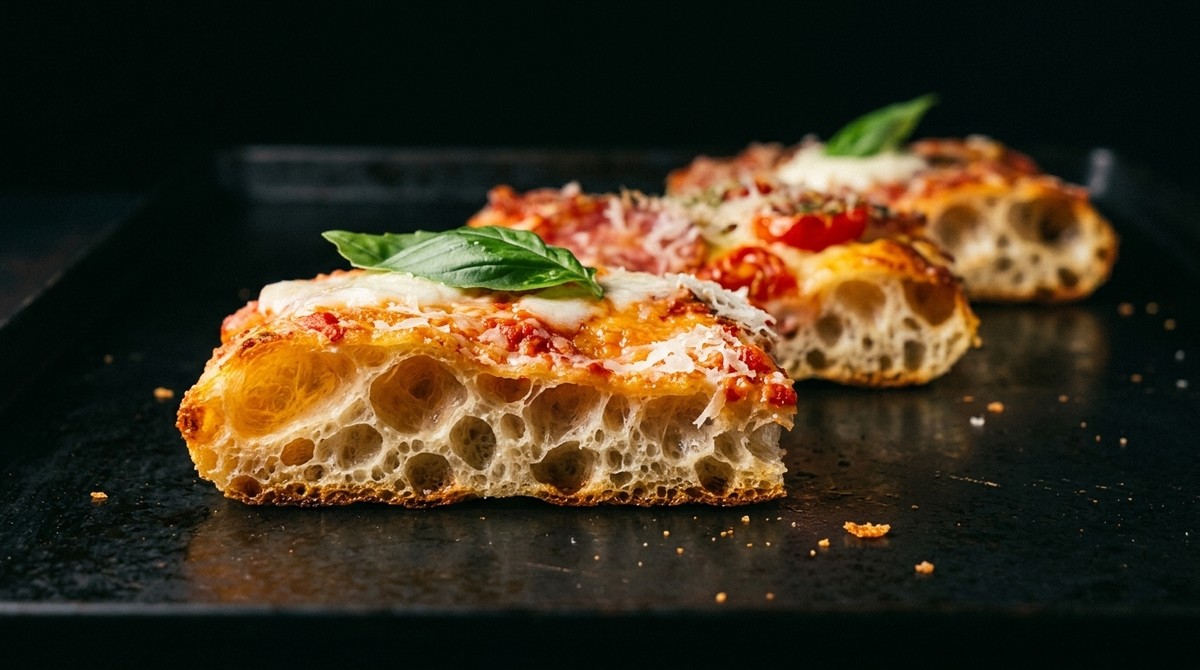
You hear the difference before you even taste it: that delicate crack when biting into the edge, followed by a light crumb full of air and flavor. When we talk about Roman dough texture examples, we aren't talking about just any dough or a conventional round pizza. We're talking about a piece of baking crafted with time, water, temperature, and precision. Roman pizza in teglia has character: it’s croccante on the bottom, light on the inside, and capable of holding memorable toppings without losing its structure.
Roman texture isn’t just one thing
Saying “Roman dough” might sound simple, but Rome has a vast tradition of baking and pizza. The texture changes depending on the format, hydration, thickness, fermentation time, and the exact moment of baking. That’s why a good Roman pizza doesn’t aim to be identical in every bite: it strives for balance.
In the in teglia version, baked in a pan and cut into square or rectangular slices, the base must have firmness and a deep golden color. The top, on the other hand, needs to retain its lightness. If everything crunches like a cracker, it lacks crumb. If everything is soft, it lacks tension and that contrast that makes a Roman pizza unforgettable.
Slow fermentation is one of the keys. Dough fermented for 72 hours develops more complex aromas, is easier to digest for many people, and achieves an internal structure that cannot be rushed. It’s not magic. It’s technique, patience, and respect for the craft.
Examples of texture in Roman dough
Croccante, golden base
The first great example is the croccante base. It shouldn't feel hard or dry. It should break with an elegant resistance, especially around the edges and on the part touching the pan. That golden color doesn’t happen by accident: it comes from well-hydrated dough, quality oil, a pan that conducts heat properly, and an oven that truly does its job.
This texture is ideal for moist toppings, like tomato, mozzarella, roasted vegetables, or Italian cured meats. The base acts as a foundation and keeps the slice from going limp before it reaches the table. The test is simple: pick up a slice. It should hold up firmly, but not feel heavy.
Airy, open crumb
When you pull open a good slice of Roman pizza, irregular cavities appear inside. These are the alveoli: air pockets that reveal well-managed fermentation and carefully handled dough. The goal isn’t a perfectly uniform crumb. The goal is life.
The sensation when biting into it is light, almost airy, even when the pizza has a generous presence. This is why a slice of pizza in teglia can feel satisfying without the heaviness of dense or overly compact doughs. The air isn't just filler: it’s part of the dough’s architecture.
That said, more alveoli don't always mean better pizza. A crumb with massive holes but no consistency can tear or let sauce seep through the base. The sweet spot combines aeration with elasticity. The dough should gently spring back when pressed and retain enough strength to support the toppings.
Thin, crisp crust with a satisfying bite
In Roman pizza in teglia, the crust doesn't need to puff up like that of a Neapolitan pizza. Its charm lies elsewhere: a lower profile, with a thin, crispy crust that frames the crumb. It’s a texture closer to artisan bread, more precise, and very addictive.
When the crust is well-executed, it concentrates toasted aromas and a hint of olive oil. It has a bite, but doesn't require effort. It's the kind of croccante that ensures no one leaves the crust behind on the plate.
Soft surface beneath the toppings
The top of the dough offers another contrast. Underneath the cheese, sauce, or vegetables, it can stay softer and moister than the base. That's not a flaw. It’s exactly what allows for a complete experience: crisp bottom, airy crumb in the center, and a top layer that absorbs the topping's flavor.
The challenge lies in controlling moisture. An overly watery tomato, poorly drained mozzarella, or a mountain of toppings added without care can dull the texture. Roman pizza celebrates abundance, yes, but with discipline. Each ingredient must add to the experience without stealing the spotlight from the dough.
How that texture is built
There is no secret recipe that works without method. Texture starts with a flour capable of absorbing water and developing structure. It continues with high hydration, which helps create an open crumb, and kneading that builds strength without overworking the dough.
Then comes time. During a prolonged fermentation, the dough matures, gains aromatic depth, and becomes more workable. The flavor is no longer flat. Subtle lactic, toasted, and cereal notes emerge, complementing both a pizza bianca and a version with tomato sauce.
Shaping matters too. Stretching a Roman dough doesn't mean flattening it until all the gas created during fermentation is gone. Your hands must gently distribute it, respecting that internal structure. Then, the pan defines much of the result: it allows for an even, beautifully browned base with that signature croccante finish.
Finally, there's the oven. Underbaking leaves a pale, soft base. Overbaking dries out the crumb and turns the crust bitter. The goal isn’t to “burn it so it’s crunchy,” but to achieve color, aroma, and contrast. That’s the difference between a decent pizza and a slice that stays in your memory.
Croccante doesn't mean dry
This is one of the most common mistakes when evaluating Roman pizza. Many people associate crispiness with thin, rigid, or dehydrated dough. But true Roman croccante coexists with a moist, elastic crumb. The base cracks; the interior softly yields as you bite; the flavor lingers.
There isn't just one valid preference, either. Those who love an extra-crispy slice might enjoy a pizza with fewer toppings and a more intense bake. Those looking for a softer sensation can choose a combination with mozzarella, mortadella, or vegetables that adds moisture. The beauty lies in knowing what to expect from each option, not in demanding that they all taste and feel the same.
How to spot a great Roman pizza on the first bite
Look at the bottom of the slice. It should have color, small toasted spots, and a firm, non-greasy surface. Next, observe the cross-section: an airy crumb that is irregular yet holds its shape speaks to proper fermentation and careful handling.
When you taste it, look for three moments. First, the crack of the base. Then, the softness of the crumb. Finally, the harmony with the ingredients. If the topping completely overpowers the flavor of the bread, or if the base folds like wet cardboard, true balance didn't make it to the table.
At Bianka® Pizza Romana, that pursuit becomes an experience meant to be eaten with your hands, shared, and talked about between bites. Square pizza isn't just a different format: it's a statement of texture. In San Pablo de Heredia, a well-made slice can take you much further than the routine of always ordering the same thing.
The next time you have a Roman pizza in front of you, don't rush through it. Listen to the crust, look at the crumb, and feel the contrast. That’s where the real journey begins: dough made to surprise you from the very first crack. Che buono.