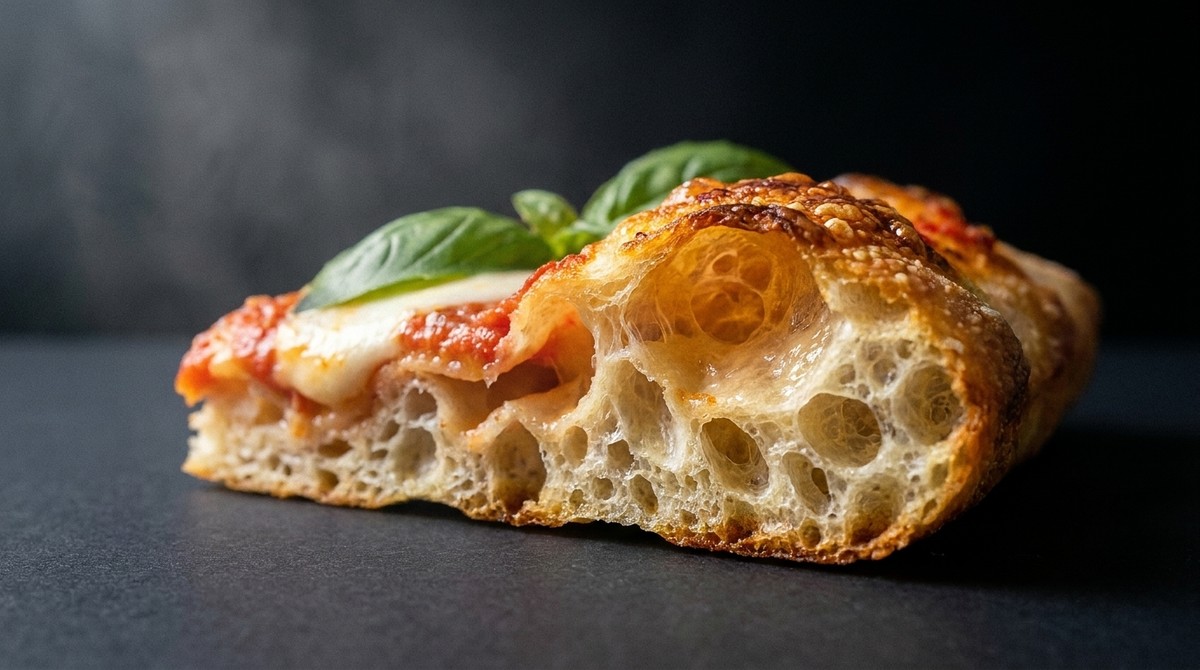
There is a difference you can hear before you taste it: that clean crack when you bite into a well-baked base. Modern artisanal fermentation is part of what makes that croccante, light, character-filled texture possible that sets a great Roman pizza apart. It is not a trend to dress up a menu. It is time, precision, and a much more serious way of treating dough.
In a pizza in teglia, fermentation does not work alone. It is in conversation with the flour, the hydration, the temperature, the rest, and the oven. When every variable is in the right place, the result needs no excuses: a base that is airy inside, golden outside, and able to support memorable toppings without turning into a heavy dough.
What modern artisanal fermentation means
To ferment is to let the yeast transform the sugars in the flour gradually. Along the way, aromas, flavor, and an internal structure develop that do not appear in a dough made in a rush. The artisanal part is in the attention: watching the dough, adjusting to the climate, respecting its times, and working it with intention.
Modern does not mean replacing Italian tradition with technological shortcuts. It means understanding it better. Today temperature is controlled with more precision, flours are chosen according to their strength and absorption, and consistent processes are designed so the same standard can be reached at every service. Tradition, yes. But carried out with contemporary judgment.
A long 72-hour fermentation, like the one that inspires our approach, is not trying to impress with a number. It is trying to give the dough the time it needs. That patience creates a pizza with more depth, better handling, and a bite that feels refined, not excessive.
Time transforms more than flavor
The difference between a short-fermented dough and a long-matured dough shows up from the first bite. A fast dough can do the job. It can be soft, hot, and satisfying. But it rarely reaches that aromatic profile, that lightness, and that elasticity that make a Roman pizza stay in the memory.
During a prolonged process, the dough develops subtle notes of cereal, baked bread, and nuts. It should not taste sour or carry an aggressive aroma. Quality is in the balance. We want complexity, not a dough that competes with the sauce, the cheese, or the toppings that go on top.
The structure changes too. The gas generated during fermentation forms irregular alveoli inside the dough. Those spaces are part of the magic: they help create a light crumb and a surface that, once it enters the oven, becomes a crispy layer. Truly croccante, not simply hard.
Roman pizza demands a different mindset
Roman pizza in teglia is not trying to look like a round pizza with a puffed rim. Its identity lives in the rectangular format, in the large-surface base, and in the contrast between a firm crust and an ethereal interior. Each slice should feel generous, but never heavy.
That is why modern artisanal fermentation fits this style so well. A hydrated, well-fermented dough needs trained hands. It is more delicate, more alive, and less forgiving of mistakes. If it is handled roughly, it loses air. If it is baked without control, it can dry out. If it is loaded with toppings that are too wet, it loses the balance that makes it special.
The winner here is not whoever piles on the most toppings. It is whoever knows how to build a slice where the dough remains the protagonist. The sauce should bring shine and acidity. The cheese should melt without drowning the base. Vegetables, cured meats, or creams should add texture, aroma, and contrast. Roman pizza is edible architecture.
Hydration: the key behind the lightness
A dough with higher hydration contains more water and can produce a more open crumb. But more water does not automatically mean a better pizza. It demands the right flour, precise folds, enough rest, and a bake capable of driving off moisture without drying out the product.
That is one of the great trade-offs of the technique. Seeking lightness can make the dough harder to work. Seeking an extremely crispy base can compromise the softness of the center. The right point depends on the style and the result you want to serve. For a premium Roman pizza, the goal is clear: a golden exterior, a firm base, an airy center.
Temperature: the detail you don't see
In Costa Rica, the climate matters. Room temperature can speed a dough up more than expected, especially on warm days. That is why a well-executed fermentation cannot depend on the clock alone. Saying "72 hours" without controlling the conditions guarantees nothing.
Refrigeration slows the process and develops flavor with more control. Cold, however, does not correct a poorly conceived formula or an over-fermented dough. The technique shows in the regularity: an excellent slice at Tuesday lunchtime and on a busy Saturday night should keep the same character.
Artisanal is not improvised
There is a romantic idea that artisanal means working without measurements, letting everything happen "by eye," and celebrating irregularity. In serious baking, that is not craft: it is inconsistency. Real craftsmanship knows the details and knows when to adjust them.
The amount of yeast, the quality of the water, the final dough temperature, and the rest time change the result. A small variation can alter the volume, the acidity, or the color of the crust. That is why the craft combines sensitivity and method. You touch the dough, you watch its tension, and you respect its rhythm, but you also measure, record, and repeat with rigor.
That discipline is what makes it possible to offer a premium experience without losing soul. At Bianka®, Roman pizza is not understood as fast food with an Italian name. It is a category with its own codes, born of a bakery tradition that deserves attention.
How to recognize a well-fermented pizza
You do not need to be a pizzaiolo to identify a great dough. Look at the base: it should be golden and crispy, not pale or greasy. When you split a slice, look for a crumb with air and structure, not a compact block. The aroma should recall freshly baked bread, with depth, but without a dominant sour punch.
When you eat it, the pizza should feel satisfying without leaving a heavy sensation. This depends on many factors, from the portion to the toppings, so there is no absolute rule. But a well-fermented dough usually has a quality that is hard to fake: it disappears easily in the bite and leaves you wanting another slice.
The texture should also hold up under its toppings. A good base supports a creamy burrata, roasted vegetables, or an intense cured meat without going limp right away. That elegant resistance is a sign of work well done.
An experience that begins before the oven
Fermentation asks for planning. The dough you will eat tonight began its path days earlier. That is the difference between producing in a rush and cooking with vision. Each rest anticipates the moment the teglia enters the oven and the aroma starts to fill the room.
For those looking for something more than the usual pizza, that detail changes the whole occasion. A night out with friends, a dinner for two, or a special lunch gains another dimension when the product has technique, history, and a texture that invites comment between bites.
The next time you hear that crack when a Roman slice is cut, pause for a second. Behind that golden crust there is flour, water, heat, and well-used patience. Che buono.