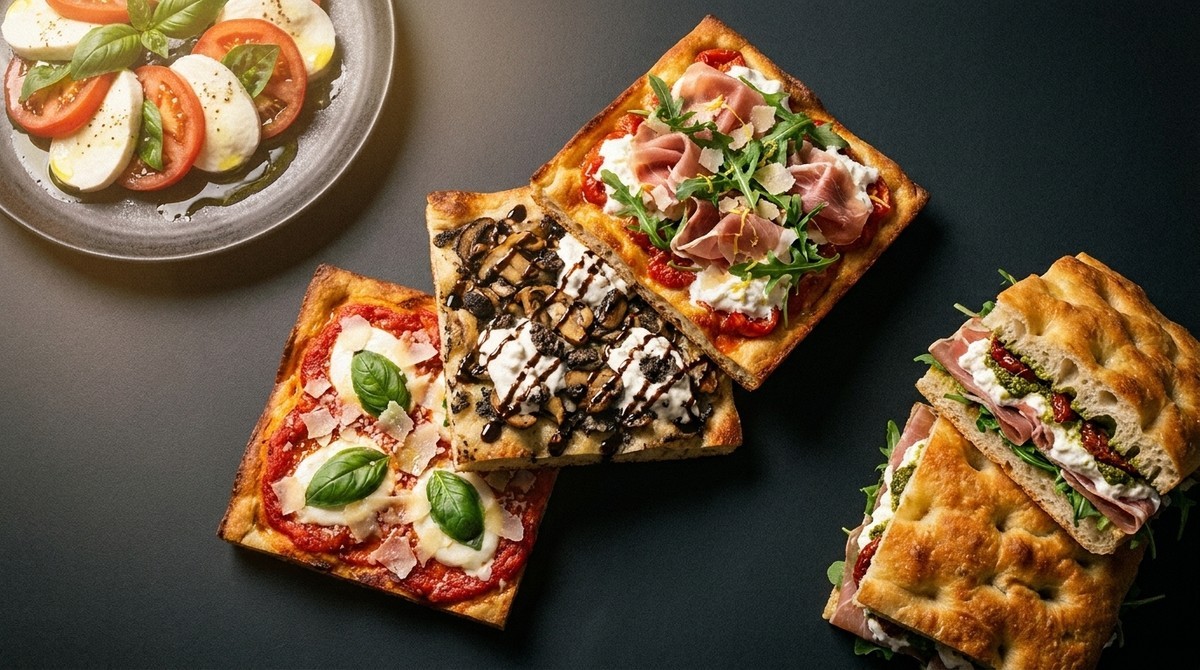
You don't judge a good dinner with friends by how many dishes fit on the table. You judge it by how many times someone says, “try this.” This Italian group dinner guide starts from a simple, powerful idea: Italian food tastes better when it lands in the middle of the table, gets cut, gets shared and gets people talking. No rigid menus or isolated plates. Just well-made food, a good table rhythm and that inevitable moment when a croccante focaccia disappears before the second round arrives.
Why an Italian dinner works so well for groups
Italian cooking has a natural advantage for bringing people together: it pairs abundance with simplicity. A table can feel generous without being complicated. A couple of antipasti, breads to share, pizza in the middle, something fresh and a sweet ending are enough to create an occasion that feels special.
The secret is choosing formats made to pass from hand to hand. Roman pizza in teglia, for example, isn't served as a closed individual choice. It's cut into slices, lets you try more than one flavor and keeps everyone involved. It's a more social experience than ordering one round pizza per person and waiting for everyone to guard their own box.
There's a visual factor too. A well-set Italian table has color, texture and height: bright tomato, green herbs, cheeses, golden dough, filled glasses. For a group of friends, a family celebration or a team outing, that turns a casual dinner into a plan worth a photo, a conversation and a repeat.
Italian group dinner guide: start with the type of gathering
Groups don't all eat the same way. Before you pick flavors or work out quantities, decide what kind of night you want to create. A sit-down dinner for eight needs a different rhythm from a looser get-together of twelve friends who arrive at different times.
Sit-down dinner, celebration or casual get-together
If the idea is to sit down, talk for a long time and eat without hurrying, plan a simple sequence: something small to open the appetite, pizzas or focaccias in the middle and a light finish. This format works very well for birthdays, reunions and couples' dinners with friends.
For a livelier gathering, where people talk standing up, come and go or want to snack while they have a drink, choose pieces that are easy to grab. Square slices of pizza, filled schiacciata cut for sharing and antipasti that don't need cutlery let the food go along with the plan instead of slowing it down.
The time changes everything too. A dinner at 6 p.m. usually calls for less food than one at 9 p.m., especially if there will be drinks. If the group is coming straight from work or a long activity, the hunger will be real. In that case, don't rely on starters alone: make sure there's enough dough, protein and vegetable options for the table to feel complete.
Work out portions without running short or over-ordering
The most useful rule is to estimate how many slices each person will eat, rather than counting pizzas. At a dinner with starters, most adults will eat two to three generous slices of Roman pizza. If pizza is the main dish and the group shows up hungry, plan on three or four slices per person.
Teenagers and groups coming off a long night usually eat more. On the other hand, if there are hearty antipasti, filled focaccia and dessert, you can cut back a little on the pizza. Context decides.
For a table of six, a mix of three different flavors usually gives you enough variety without turning the choice into a puzzle. For ten or more, aim for four or five flavors. Variety matters because it avoids the classic problem of ordering too much of one ingredient and finding out half the table wanted something else.
Don't forget dietary restrictions before you order. Asking in the group chat whether anyone is vegetarian, avoids dairy or doesn't eat pork takes less than a minute and changes the experience completely. A well-planned table doesn't force anyone to settle for the salad.
Build the table on contrast instead of excess
A memorable Italian dinner doesn't need ten dishes. It needs balance. The dough should take the lead, but it welcomes company: something acidic, something fresh, something creamy and, if the plan calls for it, something sweet at the end.
Start with a light starter. Olives, marinated vegetables, a leafy salad with lemon or well-dressed tomatoes get your palate ready without filling you up too much. Then bring the stars to the middle: pizza in teglia, focaccia or schiacciata. Add a fresh salad if the main flavors are intense or very cheesy.
When you choose pizzas, mix different profiles. One with tomato and cheese delivers the familiar flavor almost everyone expects. Another with vegetables, herbs or cream brings freshness. A third, bolder one, with cured meat, a stronger cheese or spiced ingredients, lifts the table. If you're ordering several flavors, alternate the intensity: don't put all the heavy options together.
Texture deserves as much attention as flavor. The magic of a good Roman pizza lies in the contrast between a croccante base, an airy inside and toppings that keep their identity. When the dough has slow fermentation and a good bake, it does far more than hold up the topping. It's a central part of the dish.
Choose drinks that go with the food instead of competing
You don't need to turn dinner into a formal tasting. Sparkling water, cold beer, light wine or citrusy non-alcoholic drinks work especially well because they refresh you between bites. For pizzas with tomato and cured meats, a drink with acidity or bubbles helps cleanse the palate. For more delicate focaccias, something fresh and not too sweet keeps the balance.
If there will be wine, serve a few options and repeat them. A crisp white and a light red usually work better than opening too many labels with no plan. The dinner is the center. The drink should make every bite feel better.
Coordinate the order so the food arrives at its best
Logistics decide whether a group dinner feels smooth or chaotic. If you're eating at a restaurant, book ahead and let them know if the group is large. If you're ordering in, agree on a realistic time instead of an optimistic one. Ordering on collective hunger with no plan is the fastest way to over-order, repeat flavors and wait around awkwardly.
Put one person in charge of placing the order. Nobody has to run the night; the point is to keep ten people from sending conflicting decisions at the same time. Gather preferences, set a budget and confirm the final head count a few hours ahead.
When you serve, don't stack all the boxes and expect the table to sort itself out. Cut, spread out the flavors and have napkins, plates and drinks ready before you open the food. The slices should circulate. That's the difference between a shared dinner and a race for the last croccante corner.
Mistakes that take the punch out of a dinner for sharing
The first is ordering only one “safe” flavor. It may seem practical, but it makes the dinner flat. The second is loading the table with heavy starters and leaving little room for the pizza. The third is thinking more food always means a better experience. Sometimes it only creates waste and a table with no rhythm.
It's also wise to avoid overly divisive ingredients as the only option. If someone loves spicy food, great: include an intense pizza. Balance it with flavors that invite everyone to join in, though. A group dinner should give people reasons to try something new without leaving anyone out, and nobody's taste should be forced on the table.
And don't trade quality for quantity. A handmade product, with good fermentation, well-worked dough and ingredients handled with judgment, shows from the first bite. Fewer options, chosen better, usually win.
Make the dinner feel like an occasion
The difference between “we ordered pizza” and “we put together an Italian night” lies in small gestures. Put the food in the middle, dim the lights a little, use plates even if it's a casual gathering and let the flavors arrive in rounds. You don't need themed decorations or complicated rules. You need intention.
In San Pablo de Heredia, Bianka® Pizza Romana brings that thinking to the table with pizza in teglia, filled focaccia and schiacciata made for cutting, sharing and celebrating authentic Italian bakery culture. Che buono when the dough crunches, the group stays a little longer and nobody wants the last slice to be gone.
The next time you get your people together, think less about filling the table and more about keeping it moving: good contrasts, slices in the middle and a dough worth sharing. That's where a dinner everyone will want to repeat begins.