Jul 22, 2026
Italian restaurant vs traditional pizzeria
The difference between an Italian restaurant vs a traditional pizzeria is felt before the first bite. It lies in the aroma of a dough that fermented patiently, in a menu that tells the story of a region, and in that croccante texture that makes a slice not just fast food. When you are looking for an outing that feels special, understanding that difference completely changes what you order and what you expect from the table.
Italian restaurant vs traditional pizzeria: the real difference
A traditional pizzeria is usually built around a well-known product: round pizza, familiar flavors, generous portions, and a practical dynamic for sharing or delivery. It can be a tasty, affordable, and perfect option for a hassle-free evening. Its priority is usually convenience and consistency.
An specialized Italian restaurant, on the other hand, starts from a more ambitious question: what Italian tradition does it want to represent? Italy does not have just one pizza, one dough, or one single way of eating. Rome, Naples, Florence, and other cities developed their own recipes, formats, and rhythms. That is where the value of the specialty comes in.
This is not about saying that every round pizza is basic, or that every place with Italian ingredients is automatically premium. The difference is in the intention and execution. A niche Italian concept treats technique as a central part of the experience: fermentation, hydration, flour, baking, slicing, combinations, and service.
For those who enjoy discovering places with identity, that precision matters. Ordering pizza is not the same as choosing a concept that has a story behind every bite.
The dough: where the distance begins
The dough defines much more than the crust. It defines the weight of the slice, the crunch, the crumb, the digestibility, and even the way the ingredients are perceived. In a traditional pizzeria, the recipe may be designed to produce quickly and cater to a wide menu. It works for direct, family, and uncomplicated consumption.
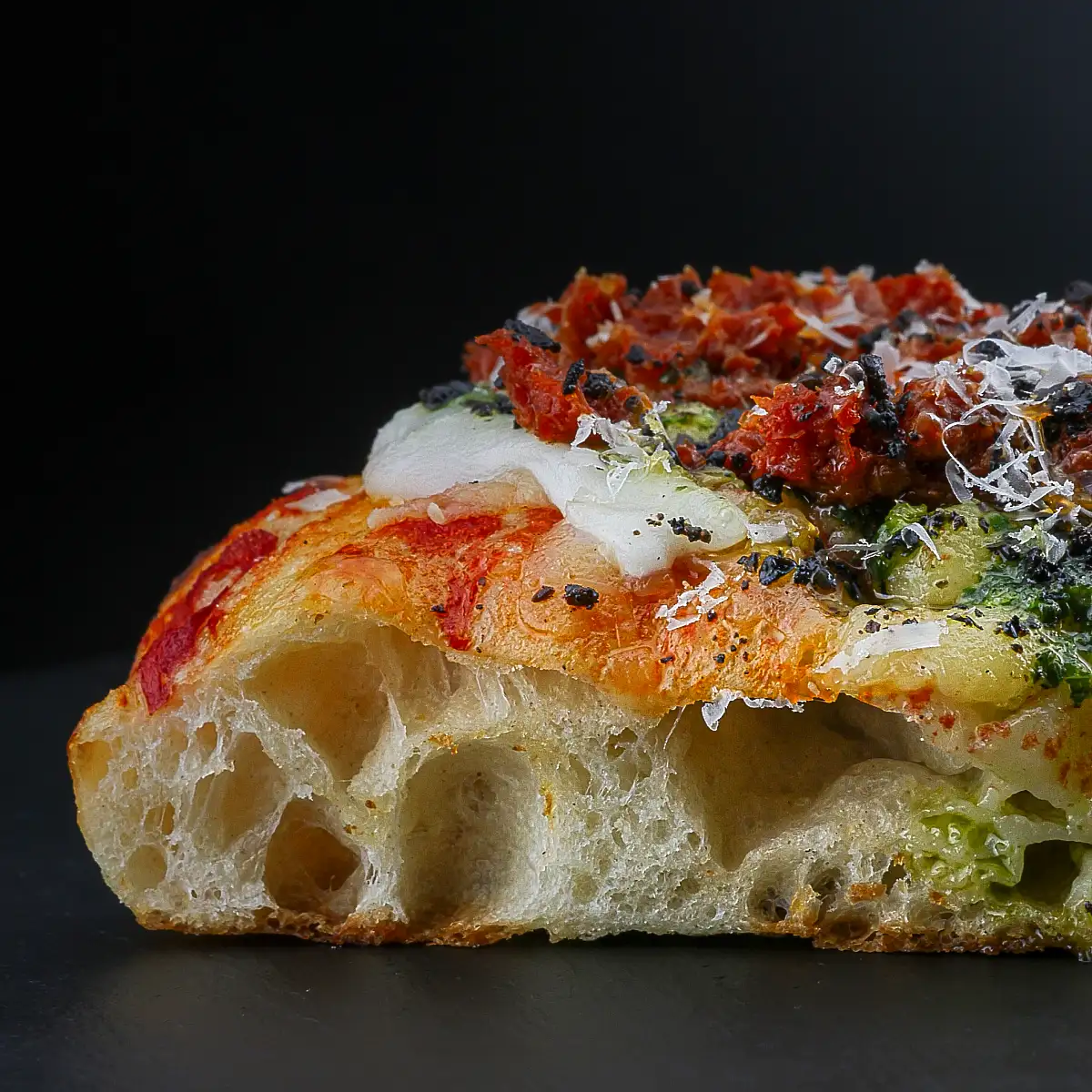
In a specialized Italian concept, the dough receives a whole other level of prominence. A 72-hour fermentation, for example, is not a decorative fact. It is time to develop flavor, structure, and a lighter texture. The ideal result is not a heavy base that competes with the toppings, but a dough with its own character: airy on the inside, firm when held, and croccante when bitten into.
The Roman pizza in teglia brings that idea to another format. It is baked in a tray, presented square or rectangular, and cut according to the appetite or plan of the table. Its base seeks a delicious contrast between the golden crust and a light crumb. It is a pizza designed to try more than one flavor, share, and discuss which was the favorite.
Of course, an artisanal dough requires patience and control. It will not always be the quickest delivery option or the cheapest on the menu. But when the craving calls for quality, texture, and a less predictable experience, it is worth every minute of the wait.
Not all Italian pizza is Neapolitan
There is a widespread idea that Italian pizza is only equivalent to Neapolitan pizza: round, with a high crust and soft center. It is a great tradition, but not the only one. Roman pizza in teglia proposes a different personality: crunchier, more versatile in the cut, and especially appealing to those who love a firm base without losing lightness.
There are also stuffed focaccia and schiacciata, two formats that connect Italian baking with a much more interesting casual meal. The focaccia can be fluffy, fragrant, and generous with fillings. The schiacciata, associated with Florence, is characterized by its thin, crispy dough, ideal for creating flavorful sandwiches without falling into the ordinary.
The menu: breadth or specialization
Another difference between an Italian restaurant vs a traditional pizzeria is found on the menu. A traditional pizzeria normally offers a wide selection of pizzas, sides, drinks, and sometimes dishes from other cuisines. The variety helps when a group has very different tastes or when looking to sort out an easy meal.
A niche Italian restaurant might have a more focused menu. Far from being a limitation, this decision allows for a deeper dive into the product. If the venue specializes in Roman pizza, it can dedicate energy to perfecting the dough, choosing ingredients that balance with that base, and designing combinations that do not get lost under a mountain of cheese or sauces.
The difference is noticeable when the ingredients have a purpose. A good prosciutto adds salinity and rich meatiness. A pistachio cream adds depth. Roasted vegetables must arrive with sweetness and texture, not as a supportless filling. The cheese must melt and accompany, not hide everything else.
Specialization also invites ordering in a different way. Instead of choosing a huge pizza for each person, you can try several slices, alternate an in teglia with a stuffed focaccia, and discover different profiles. For a date, a night out with friends, or an afternoon of serious cravings, this dynamic feels much more alive.
The experience does not end in the box
The traditional pizzeria has its moment. A movie night, a game, an impromptu family gathering: a familiar and abundant pizza does the trick. There is nothing wrong with that. Sometimes, what you want is exactly what is familiar.
But a specialized Italian restaurant proposes a different occasion. The meal becomes the plan, not just the accompaniment to the plan. The space, the presentation, the fresh cut, the conversation about texture, and the surprise of trying a format that is not found on every corner all matter.
For an urban crowd looking for photogenic yet substantial places, this makes a real difference. A pizza can look incredible in a photo, sure. But it must deliver on its promise upon the first bite. The crunch must sound. The dough must feel crafted. The flavors must have clarity.
In San Pablo de Heredia, Bianka® Pizza Romana brings that vision to a concrete reality: Italian baking tradition, Roman pizza in teglia, and formats that break the mold of the generic round pizza. It is an experience to approach with curiosity and leave with a new standard for pizza.
Price: what you are really paying for
Comparing prices without looking at the process can be misleading. A fast-production pizza and a long-fermentation pizza do not carry the same costs or require the same amount of work. The flour, technique, resting time, daily preparation, and ingredient selection change the equation.
That does not mean you should always choose the most expensive option. It depends on the occasion, the budget, and what you want to eat. If you need to feed many people quickly, a traditional pizzeria might be the right decision. If you want to celebrate, have a different kind of date, or treat yourself to an artisanal product, the specialized Italian restaurant offers another kind of value.
The best criteria is not to think only about quantity. Ask yourself what kind of experience you want to remember. A memorable pizza does not have to be huge: it has to have technique, balance, and personality.
How to choose according to your plan
If the plan is practical, a broad menu and familiar flavors usually win. If the plan is about discovery, sharing several options, and eating something with more character, look for specialization. Check what kind of pizza they make, how they describe the dough, and whether the format responds to a concrete tradition or only uses Italian words as decoration.
Also pay attention to the texture that you like. If you love a very soft center and a puffy crust, you are probably more attracted to the Neapolitan style. If you are looking for a golden, light, and croccante base that holds ingredients without folding, the Roman pizza in teglia might become your new obsession.
The next time the craving appears, do not settle for asking what toppings there are. Ask how they work the dough, what city inspires the recipe, and what texture it promises. That is where an outing with more flavor, history, and a lot of che buono begins.