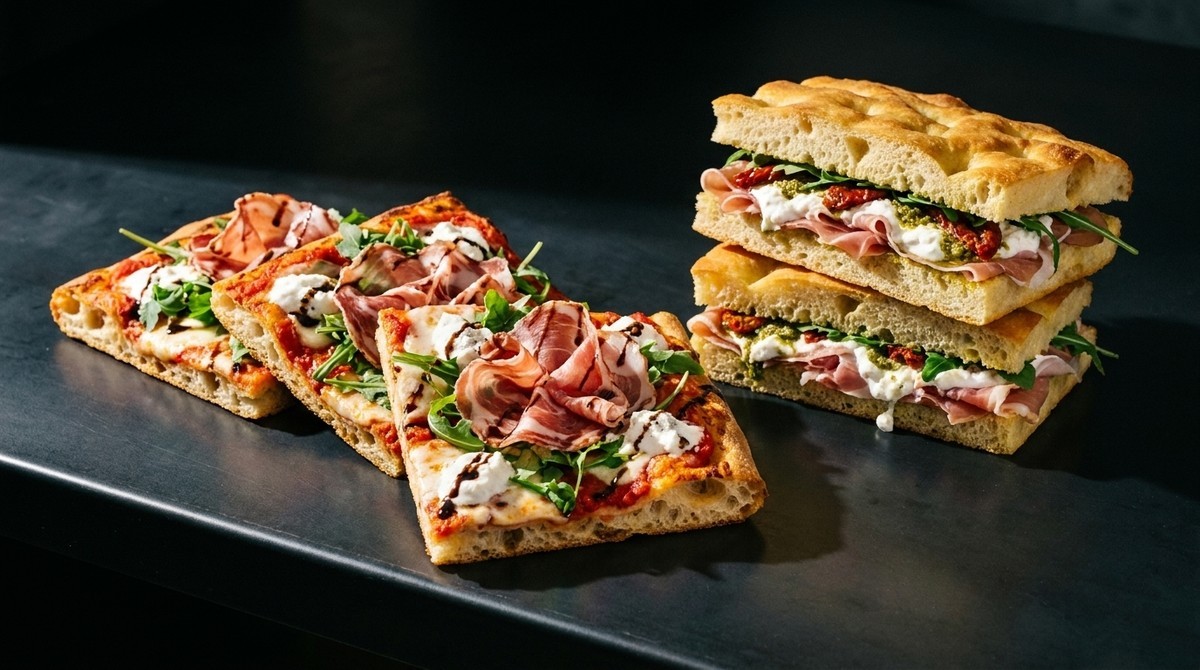
A well-stocked Italian display case can cause a delicious kind of confusion: a rectangular tray, golden dough, croccante edges and toppings that make you want a slice of everything. Then the question comes up: pizza al taglio versus focaccia, which is which? They share flour, fermentation and a spectacular presence on the counter, yet they aren't the same thing. The difference lives in the intent behind the dough, the way it's served and, above all, the bite.
If you want to move past generic round pizza, understanding that distinction changes the experience. You don't need to crown an absolute winner. What matters is knowing what to order when you're craving an airy base with baked-on toppings, or when what you want is Italian bread with character, olive oil and a generous filling.
Pizza al taglio versus focaccia: where the difference comes from
Pizza al taglio was born for the city. Its name literally means pizza by the cut. In Rome, it's made in large rectangular trays, displayed with different toppings and cut to whatever size you ask for. Traditionally it sells by weight, which makes perfect sense when you want to try several combinations in one visit.
Its star is a dough designed as pizza: hydrated, fermented and baked to carry toppings without losing lightness. A good Roman pizza in teglia should have a firm, crisp base, an open crumb and a surface that stays alive under the sauce, cheese, vegetables or cured meats. Thickness alone won't do it. It has to be light, sturdy and full of flavor.
Focaccia belongs first to the world of bread. It's a broad family of Italian flatbreads with very different regional styles. Focaccia genovese, for example, stands out for its deep dimples, its olive oil and its salty edge. In Florence, schiacciata is usually thinner and drier, and especially good for splitting, filling and eating as a sandwich.
The confusion makes sense because both can arrive rectangular, golden and pan-baked. A pizza al taglio, though, is built to show off and carry a topping. A focaccia is built so the dough, the oil and the bake speak first.
The dough: same family, different personality
In both cases, you can't improvise quality. Flour, water, yeast, salt, rest and temperature all matter. Each one is after a different texture, though.
Roman pizza al taglio goes for contrast. The underside should make a sound when you break it. The crumb should open into irregular bubbles and feel moist, never heavy. When the fermentation is handled with patience, the result has depth and a lighter feel as you eat it. At Bianka® Pizza Romana, 72-hour fermentation is part of that pursuit: a dough with structure, lightness and a croccante you remember.
Focaccia can be very airy, but its relationship with oil is more obvious. In a focaccia genovese, the oil perfumes the surface, pools gently in the dimples and creates a golden, flexible crust. It doesn't necessarily try to crunch from the base like a Roman pizza. Its pleasure lies in a tender, flavorful, slightly stretchy crumb.
Schiacciata takes another path. It's a flatter Tuscan focaccia, with a pronounced crust and a less puffy center. If you're going to fill it with mortadella, prosciutto, cheeses or vegetables, that firmness is a virtue: it gives you a clean bite and keeps the bread from overshadowing the filling.
The topping plays a different role
In pizza al taglio, the toppings are a central part of the design. There are red versions with tomato and mozzarella, white ones with potato and rosemary, and combinations with mushrooms, artichoke, cured meats, stracciatella or seasonal vegetables. The dough is the platform, but the topping sets the course. That's why people get a slice of each style: every square offers a different experience.
With focaccia, the ingredients can go on top, inside or simply alongside. A classic focaccia can carry oil, salt, rosemary, onion or olives and need nothing more. That's enough because the piece has its own identity. When you split it and fill it, the center takes the spotlight and the bread becomes the perfect frame.
Here's a useful rule: if you like choosing from several topped trays and eating different slices, you're probably after pizza al taglio. If you picture an Italian bread split open, warm, with plenty of filling and a more bread-like texture, filled focaccia is your answer.
How do you eat each one?
Pizza al taglio is spontaneous and easy to share. You order it by the cut, eat it with your hands, and it works just as well for a quick lunch, dinner with friends or a table where nobody wants to commit to a single flavor. One person can order a small slice of pizza bianca and another with tomato; someone else can go straight for a bold combination. That freedom is part of its Roman charm.
Focaccia moves at more of an Italian-bakery pace. It can go alongside a meal, cover a savory breakfast or turn into a hearty lunch when it's filled. Its format invites you to eat the whole piece, especially when it's fresh from the oven and the filling blends into the crumb.
The ideal temperature changes too. Pizza al taglio should arrive with its base alive, crisp and ready to hold the topping. Focaccia is best warm, but it handles a few minutes' wait better because its texture doesn't depend only on a burst of crunch. That doesn't make one fresher than the other. They were designed for different moments.
The decision depends on your craving
There's no need to turn pizza al taglio versus focaccia into a battle of doughs. The right choice depends on what you're after in that moment. For a Roman pizza experience, with the topping in the lead, slices by the cut and an edge that crunches, pizza al taglio comes out ahead. If you want Italian bread, olive oil, a flavorful crumb and the option of a powerful filling, focaccia offers another kind of satisfaction.
It's also worth thinking about the setting. Pizza al taglio is ideal for sharing and trying a variety. Filled focaccia tends to feel more personal, closer to a handmade sandwich. If the table calls for a meal with conversation, photos and several combinations in the middle, trays of pizza are a great idea. If the plan is something hearty to take out or a lunch break that feels special, a well-built schiacciata may be exactly what you need.
The detail that separates memorable from ordinary
A rectangular shape doesn't guarantee authentic pizza al taglio, just as adding rosemary doesn't turn any bread into focaccia. The real difference shows up in the technique: enough fermentation, well-controlled hydration, precise baking and respect for the ingredients. An overfermented dough loses its structure; a rushed one feels dense. Too much topping soaks the base; a poorly balanced filling disappears into too much bread.
That's why these foods deserve attention. They look simple because they start from everyday ingredients, but getting a light, golden base full of character takes craft. This is niche Italian cooking at its best: direct, handmade and with no need for disguises.
The next time you see a golden tray, don't choose only by what's on top. Ask yourself what texture you want to feel first. If the answer is a croccante base holding up a flavorful Roman slice, order pizza al taglio. If you're thinking of warm bread, olive oil and a filling that steals the moment, go for focaccia. Che buono.