Aug 9, 2026
Pizza bianca vs. focaccia: what is the difference?
The display case of an Italian bakery can place them side by side and trigger the inevitable question: pizza bianca vs focaccia, what really changes? Both are born from a dough with flour, water, yeast, salt, and olive oil. Both can look golden, rectangular, and temptingly simple. But at the first bite, the difference is felt: one seeks a crispy, airy contrast; the other embraces a softer, moister, and more generous crumb.
It is not about declaring a winner. It is about knowing what craving is in front of you. If you are looking for a light base to fill, a Roman pizza bianca has a lot to say. If you want table bread with olive oil, herbs, or sides, focaccia might be exactly your thing.
Pizza bianca vs focaccia: the essential difference
Roman pizza bianca is, in its most classic expression, a dough baked without tomato sauce or cheese as protagonists. It features olive oil, salt and, depending on the recipe, rosemary or other minimal touches. Its apparent simplicity is its grace: the flavor depends on a well-managed fermentation, dough handling, and baking that develops a firm crust and an internal structure full of air.
Focaccia, especially Genovese focaccia ligure, is also a flatbread enriched with olive oil. However, it is recognized by its finger-marked dimples and a brine of water, salt, and oil that settles into those cavities before baking. The result is usually more tender, shiny, and juicy on the surface, with a fluffy crumb that invites you to eat it alone or share it at the table.
To put it directly: pizza bianca usually feels closer to a pizza without toppings, designed to be split, filled, or eaten on the go. Focaccia behaves more like an aromatic and fluffy Italian flatbread, although there are endless regional interpretations.
Origin also shapes character
Pizza bianca is an everyday institution in Rome. It is found in bakeries and pizzerias al taglio, cut to the size that each person requests. Roman tradition values that dough base with irregular bubbles, a well-toasted bottom, and an exterior that crunches without becoming heavy. It is common to split it open and fill it with mortadella, prosciutto, grilled vegetables, or cheeses. Few things say Rome as clearly as a freshly baked pizza bianca, split and still warm.
Focaccia has a much broader geography. The ligure version is probably the most recognized, but there are focaccias in different areas of Italy, each with its own thickness, hydration level, and toppings. Some have onion; others, olives, tomato, potatoes, or herbs. In certain recipes, it approaches fluffy; in others, it is thinner and crispier. Therefore, comparing all focaccia to a single pizza bianca can oversimplify a very diverse family of breads.
There is also a frequent confusion outside of Italy: calling any pizza without tomato sauce "pizza bianca." That description may work on a menu, but it does not always refer to traditional Roman pizza bianca. A pizza with mozzarella, ricotta, mushrooms, and no tomato can be a white pizza. On the other hand, pizza bianca from a Roman bakery can shine precisely because it does not need that heavy load of ingredients.
Dough, fermentation, and texture: where the magic happens
Both doughs can work with long fermentations and a considerable hydration. There is no universal formula that allows saying that one always carries more water than the other. Each master baker adjusts according to the flour, the weather, the oven, and the texture they want to achieve.
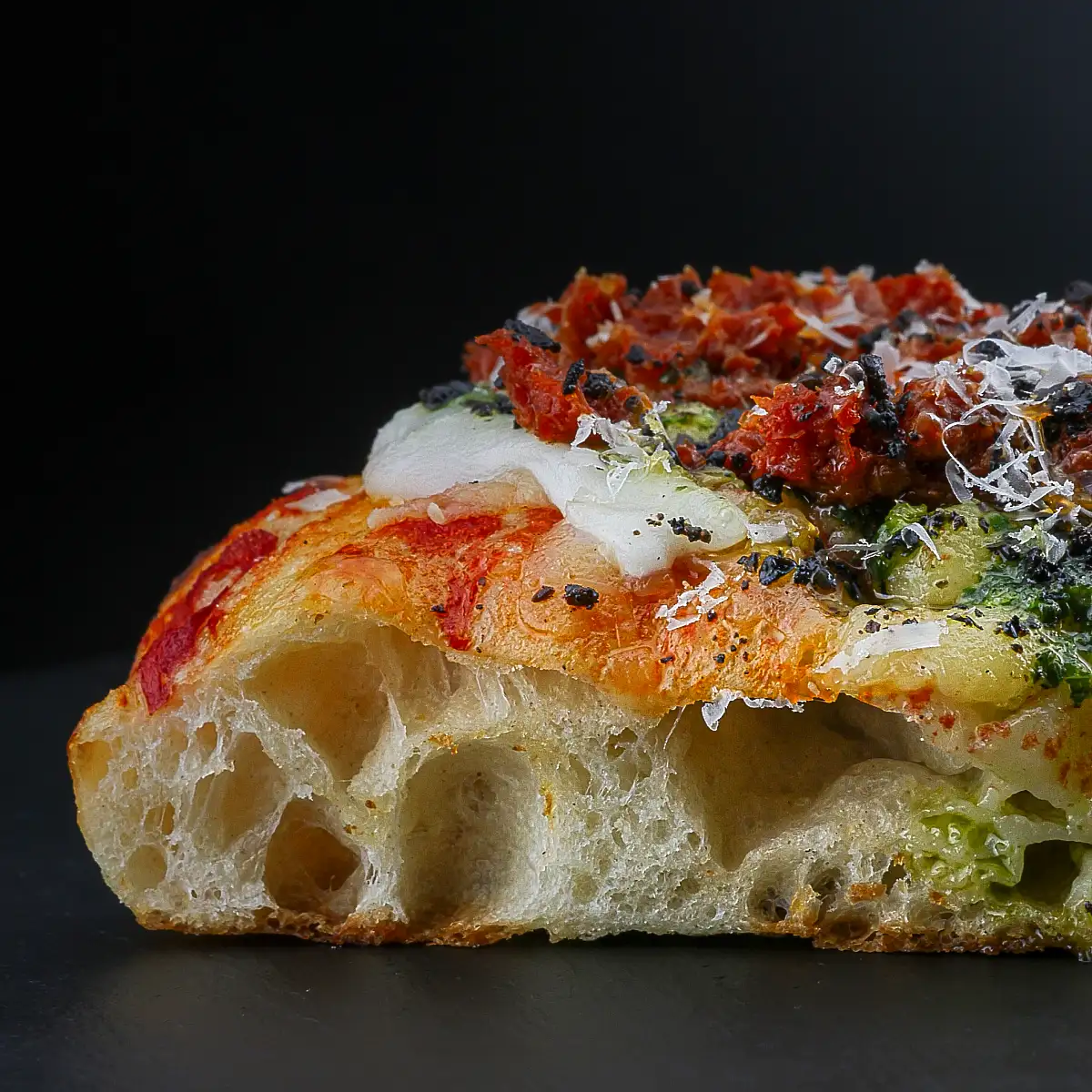
The difference is in the intention. In Roman pizza bianca, the dough is usually stretched to build a wide, airy base, with visible alveoli and a crispy bottom. It must be light when lifted, yet resistant to filling. A good piece does not feel greasy or dense: it breaks slightly at the edges and retains elasticity in the center.
Focaccia pursues another sensation. Its dimples are not decoration. They retain oil, brine, and flavor. That moisture integrates into the surface and leaves a richer bite. It can have golden edges and a toasted base, of course, but its hallmark is usually its internal softness. It is bread to tear with your hand, dip in oil, or accompany with a glass of wine.
Here enters a detail that changes everything: the oven. A Roman-inspired pizza bianca calls for temperature and precision to achieve a crispy base without drying out the crumb. A focaccia also appreciates a good blast of heat, but the brine and oil transform the surface in a different way. It is not just flour against flour. It is technique, time, and purpose.
Which works best for fillings?
For a high-level Italian sandwich, pizza bianca is usually a spectacular choice. Its structure allows it to be opened without falling apart, and its discreet flavor lets ingredients like mortadella, stracciatella, pesto, prosciutto, or vegetables have room. The contrast between the crispy crust and a creamy or savory filling turns every bite into a complete experience.
Focaccia is also filled, of course. In fact, there are wonderful preparations made as a focaccia sandwich. But the softer crumb and the oil present on its surface change the equation. With very wet fillings, it can feel more filling and less defined in texture. This is not a flaw: it is ideal for those who want a bready, warm, and comforting bite.
If the filling is the protagonist, pizza bianca creates a lighter and crispier frame. If the bread must contribute a lot of flavor on its own, focaccia takes the lead. It depends on what you want to highlight.
How to recognize a good pizza bianca
You don't need to be an expert to distinguish a well-executed piece. Look at the bottom: it should have color and firmness, not look pale or wet. Look at the crumb when cut: the bubbles should be irregular and lively, not a compact mass. When touched, the crust should sound slightly crispy, while the interior retains flexibility.
The aroma matters as much as the look. It should smell of toasted wheat, clean fermentation, and olive oil, not raw yeast or excess grease. And even if pizza bianca is simple, it should not be flat in flavor. The salt, oil, and baking must be in balance.
At Bianka® Pizza Romana, this search for texture comes from a clear idea: the dough is not a vehicle for toppings. It is the product. A 72-hour fermentation and precise baking give Roman pizza in teglia its own character, with that crispy base that completely changes the experience.
And where does schiacciata fit in?
Schiacciata often comes up in conversation because it is also a flat Italian dough and wonderful for filling. It is typical of Tuscany and, although it shares similarities with focaccia, it has its own identity. Many versions are thinner, with a firm bite and a surface marked by olive oil and salt.
It is not correct to use pizza bianca, focaccia, and schiacciata as synonyms. They are different expressions of the same Italian passion for flour, time, and the oven. Rome, Liguria, and Tuscany speak different dialects even when the language is fermented dough.
The right choice depends on the moment
Order pizza bianca when you want a more Roman, light, crispy experience that is ready for a memorable filling. Choose focaccia if you crave a softer dough, with olive oil at the forefront and enough flavor to be enjoyed without too many sides. And if you are offered a well-made schiacciata, expect a Tuscan alternative with its own personality.
The next time you see a golden dough behind the glass, don't reduce it to "bread with oil." Ask where it comes from, how it fermented, and what texture it aims for. That is where the true Italian craving begins. Che buono.