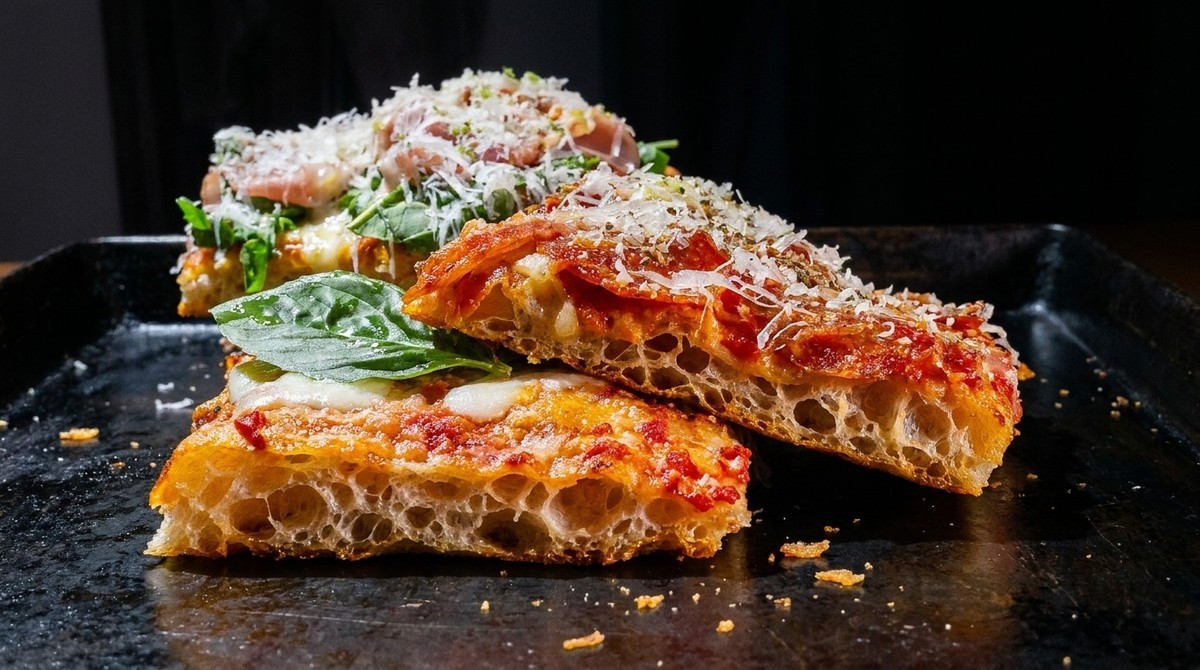
A pizza reaches the table and the first sound tells you almost everything: that clean crack when you bite can be memorable. Still, the answer to what separates a crispy pizza from a fluffy one doesn't require picking a side. The best doughs manage a croccante base and a light, airy inside full of character. The secret is how that texture gets built, from the flour to the last minute in the oven.
If all you know is conventional round pizza, discovering Roman pizza in teglia can change the conversation. It's square, generous, cut tall and designed so every slice has contrast. You won't find a hard crust or a soft bread with cheese on top. It's Italian technique turned into a bite you can hear, feel and remember. Che buono.
What separates a crispy pizza from a fluffy one
A crispy pizza is defined above all by its outside. The base and edges have a dry, golden, firm layer that breaks easily. That crunch appears when the oven's heat drives off surface moisture and triggers the Maillard reaction, which creates the toasted color and aromas that recall fresh-baked bread, nuts and cereal.
A fluffy pizza, on the other hand, shows itself in the crumb. When you break it open, you see alveoli: air bubbles of different sizes that make the dough light and elastic instead of compact. A good fluffy crumb doesn't stick to the roof of your mouth or feel wet or raw. It has structure, spring and a developed flavor.
Here's the distinction that matters most: a crispy pizza shouldn't be dry, and a fluffy pizza shouldn't be gummy. When both qualities live together, every bite starts with a croccante snap and ends with a soft, aromatic, light crumb. That's one of the most sought-after signatures of a well-made Roman pizza.
Fermentation: where the real flavor begins
Before the oven, the dough needs time. Much more time than a quick pizza usually gets. During a long fermentation, the yeast transforms the sugars in the flour and produces gases that get trapped in the gluten network. That's how the alveoli form, giving volume and that airy feeling when you eat it.
A 72-hour fermentation, when it's precisely controlled, gives you more than a pretty crumb. It deepens the flavor of the dough, makes it easier to handle and favors a texture that doesn't come across as heavy. It isn't a magic formula: it depends on the flour, the hydration, the temperature and the skill of whoever works the dough. It does make a real difference compared with a base made and baked in a hurry.
It also explains why a tall slice can feel lighter than you'd expect. The air inside the crumb isn't filler. It comes from patient fermentation and shaping that respects the gas that built up instead of pressing it out before baking.
Flour, water and handling: three decisions that change the bite
Flour determines how far the dough can stretch without tearing and how much gas it can hold. A flour with the right strength helps create a sturdy structure that can support an open crumb. If the flour isn't up to the process, you can end up with a flat or overly dense pizza.
Hydration, meaning the amount of water relative to flour, is decisive too. High-hydration doughs tend to produce larger air pockets and a moister, lighter center. In exchange, they take experience: they're harder to handle and need a precise bake so all that moisture doesn't compromise the base.
Finally, there's handling. Pressing a dough carelessly pushes out the air it took hours to develop. Stretching it gently, letting it rest and moving it properly into the teglia help protect its structure. The final texture comes from a chain of well-executed decisions, and no single ingredient can produce it alone.
The oven decides whether the crunch holds
An excellent dough can go to waste in a badly calibrated oven. To get a pizza that's crisp outside and fluffy inside, the heat has to cook the base firmly without drying out the crumb. Temperature, the type of pan, the position in the oven and the baking time matter as much as the recipe.
With pizza in teglia, the pan plays a central role. It transfers heat straight to the base, helping it brown and turn crisp. The goal is a sturdy crust that holds toppings without bending or going soggy right away, and nobody wants a bottom as rigid as a cracker.
The finish can take two stages as well. First, the dough bakes to set its structure and brown the base. Then some toppings go on, or finish heating, so they keep their identity. Overcooked mozzarella can release water; fresh greens added too early can wilt. The pizza's texture depends on the whole composition, far beyond the bread.
Toppings can lift or ruin a perfect base
A watery sauce, undrained vegetables or too much cheese can soften even the best base. That's why a well-planned pizza doesn't pile on ingredients for the sake of it. It looks for balance between moisture, fat, acidity, salt and temperature.
Toppings also change the experience depending on when they go on. Prosciutto, for example, can shine when added at the end to keep its delicate texture. Roasted vegetables add depth without flooding the dough. A well-spread cheese cream adds richness, but it needs room so the base can still speak.
That doesn't mean a pizza has to be minimalist. It means every ingredient needs a purpose. A memorable slice offers contrast: toasted dough, an airy crumb, melting cheese, a hint of acidity, something fresh and, when it fits, a spicy or salty touch that wakes everything else up.
Not every pizza is after the same texture
Neapolitan pizza, for example, usually stands out for a puffy, tender rim, a more flexible base and a center that can be soft. It's a spectacular style when it's served fresh from the oven and eaten right away. Roman pizza in teglia goes after a different architecture: more structure, a more croccante base and an open crumb that can carry generous toppings.
No style is automatically better. It depends on what you want to eat and on the occasion. If you're after a pizza with tall, foldable, very tender edges, you'll probably enjoy another approach. If you want the contrast of a base that crunches, a square slice with presence and a fermented dough that feels light, romana in teglia has a lot to say.
Timing plays a part too. A very crispy pizza can lose some of its charm if it sits too long in a closed box, because the steam softens the base. A fluffy pizza, for its part, needs enough baking so the inside doesn't turn pasty. The best option isn't a fixed label. It's a pizza baked to arrive at its peak.
How to recognize a well-made Roman pizza
Look at the base before you take the first bite. It should look golden, with even toasting and no pale or damp patches. When you lift the slice, it should keep its shape without feeling heavy. When you break it, look for a crumb with visible bubbles and an irregular structure, a sign of real fermentation and good handling.
Then listen and taste. The crunch should be pleasant, never aggressive. The crumb should taste good on its own, even at the edges without topping. If the pizza tastes only of cheese or sauce, the dough got pushed into the background. In a great pizza, the base is the star.
At Bianka® Pizza Romana, that pursuit becomes slow-fermented pizza in teglia with a croccante texture and combinations designed so the dough keeps its place. It's an invitation to leave generic pizza behind and discover why people in Rome eat it square too.
The next time you pick a slice, don't just ask which one has the most cheese or toppings. Ask how the dough fermented, how the base was baked and what texture it promises when you bite in. When a pizza crunches outside and breathes inside, it doesn't need much explaining. You just have to taste it.