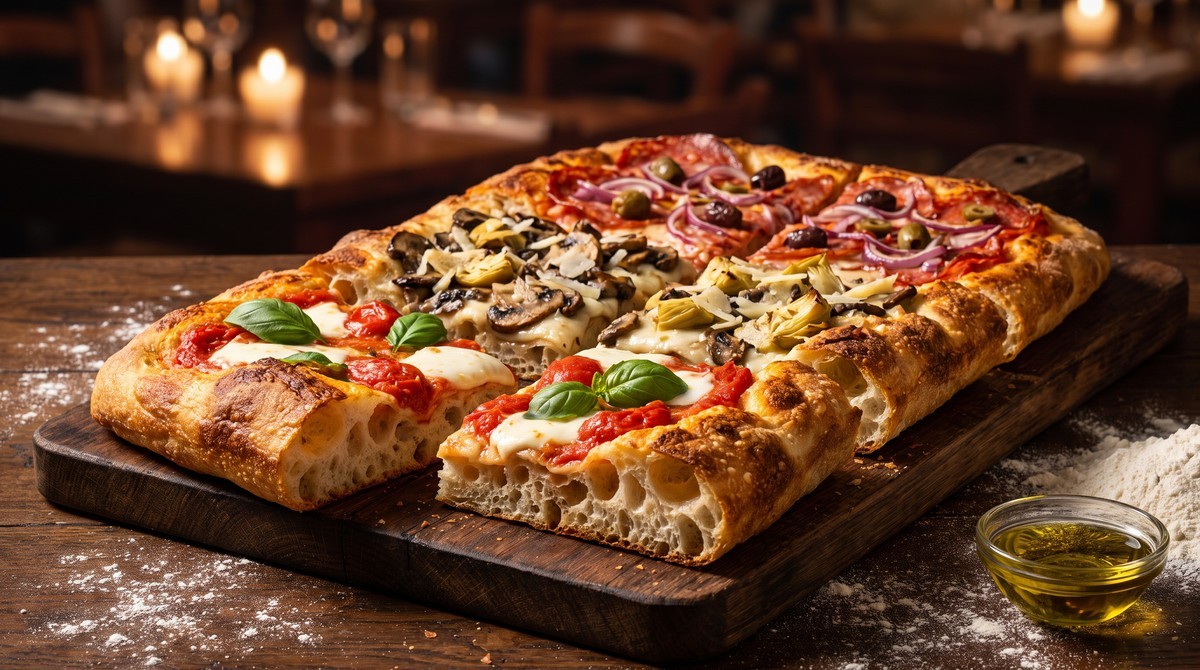
A table full of hungry people doesn't need anything complicated: it needs a Roman pizza to share, cut into generous squares, with croccante edges, an airy center and toppings that look as good as they taste. It's the kind of order that turns an ordinary outing into a plan people talk about, photograph and, above all, enjoy without any fuss.
In Costa Rica, ordering "pizza" isn't enough anymore. When the plan is getting together with friends, celebrating something small or making a family dinner a bit special, the difference lies in the style, the dough and the way you eat it. Roman pizza in teglia is made for exactly that: put the tray in the middle and let everyone pick their next square.
Why Roman pizza works so well for sharing
Traditional round pizza is usually cut into triangular slices. It's familiar, practical and it works. Roman pizza in teglia plays a different game. It's baked in a pan, cut into rectangular or square pieces and lets you combine flavors more naturally when there are several people at the table.
That format is more than pretty. It makes sharing easy. One person wants a classic, another wants vegetables, someone else goes straight for a bolder flavor. Instead of negotiating one pizza for everyone, you can put together a selection that works for the whole table.
Then there's the texture. A good Roman pizza should make a sound when you break it: a firm, light and crisp base with an airy crumb that holds the toppings without turning heavy. That contrast between croccante outside and soft inside means one piece leads to the next, even when nobody's that hungry anymore.
The key is that it doesn't feel like a compromise. It feels like an experience made for being together.
The dough rules: 72 hours you can taste
Not every pan pizza is Roman pizza. Technique carries weight, and fermentation is one of its big secrets. A dough made with patience, like one with 72-hour fermentation, develops flavor, lightness and a structure you can't get by rushing the process.
You notice the result from the first bite. The base doesn't compete with the toppings or shrink into a mere carrier. It has its own character: toasted, fragrant, with that baker's touch that connects with the Roman tradition. The pizza gets more interesting because every element has a job.
For a night out with friends, that matters more than it seems. A very dense pizza fills you up fast and slows the table down. A well-fermented dough lets you enjoy different flavors, talk, snack and keep sharing without that heavy feeling a conventional pizza sometimes leaves.
Of course, it all depends on appetite and occasion. For a quick lunch, a smaller selection may be enough. For a long night, a family get-together or a celebration with your crew, it's worth ordering variety and leaving room to try things. The fun is not having to pick just one.
How to order Roman pizza to share and get it right
The best strategy isn't ordering "a lot" for the sake of it. It's building a table with contrasts. Combine a familiar flavor, a bolder one and a fresh or vegetable option. That way everyone finds a favorite and also has a reason to try something new.
If there are two of you, a tray with well-chosen flavors can turn into a date that's different from the usual dinner. If there are four or more, the in teglia format shines even brighter: the pieces are easy to pass around, you can rotate flavors and nobody gets stuck with a combination they don't love.
Think about the moment, too. For an afternoon with friends, pizza can sit in the middle as the star. For a fuller dinner, a stuffed focaccia or a schiacciata can round out the table with another texture and another take on Italian baking. The idea is variety with intention, not piling on dough.
And there's one rule that almost never fails: order a little more than you think you'll need when your group loves good food. Roman pizza lends itself to "just one more square." It's a dangerous phrase, but che buono.
Flavors that get people talking
Quality ingredients give each square its own identity. Tomato can bring acidity and sweetness, cheeses creaminess and depth, Italian cured meats a salty, aromatic punch, roasted vegetables freshness and contrast. When the dough has a solid technical base, those flavors don't get lost.
That's why a shared selection shouldn't be identical from end to end. Variety starts conversations. Which one was your favorite? Which would you order again? Which surprised you most? At a foodie table, those questions are part of the plan.
It's also a great option if you want to get away from generic pizza without getting into a stiff or overly formal experience. Roman pizza has craft, tradition and precision, but you eat it with your hands. Premium, yes. Pretentious, never.
The ideal format for groups, dates and small celebrations
Some meals just get it done. Others set the mood. Roman pizza belongs to the second group. A freshly served tray changes the table instantly: colors, aromas, the crunch of the dough and that inevitable moment when everyone leans in to pick their first piece.
On a date, sharing lets you taste, recommend and discover what you both like. With friends, it avoids ordering several identical pizzas to "keep it simple." On a family outing, it helps adults and kids find something they like without giving up quality.
For a small celebration, it works especially well because it keeps things casual while still feeling special. You don't need a huge reason to eat something memorable. Sometimes it's enough that it's Friday, that the whole group made it or that you feel like trying something different in San Pablo de Heredia.
Bianka® Pizza Romana understands that occasion: pizza from the Italian baking tradition, made to arrive at the table with personality, texture and presence. It isn't a square version of the same thing. It's a different way to experience pizza.
Sharing is also choosing better
Roman pizza in teglia isn't trying to replace every round-pizza craving. There are days for the familiar, for something quick and for an individual slice. But when the plan calls for variety, technique and food that surprises you at first sight, the Roman tray has a clear advantage.
Its format invites you to try more than one flavor. Its fermented dough brings a texture you remember. And its look turns a casual meal into a moment with more intention. That's the difference between simply ordering dinner and putting together a plan your group will want to repeat.
Next time you have to decide where to eat or what to order for a group, don't settle for the predictable. Find a freshly baked tray, gather your people and let the first crunch set the tone for the night.